

- Updated: February 17, 2026
- 6 min read
Agoda Launches APIAgent: Zero‑Code MCP Server for REST‑to‑GraphQL Conversion and AI Agents
Agoda Launches APIAgent – Zero‑Code Bridge That Turns Any REST or GraphQL API into an MCP Server
Direct answer: Agoda’s new APIAgent is an open‑source proxy that instantly converts any REST or GraphQL endpoint into a Model Context Protocol (MCP) server without writing code or deploying custom services, thereby eliminating the so‑called “integration tax” for AI agents.
What Is APIAgent?
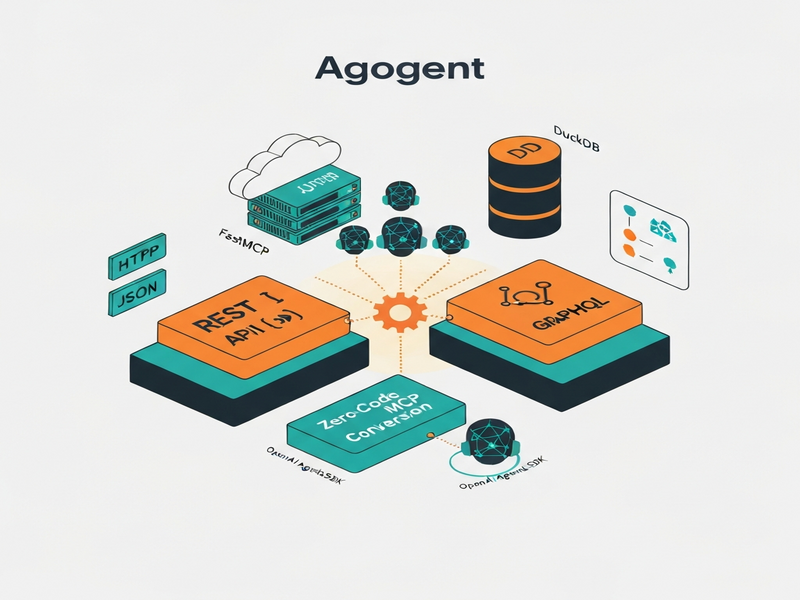
APIAgent is a universal MCP server that sits between large language models (LLMs) such as Claude, GPT‑4, or Gemini and the underlying business APIs. By feeding the tool an OpenAPI specification (for REST) or a GraphQL schema, developers get an instantly usable MCP interface that LLMs can call as native functions. The solution is built on three core components:
- FastMCP – a high‑performance MCP runtime that handles request routing and tool discovery.
- OpenAI Agents SDK – orchestrates LLM reasoning, tool selection, and response formatting.
- DuckDB – an in‑process SQL engine that performs on‑the‑fly data shaping, aggregation, and filtering before the result reaches the model.
Key Features of APIAgent
Zero‑Code MCP Conversion
Simply point APIAgent at an openapi.yaml or GraphQL endpoint, and it auto‑generates the MCP tool definitions. No Python, TypeScript, or Docker containers are required, which aligns perfectly with the UBOS platform overview’s low‑code philosophy.
FastMCP Engine
FastMCP delivers sub‑millisecond latency for tool discovery and request routing. It caches schema introspection results, so repeated calls incur virtually no overhead. This speed is essential for real‑time travel‑booking assistants that need to surface the top 10 hotels in Bangkok within seconds.
OpenAI Agents SDK Integration
The SDK abstracts the LLM‑to‑tool handshake, handling function calling, parameter validation, and response parsing. It also supports OpenAI ChatGPT integration, enabling developers to plug in any OpenAI model with a single configuration line.
DuckDB‑Powered Post‑Processing
When an API returns massive, unsorted datasets, APIAgent streams the JSON into DuckDB, runs SQL transformations (e.g., SELECT * FROM data WHERE rating > 4 ORDER BY reviews DESC LIMIT 10), and returns a concise payload. This eliminates the need for custom ETL pipelines and reduces network traffic.
Recipe Learning
After a successful natural‑language query, APIAgent records the execution trace as a reusable “recipe.” Future similar queries bypass the LLM reasoning step, directly invoking the stored recipe. This dramatically cuts latency and LLM usage costs—critical for high‑volume consumer‑facing bots.
Security‑First Design
By default APIAgent runs in read‑only mode. Mutating HTTP verbs (POST, PUT, DELETE) are blocked unless explicitly whitelisted in a YAML configuration. This “safe by default” stance mirrors the security model of the Enterprise AI platform by UBOS, protecting production data from accidental writes.
The Integration‑Tax Problem It Solves
In traditional AI‑agent pipelines, each new API required a bespoke MCP server, custom code, and a deployment pipeline—a cost that scales linearly with the number of services. Agoda’s engineering team coined this overhead “integration tax.” For enterprises with thousands of micro‑services, the tax becomes prohibitive.
APIAgent eliminates that tax by providing a single, schema‑driven proxy. The result is a one‑to‑many mapping: one APIAgent instance can expose dozens of internal APIs as MCP tools, all without touching a line of code.
Benefits for Developers and Enterprises
- Speed to market: Teams can prototype AI‑driven features in hours instead of weeks.
- Cost reduction: Zero‑code servers mean no extra cloud compute for custom MCP services.
- Scalability: One APIAgent instance can serve thousands of endpoints, making it ideal for large SaaS platforms.
- Maintainability: Schema changes are automatically reflected; developers only need to update the OpenAPI spec.
- Observability: Integrated logging works seamlessly with the Workflow automation studio for end‑to‑end tracing.
How APIAgent Fits Into the UBOS Ecosystem
UBOS already offers a suite of low‑code building blocks that complement APIAgent perfectly:
- Use the Web app editor on UBOS to create front‑end interfaces that call the MCP endpoints generated by APIAgent.
- Orchestrate multi‑step workflows with the Workflow automation studio, chaining APIAgent calls with other AI agents.
- Accelerate time‑to‑value with UBOS templates for quick start, such as the “AI SEO Analyzer” or “AI Article Copywriter” which can now consume any internal data source via APIAgent.
- Monetize the integration through the UBOS partner program, offering APIAgent as a value‑added service to SaaS partners.
Real‑World Use Cases
Below are a few scenarios where APIAgent shines, each linked to a ready‑made UBOS template or integration:
Travel‑Booking Assistant
Combine APIAgent with the AI YouTube Comment Analysis tool to surface user sentiment about destinations, then query Agoda’s hotel catalog via MCP to suggest the best options.
AI‑Powered SEO Dashboard
Feed the AI SEO Analyzer with live site metrics pulled through APIAgent, enabling marketers to run instant keyword‑ranking queries without writing custom scrapers.
Customer Support Automation
Integrate Customer Support with ChatGPT API with APIAgent to let support bots retrieve order status, refund policies, or flight itineraries directly from internal services.
Multilingual Knowledge Base
Pair APIAgent with the Multi-language AI Translator to expose product data in dozens of languages without duplicating APIs.
Getting Started Quickly
Developers can spin up APIAgent in three steps:
- Clone the public repository (link provided in the original release).
- Provide an OpenAPI or GraphQL schema URL.
- Run
docker run -p 8080:8080 ubos/apiaagent– the MCP server is live instantly.
For a no‑code experience, use the UBOS solutions for SMBs to host the container with a single click, then connect your LLM via the Telegram integration on UBOS for real‑time chat interactions.
Pricing and Support
APIAgent itself is open source, but UBOS offers managed hosting under its UBOS pricing plans. Enterprise customers can opt for the Enterprise AI platform by UBOS, which includes SLA‑backed support, dedicated security reviews, and custom connector development.
External Reference
For the full technical announcement and community discussion, see the original MarkTechPost article.
Conclusion
Agoda’s APIAgent tackles the most painful bottleneck in agentic AI—connecting LLMs to real‑world data—by delivering a zero‑code, high‑performance MCP bridge. When paired with UBOS’s low‑code ecosystem, developers can rapidly prototype, secure, and scale AI‑driven products across startups, SMBs, and large enterprises. The result is a new era where AI agents spend less time “learning how to talk” and more time delivering tangible business value.