

- Updated: February 15, 2026
- 5 min read
Dead Simple CI (DSCI): Streamlined Continuous Integration for Faster Development
Dead Simple CI (DSCI) is an open‑source, YAMLess continuous integration platform that enables developers to run full CI/CD pipelines on a single server without the overhead of complex YAML, Terraform, or Ansible configurations.
What Is DSCI? – The “Dead Simple” Approach to Continuous Integration
DSCI, short for Dead Simple CI, is a lightweight CI/CD solution built around its GitHub repository. The project combines the modern Telegram integration on UBOS with a YAMLess pipeline engine, allowing developers to define build steps directly in Bash or Python scripts. By bundling Forgejo (a self‑hosted Git service) with container‑based runners, DSCI delivers a “batteries‑included” platform that runs on a single VPS or any modest server.
Unlike traditional CI tools that require extensive configuration files, DSCI treats the entire pipeline as code—no hidden magic, just plain scripts. This philosophy aligns perfectly with the needs of small teams, startups, and DevOps engineers who want rapid feedback loops without a steep learning curve.
Core Features and Advantages of DSCI
Single‑Server Footprint
All components—Forgejo, the pipeline runner, and supporting services—are installed on a single machine. This reduces operational costs and simplifies network configuration, making DSCI ideal for UBOS solutions for SMBs.
YAMLess Pipelines
Instead of verbose YAML, DSCI lets you write pipeline steps in familiar Bash or Python. This eliminates the need for specialized DevOps knowledge and accelerates onboarding for developers who already know these languages.
Container‑Based Isolation
Each job runs inside a Docker container, guaranteeing reproducible environments. The platform also supports custom containers, enabling you to test across multiple runtimes without additional VM management.
Built‑In Plugins
DSCI ships with a library of plugins that extend functionality—code quality checks, secret scanning, and artifact publishing. Many of these plugins are hosted on SparrowHub and can be added with a single command.
Self‑Hosted Security
Because everything runs on your own server, you retain full control over source code, credentials, and network access—critical for compliance‑heavy industries.
Developer‑Centric UI
The integrated Forgejo UI provides a familiar Git experience, while the DSCI dashboard offers real‑time pipeline status, logs, and artifact browsing.
Typical Use Cases & Community Support
- Start‑ups needing rapid CI/CD: Deploy a full pipeline in minutes without hiring a dedicated DevOps team. See how UBOS for startups leverages similar simplicity.
- Educational labs: Professors can spin up isolated CI environments for each student group, ensuring fair grading and reproducibility.
- Legacy codebases: Teams can wrap existing Bash build scripts inside DSCI containers, modernizing CI without rewriting the entire build system.
- Micro‑service testing: Each service can be built, tested, and containerized in its own job, then orchestrated via simple Bash scripts.
The DSCI community is active on Discord, offering real‑time help, plugin contributions, and best‑practice guides. The project’s DevOps resources page aggregates tutorials, cheat sheets, and case studies that complement DSCI’s documentation.
Illustration Overview
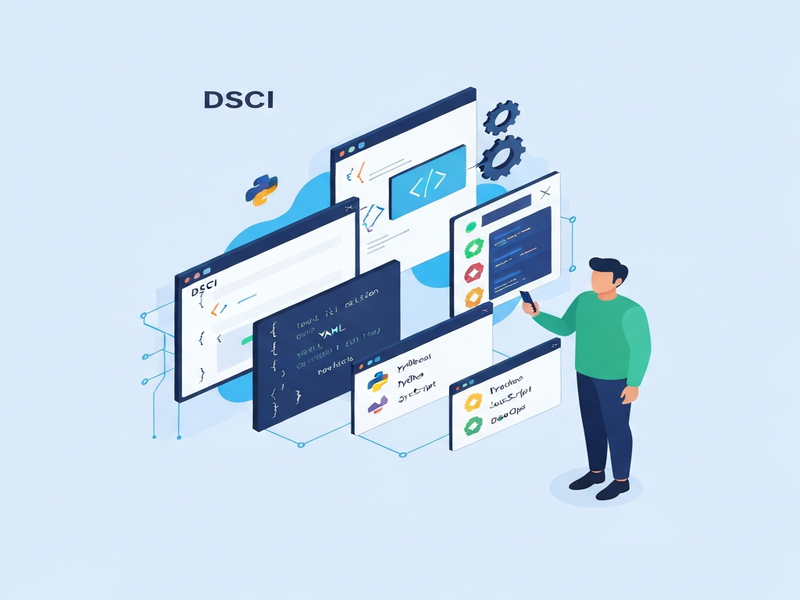
The diagram visualizes DSCI’s core components: Forgejo as the Git server, the YAMLess pipeline runner, Docker containers for isolation, and optional plugins for extended functionality.
Explore the Official GitHub Repository
For a deep dive into the source code, installation steps, and contribution guidelines, visit the official DSCI GitHub repository. The README provides a quick‑start script that provisions the entire stack on a fresh Ubuntu VPS in under ten minutes.
Further Reading on UBOS and Related AI Tools
While DSCI focuses on CI/CD, the broader UBOS platform overview offers a suite of AI‑enhanced services that can be combined with your pipelines:
- AI marketing agents that automate campaign creation directly from build artifacts.
- Workflow automation studio for orchestrating multi‑step processes beyond code builds.
- Enterprise AI platform by UBOS for scaling AI workloads alongside your CI pipelines.
- Web app editor on UBOS to prototype front‑ends that can be automatically tested with DSCI.
- UBOS pricing plans that include free tiers suitable for hobby projects and startups.
- UBOS partner program for co‑marketing and technical support collaborations.
- UBOS templates for quick start—including a ready‑made CI/CD template that mirrors DSCI’s architecture.
Developers interested in AI‑driven code analysis can also explore the AI SEO Analyzer or the AI Article Copywriter for generating documentation alongside code.
For those building chat‑oriented tools, the ChatGPT and Telegram integration showcases how DSCI pipelines can trigger bots for build notifications.
Explore additional AI utilities such as AI Video Generator, AI Image Generator, and AI Email Marketing to enrich your product releases.
Conclusion & Call‑to‑Action
Dead Simple CI delivers a pragmatic, open‑source answer to the perennial pain points of continuous integration: complexity, cost, and steep learning curves. By embracing Bash/Python scripts, container isolation, and a single‑server model, DSCI empowers developers, DevOps engineers, and CI/CD enthusiasts to ship faster and with greater confidence.
If you’re looking for a lean CI solution that integrates seamlessly with modern AI tools, give DSCI a try today. Clone the repository, follow the quick‑start guide, and start automating your builds within minutes. For extended capabilities—such as AI‑enhanced testing, automated documentation, or intelligent deployment notifications—pair DSCI with the rich ecosystem of UBOS homepage services.
Ready to simplify your CI pipeline? Download DSCI now and join the community on Discord for support, plugins, and best practices.
Andrii Bidochko
CTO UBOS
Andrii Bidochko is an AI entrepreneur and researcher focused on AI agents, reinforcement learning, and autonomous systems. He writes about the technologies shaping the future of machine intelligence, from frontier models and agent architectures to real-world AI applications.