

- Updated: February 13, 2026
- 8 min read
In‑Depth Guide: Building a High‑Fidelity Synthetic Data Pipeline with CTGAN and SDV
The Complete CTGAN‑SDV Pipeline Guide for High‑Fidelity Synthetic Data
Answer: The CTGAN‑SDV pipeline delivers a production‑ready workflow that transforms raw mixed‑type tabular data into realistic, privacy‑preserving synthetic datasets, while providing built‑in constraint handling, conditional sampling, loss visualisation, rigorous statistical evaluation with SDMetrics, and seamless model persistence for downstream machine‑learning tasks.
What Is CTGAN and Why the SDV Ecosystem Matters
CTGAN (Conditional Tabular GAN) is a generative adversarial network specially designed for mixed‑type tabular data. It learns the joint distribution of categorical and numerical columns, enabling conditional generation—for example, “sample only customers from New York with income > 50 K”. The UBOS platform overview highlights that CTGAN shines when paired with the OpenAI ChatGPT integration for prompt‑driven data exploration.
The Synthetic Data Vault (SDV) extends CTGAN with a rich metadata layer, constraint graph, and evaluation suite (SDMetrics). SDV’s Chroma DB integration stores generated embeddings for fast similarity search, while the ElevenLabs AI voice integration can vocalise data quality reports for non‑technical stakeholders.
Step‑by‑Step Walkthrough of the CTGAN‑SDV Pipeline
1️⃣ Installation & Environment Setup
Begin by creating an isolated Python environment. The following pip command pulls the exact versions required for reproducibility:
pip install "ctgan" "sdv" "sdmetrics" "scikit-learn" "pandas" "numpy" "matplotlib"UBOS’s Workflow automation studio can orchestrate this step across cloud VMs, guaranteeing consistent runtime across teams.
2️⃣ Data Preparation
Load your raw dataset, clean column names, and separate categorical from numerical features. A typical snippet looks like this:
import pandas as pd
real = pd.read_csv("customer_data.csv")
real.columns = [c.strip().replace(" ", "_") for c in real.columns]
categorical_cols = real.select_dtypes(include=["object"]).columns.tolist()
numerical_cols   = [c for c in real.columns if c not in categorical_cols]
For startups that need rapid onboarding, the UBOS for startups page offers a one‑click data‑prep template.
3️⃣ Training a Standalone CTGAN Model
Instantiate CTGAN with a modest number of epochs for a quick proof‑of‑concept, then fit it on the cleaned dataframe:
from ctgan import CTGAN
ctgan = CTGAN(epochs=30, batch_size=500, verbose=True)
ctgan.fit(real, discrete_columns=categorical_cols)
After training, generate a synthetic sample to sanity‑check column distributions:
synthetic = ctgan.sample(5000)
print(synthetic.head())
The AI marketing agents can automatically draft a data‑quality summary from this output.
4️⃣ Enforcing Business Rules with SDV Constraints
SDV lets you declare semantic metadata and structural constraints. For example, enforce that age >= 18 and that country and currency appear as valid pairs:
from sdv.metadata import SingleTableMetadata
from sdv.cag import Inequality, FixedCombinations

metadata = SingleTableMetadata()
metadata.detect_from_dataframe(real)
metadata.update_column(column_name="age", sdtype="numerical")
metadata.update_column(column_name="country", sdtype="categorical")
metadata.update_column(column_name="currency", sdtype="categorical")

constraints = [
    Inequality(low_column_name="age", high_column_name="age", low=18),
    FixedCombinations(column_names=["country", "currency"])
]
These constraints are attached to the synthesiser before training:
from sdv.single_table import CTGANSynthesizer
synth = CTGANSynthesizer(metadata=metadata, epochs=30, batch_size=500)
synth.add_constraints(constraints)
synth.fit(real)
SMBs can explore the UBOS solutions for SMBs to manage constraint libraries centrally.
5️⃣ Visualising Generator & Discriminator Losses
SDV exposes a loss dataframe that can be plotted with matplotlib. The following code automatically picks the appropriate column names, making the script robust to library updates:
import matplotlib.pyplot as plt
loss_df = synth.get_loss_values()
xcol = next((c for c in ["epoch","step","iteration"] if c in loss_df.columns), None)
gcol = next((c for c in ["generator_loss","gen_loss"] if c in loss_df.columns), None)
dcol = next((c for c in ["discriminator_loss","disc_loss"] if c in loss_df.columns), None)

plt.figure(figsize=(10,4))
x = loss_df[xcol] if xcol else range(len(loss_df))
if gcol: plt.plot(x, loss_df[gcol], label="Generator")
if dcol: plt.plot(x, loss_df[dcol], label="Discriminator")
plt.xlabel(xcol or "step")
plt.ylabel("Loss")
plt.legend()
plt.title("CTGAN Training Dynamics (SDV Wrapper)")
plt.show()
Embedding this chart in a Web app editor on UBOS lets data scientists share live training dashboards with stakeholders.
6️⃣ Conditional Sampling for Targeted Scenarios
Suppose you need synthetic records where region = "EMEA". SDV’s Condition API makes this trivial:
from sdv.sampling import Condition
condition = Condition({"region": "EMEA"}, num_rows=2000)
synthetic_cond = synth.sample_from_conditions([condition])
print(synthetic_cond["region"].value_counts())
Such focused generation is ideal for privacy‑preserving A/B tests, and the ChatGPT and Telegram integration can push the sampled slice directly to a secure Slack‑like channel for rapid review.
7️⃣ Rigorous Evaluation Using SDMetrics
SDMetrics provides two complementary reports: DiagnosticReport (distributional fidelity) and QualityReport (utility for downstream models). Example usage:
from sdmetrics.reports.single_table import DiagnosticReport, QualityReport
diagnostic = DiagnosticReport()
diagnostic.generate(real_data=real, synthetic_data=synthetic_cond, metadata=metadata.to_dict())
print("Diagnostic score:", diagnostic.get_score())

quality = QualityReport()
quality.generate(real_data=real, synthetic_data=synthetic_cond, metadata=metadata.to_dict())
print("Quality score:", quality.get_score())
High scores (>0.8) indicate that the synthetic data preserves both statistical properties and predictive power, a prerequisite for compliance‑driven data sharing.
8️⃣ Testing Downstream ML Models on Synthetic Data
Train a simple classifier on synthetic data and evaluate it on a real hold‑out set. This “train‑synthetic → test‑real” experiment quantifies utility loss:
from sklearn.model_selection import train_test_split
from sklearn.pipeline import Pipeline
from sklearn.compose import ColumnTransformer
from sklearn.preprocessing import OneHotEncoder
from sklearn.linear_model import LogisticRegression
from sklearn.metrics import roc_auc_score

train_real, test_real = train_test_split(real, test_size=0.25, random_state=42, stratify=real["target"])

preprocess = ColumnTransformer([
    ("cat", OneHotEncoder(handle_unknown="ignore"), categorical_cols),
    ("num", "passthrough", numerical_cols)
])

clf = Pipeline([("prep", preprocess), ("logreg", LogisticRegression(max_iter=200))])
clf.fit(synthetic_cond.drop(columns=["target"]), synthetic_cond["target"])
pred_syn = clf.predict_proba(test_real.drop(columns=["target"]))[:,1]
auc_syn = roc_auc_score(test_real["target"], pred_syn)
print("Synthetic‑train → Real‑test AUC:", auc_syn)
If the AUC gap is minimal, you have a production‑ready synthetic dataset ready for model‑as‑a‑service deployments.
9️⃣ Persisting the Synthesiser for Future Use
Save the trained synthesiser to disk and reload it later without retraining:
model_path = "ctgan_sdv.pkl"
synth.save(model_path)

from sdv.utils import load_synthesizer
loaded = load_synthesizer(model_path)
sample = loaded.sample(1000)
print(sample.head())
The UBOS partner program offers managed model‑registry services that store these artefacts securely and expose them via REST APIs.
Why Adopt the CTGAN‑SDV Pipeline? Benefits & Real‑World Scenarios
- Privacy‑by‑Design: Synthetic data removes personally identifiable information while preserving statistical relationships, satisfying GDPR and CCPA.
- Rapid Prototyping: Data scientists can spin up a synthetic replica of a production database in minutes, enabling safe experimentation.
- Cost Reduction: Avoid expensive data‑licensing fees by generating high‑quality substitutes for training large models.
- Regulatory Compliance: Auditable constraint graphs (e.g., age ≥ 18) demonstrate adherence to domain‑specific rules.
- Cross‑Domain Transfer: Synthetic datasets can be shared with partners without exposing raw customer data.
Industry‑Specific Use Cases
| Sector | Typical Application |
|---|---|
| FinTech | Generate synthetic transaction logs for fraud‑detection model training. |
| Healthcare | Create de‑identified patient records for clinical‑trial simulations. |
| E‑commerce | Produce synthetic click‑stream data to test recommendation engines. |
| Telecom | Simulate network usage patterns for capacity planning. |
For teams looking to accelerate AI‑driven marketing, the AI marketing agents can ingest synthetic audience profiles generated by this pipeline and instantly craft personalised campaigns.
Illustration: Visualising the CTGAN‑SDV Workflow
The diagram below captures each stage of the pipeline—from raw data ingestion to model persistence—highlighting where UBOS tools can be injected for automation.
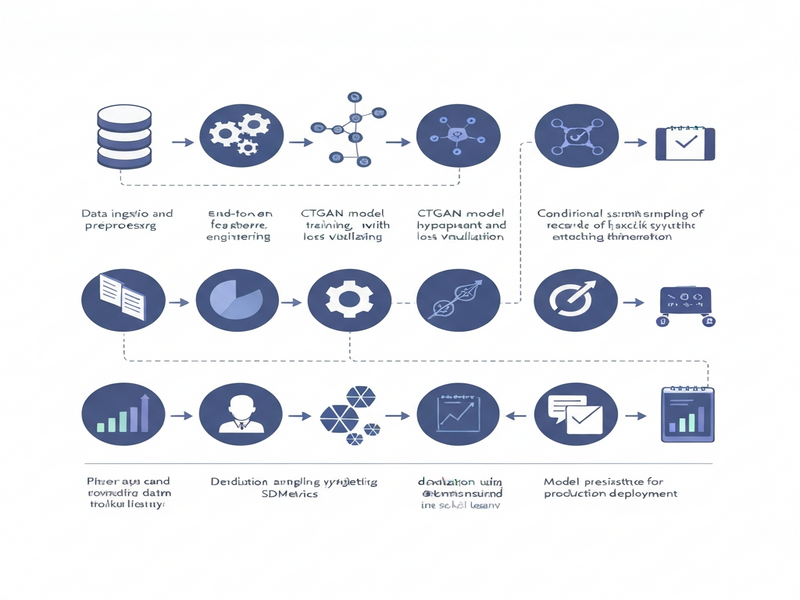
Notice the highlighted blocks for UBOS templates for quick start that pre‑configure the environment, and the UBOS pricing plans that align with compute needs for large‑scale synthesis.
Source & Further Reading
The original tutorial that inspired this guide was published on MarkTechPost. For a deeper dive into the original code snippets, visit the article here.
Explore More UBOS Capabilities
Beyond synthetic data, UBOS offers a suite of AI‑powered services that complement the CTGAN‑SDV workflow:
- Enterprise AI platform by UBOS – scalable orchestration for multi‑tenant model training.
- UBOS portfolio examples showcase real‑world deployments of synthetic data pipelines.
- AI Image Generator can visualise synthetic data distributions as heatmaps.
- AI SEO Analyzer helps you optimise the documentation of your synthetic data APIs.
- AI Article Copywriter can auto‑generate data‑card narratives for each synthetic dataset.
- AI Video Generator lets you create short explainer videos of the pipeline for onboarding.
- AI Chatbot template can answer ad‑hoc queries about data quality during stakeholder demos.
- AI Survey Generator assists in gathering feedback after synthetic data releases.
- AI YouTube Comment Analysis tool can monitor community sentiment around your synthetic data product.
- AI LinkedIn Post Optimization helps you share pipeline milestones with the professional community.
Take the Next Step
By integrating CTGAN with the SDV ecosystem, you gain a robust, auditable, and scalable synthetic data generation pipeline that meets the highest standards of privacy and utility. Whether you are a data scientist building proof‑of‑concepts, a machine‑learning engineer deploying production models, or a startup founder seeking rapid data‑driven insights, this workflow can be instantiated in minutes using UBOS’s low‑code tools.
Ready to experiment? Visit the UBOS homepage to spin up a free sandbox, explore the UBOS templates for quick start, and connect your synthetic data pipeline to the Telegram integration on UBOS for instant notifications.
Start generating privacy‑preserving synthetic data today and unlock new possibilities for AI‑driven innovation.