

- Updated: February 6, 2026
- 5 min read
DNA Page Numbers Revolutionize Synthetic Biology and Bioeconomy – Caltech Breakthrough
DNA page numbers technology—branded as Sidewinder—lets scientists stitch together thousands of short DNA fragments with near‑perfect accuracy, turning the long‑standing bottleneck in DNA synthesis into a scalable, cost‑effective reality.
Introduction – A New Chapter for DNA Synthesis
On January 21, 2026, Caltech announced a landmark invention that could rewrite the rules of genetic engineering. The method, dubbed Sidewinder, introduces the concept of “DNA page numbers,” a systematic way to order synthetic oligonucleotides (short DNA pieces) so they self‑assemble into long, error‑free sequences. This breakthrough directly addresses the most stubborn limitation in synthetic biology: the inability to reliably construct genes and genomes that span thousands to millions of base pairs.
For researchers, biotech investors, and industry leaders, the implications are immediate. Faster, cheaper, and more accurate DNA synthesis accelerates everything from custom therapeutics to sustainable material production, fueling the next wave of the UBOS homepage’s vision of an AI‑driven bioeconomy.
How the Technology Works (Sidewinder)
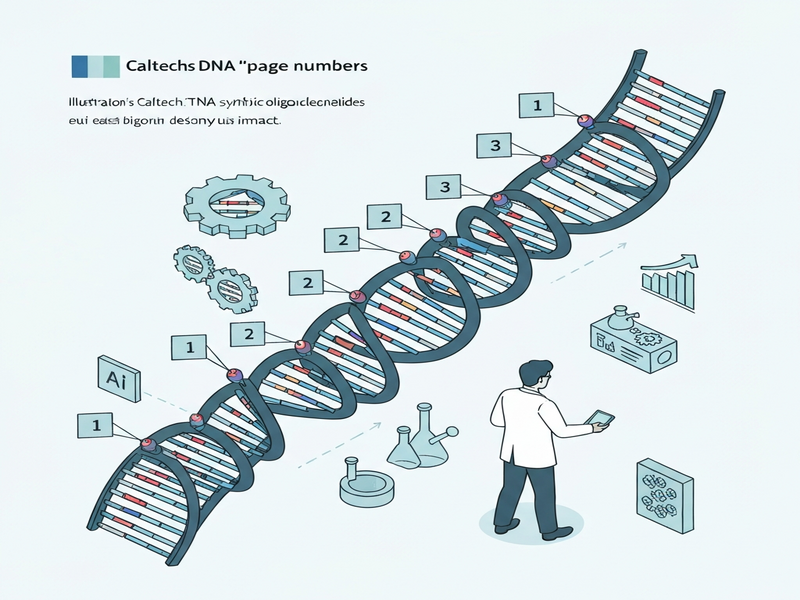
Sidewinder leverages a clever adaptation of DNA 3‑Way Junctions (3WJ) to embed temporary “page numbers” on each oligo. These tags act like bookmarks, ensuring each fragment finds its correct neighbor during assembly. The process unfolds in three clear steps:
- Tagging: Each synthetic oligo receives a unique DNA barcode that represents its position in the final sequence.
- Guided Assembly: The barcoded fragments hybridize through complementary 3WJ structures, aligning in the precise order dictated by the page numbers.
- Tag Removal: A single enzymatic reaction cleaves the auxiliary junctions, leaving behind a seamless double‑helix ready for downstream applications.
The result is a misconnection rate of roughly one in a million—a four‑ to five‑order‑of‑magnitude improvement over previous methods that struggled with error rates as high as 1‑in‑10.
Potential Impact on Synthetic Biology and the Bioeconomy
By turning the “page‑number” concept into a practical tool, Sidewinder opens doors across the entire spectrum of the bioeconomy:
- Accelerated Therapeutic Development: Custom gene therapies and mRNA vaccines can now be designed and built in days rather than months.
- Advanced Materials: Engineers can program microbes to produce polymers, bio‑fuels, or carbon‑negative building blocks with unprecedented precision.
- Agricultural Innovation: Large‑scale gene stacks for crop resilience become feasible without the costly iterative breeding cycles.
- Cost Reduction: Synthetic oligos are inexpensive; Sidewinder’s efficient assembly dramatically lowers the overall price of long‑DNA constructs.
These capabilities align perfectly with the goals of the Enterprise AI platform by UBOS, which aims to integrate AI‑driven design with rapid biological manufacturing.
Expert Quotes and Research Context
“DNA is the source code of life. Sidewinder gives us a new way to write that code at scale, turning imagination into reality faster than ever before.” – Kaihang Wang, Assistant Professor of Biology & Biological Engineering, Caltech
Frances Arnold, Nobel Laureate and Caltech’s Linus Pauling Professor, praised the invention as “a powerful step toward the goal of writing DNA of any complexity.” She highlighted the synergy between AI‑based protein design and Sidewinder’s assembly precision, noting that the combined workflow could “compress years of experimental iteration into weeks.”
Co‑author Noah Robinson added, “To engineer a cell as a programmable computer, we first need a reliable way to construct the DNA that tells it what to do. Sidewinder is that reliable way.”
The research, funded by the NSF, NIH, and the Shurl & Kay Curci Foundation, appears in Nature (January 21, 2026) and is already being licensed by Genyro, a biotech startup co‑founded by Wang, to accelerate commercial translation.
Applications and Future Prospects
Beyond the immediate laboratory advantages, Sidewinder is poised to become a cornerstone of several emerging sectors:
1. AI‑Powered Drug Discovery
Integrating Sidewinder with AI marketing agents (adapted for biotech) can automate target identification, sequence design, and rapid prototyping of therapeutic genes.
2. Sustainable Manufacturing
Engineered microbes can now be programmed with entire metabolic pathways in a single construct, enabling scalable production of bio‑based chemicals, plastics, and fuels.
3. Precision Agriculture
Long‑DNA cassettes encoding multi‑gene traits (drought tolerance, nitrogen fixation) become deployable via gene‑editing platforms, reducing reliance on chemical inputs.
4. Education & Rapid Prototyping
Startups can leverage the UBOS templates for quick start to build custom DNA design pipelines, shortening time‑to‑market for novel biotech solutions.
Looking ahead, the research team plans to couple Sidewinder with large‑language‑model‑driven design tools, creating a closed‑loop system where AI proposes a genetic circuit and Sidewinder instantly builds it. Such integration could make “design‑and‑build” cycles as fast as software compilation.
Conclusion and Call to Action
The invention of DNA page numbers marks a pivotal moment for the bioeconomy. By eliminating the assembly bottleneck, Sidewinder empowers synthetic biologists to move from concept to functional DNA at unprecedented speed and scale. For investors, this translates into faster ROI on biotech ventures; for researchers, it means more experiments per year; for industry, it opens new product categories that were previously infeasible.
Ready to explore how AI‑enhanced platforms can accelerate your biotech projects? Visit the UBOS platform overview to discover tools that integrate seamlessly with Sidewinder‑style workflows. Whether you’re a startup (UBOS for startups), an SMB (UBOS solutions for SMBs), or an enterprise, the next generation of DNA synthesis is already within reach.
Stay ahead of the curve—subscribe to our updates, explore the UBOS portfolio examples, and join the conversation shaping the future of synthetic biology.
Read the original Caltech announcement for full technical details: Invention of DNA “Page Numbers” at Caltech.