

- Updated: February 5, 2026
- 6 min read
Claude AI Surge: Anthropic’s Generative Coding Platform Takes Center Stage
Claude AI, Anthropic’s flagship generative‑AI model, has experienced a rapid surge in adoption thanks to the launch of Claude Code and the new Opus 4.6 architecture, which together enable developers and enterprises to build sophisticated AI agents, automate coding tasks, and accelerate digital transformation across multiple sectors.
Claude’s Recent Surge: A Quick Overview
During the holiday season of 2025‑2026, Claude Code became the talk of the tech community. Word‑of‑mouth growth spiked by 13 percentage points in a single month, while rival platforms saw a modest decline. Anthropic reported that Claude Code crossed the $1 billion revenue milestone and is now courting a $20 billion funding round at a $350 billion valuation. The buzz is not just hype; real‑world deployments are delivering measurable productivity gains, prompting startups, SMBs, and enterprises to reevaluate their AI strategies.
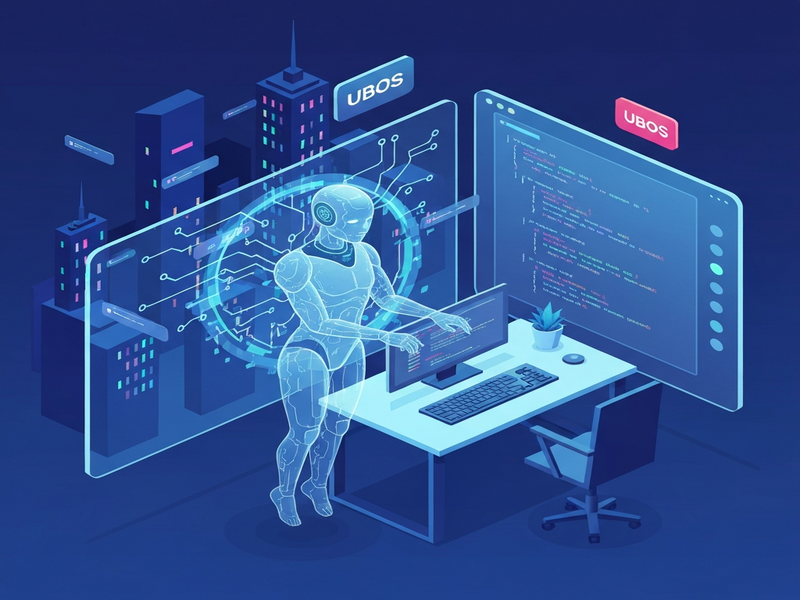
Image: Claude AI’s impact visualized on the UBOS platform.
Claude Code and the Opus 4.6 Model: What’s New?
Claude Code: The AI Coding Platform
Claude Code is Anthropic’s AI coding platform that lets developers write, debug, and refactor code through natural‑language prompts. Since its February 2025 debut, the platform has evolved into a self‑improving system where up to 90 % of the generated code is authored by Claude itself. Key capabilities include:
- Multi‑language support (Python, JavaScript, Go, Rust, etc.)
- Context‑aware file handling with persistent “agent memory”
- Integrated testing suite that auto‑generates unit tests
- Seamless CI/CD pipeline hooks via the Workflow automation studio
Opus 4.6: The Engine Behind the Surge
Opus 4.6 is the latest iteration of Anthropic’s large‑scale transformer family. According to Dianne Na Penn, head of research product management, Opus 4.6 “thinks longer” and delivers 30 % faster inference while maintaining higher precision on complex, multi‑step tasks. Highlights include:
- Extended context window (up to 128 k tokens)
- Improved tool‑use reasoning for AI agents
- Robust security hardening that reduces blocker‑level vulnerabilities by 40 %
- Native integration with OpenAI ChatGPT integration for hybrid workflows
Real‑World Applications Across Industries
Claude’s agentic capabilities are reshaping workflows far beyond traditional software development. Below are the most compelling use‑cases observed in the first quarter of 2026.
Healthcare & Life Sciences
- Automated analysis of MRI scans using Claude‑driven pipelines, reducing radiologist review time by 45 %.
- Generation of patient‑specific treatment summaries via natural‑language prompts.
FinTech & Financial Analytics
- Dynamic risk‑model generation for loan underwriting, powered by Claude’s extended context.
- Real‑time compliance monitoring with AI agents that audit transaction logs.
E‑Commerce & Marketing
- Creation of SEO‑optimized product copy using the UBOS templates for quick start, cutting copy‑writing cycles from days to minutes.
- Personalized email campaigns generated by AI marketing agents that adapt tone based on user behavior.
Education & Knowledge Work
- Automated generation of study notes and summaries (e.g., “Summarize for a 2nd Grader”) using Claude’s language capabilities.
- Interactive tutoring bots that can answer domain‑specific queries with citations.
Software Development & DevOps
- Full‑stack code generation for internal tools, demonstrated by the AI Article Copywriter template.
- Continuous integration pipelines that self‑heal failing builds using Claude‑driven agents.
Industry Reactions and the Competitive Landscape
Anthropic’s rapid ascent has sparked a wave of commentary from CEOs, venture partners, and rival AI labs.
Positive Endorsements
- Mike Brevoort, principal architect at Mytra, called the holiday‑season rollout a “water‑in‑the‑face” moment, noting that Claude turned “magic castle” ideas into production‑ready code.
- Allie K. Miller, CEO of Open Machine, highlighted the shift from “step‑by‑step Lego assembly” to “just give the castle, and it builds itself.”
- Aaron Levie, Box CEO, sees Claude as the prototype for future autonomous AI agents that will extend beyond coding into broader knowledge work.
Critical Perspectives
- Security researcher Joe Tyler flagged that Opus 4.5 (the predecessor) exhibited more “blocker‑level vulnerabilities” than OpenAI’s GPT‑5.2, prompting Anthropic to double‑down on hardening for Opus 4.6.
- Open‑source advocates point to emerging alternatives like OpenHands and OpenCode, which promise lower pricing models for SMBs.
- Brand‑trust metrics from Caliber show an 11‑point dip for Anthropic since September 2025, suggesting that sustained user confidence will require transparent governance.
Competitor Moves
While Claude gains momentum, rivals are not idle:
- OpenAI launched a dedicated Codex desktop app for macOS, aiming to recapture developers who favor native tooling.
- Google Gemini 3 continues to dominate image‑generation benchmarks, yet many engineering teams still prefer Claude for its agentic reasoning.
- Emerging startups are building “plug‑and‑play” AI agents on platforms like Enterprise AI platform by UBOS, leveraging Claude‑style APIs for rapid prototyping.
Future Outlook: What’s Next for Claude?
Anthropic’s roadmap for Claude focuses on three strategic pillars: scalability, safety, and ecosystem expansion.
Scalability & Performance
Opus 4.6 will be followed by a 7‑parameter “Opus 5.0” slated for Q4 2026, promising sub‑second latency for multi‑modal queries and deeper integration with edge‑compute nodes.
Safety & Governance
Anthropic is investing in continuous red‑team testing and third‑party audits. The upcoming model card for Opus 4.6 will detail mitigations for hallucination, data leakage, and bias.
Ecosystem & Partnerships
Strategic collaborations are already in place:
- Integration with ChatGPT and Telegram integration to enable real‑time code review bots on messaging platforms.
- Partnership with Chroma DB integration for vector‑search‑enhanced knowledge bases.
- Voice‑enabled workflows via ElevenLabs AI voice integration, allowing developers to dictate code and receive spoken diagnostics.
These moves position Claude not just as a coding assistant but as a foundational layer for AI‑first enterprises that need end‑to‑end automation.
Conclusion: Why You Should Pay Attention Now
Claude’s rapid adoption demonstrates that generative AI is moving from experimental labs into the core of business operations. Whether you are a startup looking for a fast‑track AI stack, an SMB seeking to automate repetitive coding tasks, or an enterprise aiming to build autonomous agents, Claude offers a compelling blend of speed, accuracy, and extensibility.
Ready to explore AI‑driven development on a platform that already supports Claude‑style agents? Visit the UBOS homepage to discover a unified environment for building, deploying, and scaling AI applications. Check out the UBOS platform overview for a deeper dive into the architecture, or explore the UBOS for startups program that offers credits and mentorship for early‑stage teams.
For developers eager to prototype instantly, the UBOS templates for quick start include ready‑made Claude‑Code projects such as the AI Article Copywriter and the AI YouTube Comment Analysis tool. Pair these with the Web app editor on UBOS and the Workflow automation studio to turn ideas into production‑grade services in hours, not weeks.
Stay ahead of the curve—subscribe to our AI news feed, explore the generative AI hub, and join the UBOS partner program to collaborate on the next wave of AI agents.
For a deeper journalistic perspective, read the original report on The Verge, which details the market dynamics fueling Claude’s rise.