

- Updated: February 4, 2026
- 6 min read
TikTok System Design: In‑Depth Architecture Overview
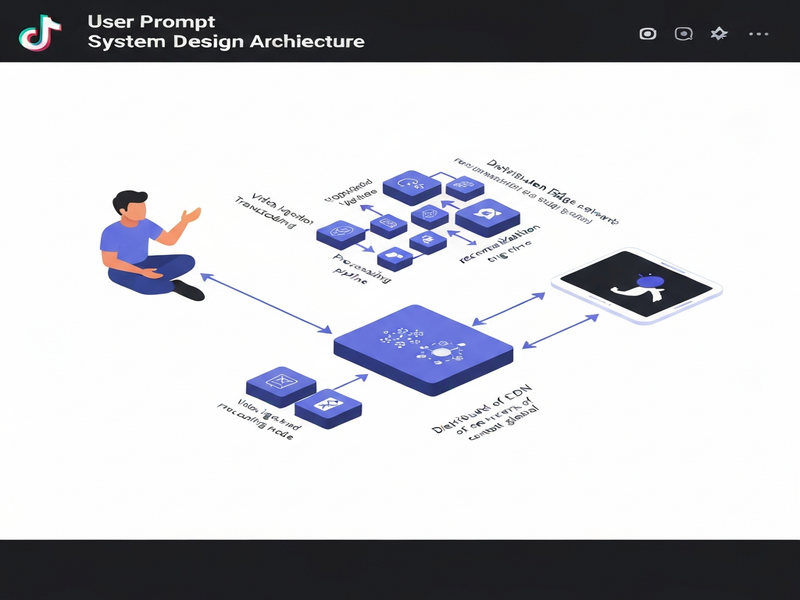
TikTok’s system design combines a micro‑service architecture, edge‑focused CDN, real‑time recommendation engine, and robust fault‑tolerant mechanisms to stream billions of short videos with sub‑second latency worldwide.
1. Functional & Non‑Functional Requirements
Designing a platform that serves over a billion daily active users forces engineers to balance strict functional goals with equally demanding non‑functional constraints. Below is a MECE‑structured breakdown.
Functional Requirements
- Video upload & playback supporting multiple codecs, resolutions, and adaptive bitrate streaming.
- Engagement primitives – likes, comments, shares, duets, stitches, and live streaming.
- Personalized discovery via the “For You” feed powered by machine‑learning models.
- Search across videos, users, hashtags, and sounds with multi‑facet filters.
- Real‑time notifications for interactions, trends, and live events.
Non‑Functional Requirements
- Low latency: video start‑up time < 200 ms for 95 % of sessions.
- High availability: target uptime ≥ 99.99 % across all regions.
- Global scalability: auto‑scale to handle viral spikes of > 10× normal traffic.
- Fault tolerance: graceful degradation and automatic failover.
- Data privacy & compliance: GDPR, CCPA, and regional data‑localization.
2. High‑Level Microservice Architecture
TikTok adopts a distributed microservice model where each domain—video ingestion, transcoding, recommendation, analytics—lives in its own service boundary. This enables independent scaling, rapid deployment, and isolation of failures.
The UBOS platform overview illustrates a similar pattern: an API gateway fronts all traffic, routing requests to dedicated services while handling authentication and rate limiting.
- API Gateway – entry point for mobile/web clients.
- Video Ingestion Service – handles chunked uploads, metadata extraction, and initial moderation.
- Transcoding Service – creates multi‑resolution ABR streams.
- CDN Layer – edge caching for ultra‑low latency delivery.
- Recommendation Engine – real‑time ranking of candidate videos.
- Social Graph Service – stores follows, likes, duets, and other relationships.
- Analytics Pipeline – processes billions of events per day.
- Live‑Streaming Service – low‑latency broadcast and chat.
3. Video Ingestion, Transcoding, and CDN Distribution
3.1 Ingestion Pipeline
Creators initiate an upload session via the API gateway, which returns a pre‑signed URL for chunked, resumable uploads. Chunks land in a distributed object store, where a lightweight Workflow automation studio triggers parallel jobs:
- Format validation and basic policy checks.
- Metadata extraction (duration, audio tracks, hashtags).
- Push to a moderation queue powered by AI models.
3.2 Transcoding Service
Once a video passes moderation, the OpenAI ChatGPT integration can be leveraged to generate descriptive captions, while the transcoding cluster creates 240p, 480p, 720p, and 1080p renditions using hardware‑accelerated codecs. The service stores hot, warm, and cold tiers:
- Hot storage for trending clips (sub‑second fetch).
- Warm storage for recent uploads.
- Cold storage for archival content.
3.3 CDN Strategy
A multi‑CDN approach mirrors the Enterprise AI platform by UBOS. Edge nodes cache the most‑requested renditions, while a global Anycast routing layer directs users to the nearest PoP. Adaptive Bitrate Streaming (ABR) dynamically switches quality based on real‑time network conditions, ensuring seamless swipes.
Pre‑fetching logic, implemented via the Web app editor on UBOS, loads the next three videos in the feed into the client buffer, guaranteeing that the “next‑up” experience feels instantaneous.
4. Recommendation Engine & Social Graph
The heart of TikTok’s addictiveness is its “For You” feed. It fuses collaborative filtering, content‑based similarity, and real‑time engagement signals.
Feature vectors for videos and users are stored in a Chroma DB integration, enabling fast nearest‑neighbor searches. The ranking pipeline consists of:
- Candidate generation from trending pools, follow‑graph, and similarity search.
- Scoring via deep learning models served through ChatGPT and Telegram integration for rapid inference.
- Business rule filters (regional compliance, content safety).
- Final ordering and delivery to the client.
The AI marketing agents concept is reused here: each user is treated as a “marketing persona” whose preferences are continuously updated by streaming events.
The social graph, stored in a sharded key‑value store, tracks billions of edges (follows, likes, duets). This graph influences the recommendation engine by boosting content that has high engagement within a user’s immediate network, creating a viral amplification loop.
5. Real‑Time Engagement and Analytics
Every swipe, like, or comment generates an event that is streamed into a low‑latency pipeline built on Apache Kafka and Flink. The pipeline feeds two critical subsystems:
- Feedback loop – updates user feature stores within seconds, influencing the next recommendation.
- Analytics dashboard – powered by the AI SEO Analyzer, providing product managers with real‑time KPI visualizations (watch‑time, completion rate, virality score).
For content moderation, TikTok employs a hybrid AI‑human workflow. The Talk with Claude AI app can be repurposed to flag policy‑violating frames, while human reviewers handle edge cases.
6. Scalability, Fault Tolerance, and Security Measures
TikTok’s architecture is engineered for “infinite” scale. Key techniques include:
- Horizontal scaling of stateless services behind load balancers.
- Sharding of databases by geographic region and user ID range.
- Auto‑scaling groups that spin up additional transcoding nodes during viral spikes.
- Multi‑region replication for user profiles, social graph, and video metadata.
- Graceful degradation – if the recommendation service degrades, the system falls back to a “trending‑only” feed.
Security is baked in at every layer. TLS encrypts all traffic, while AES‑256 protects data at rest. Role‑based access control (RBAC) governs internal service communication. The ElevenLabs AI voice integration is used for audio watermarking, ensuring content provenance.
For compliance, TikTok follows a data‑localization strategy similar to the UBOS solutions for SMBs, storing user data in regional data centers and applying anonymization before feeding it to analytics.
7. Future Evolution Trends
As user expectations evolve, TikTok’s system design will incorporate emerging technologies:
- Edge AI inference – deploying lightweight recommendation models on CDN edge nodes for sub‑10 ms latency.
- Federated learning – on‑device model updates that respect privacy while improving personalization.
- Generative video creation – leveraging the AI Video Generator to auto‑produce short clips from text prompts.
- Multimodal content analysis – using Image Generation with Stable Diffusion and audio embeddings for richer recommendation signals.
- Voice‑first interactions – integrating AI Voice Assistant for hands‑free browsing.
Partners can accelerate these innovations through the UBOS partner program, gaining access to pre‑built templates such as the UBOS templates for quick start that include ready‑made pipelines for video processing and recommendation.
8. Conclusion
TikTok’s system design is a masterclass in marrying ultra‑low‑latency video delivery with AI‑driven personalization at global scale. By decomposing the platform into focused microservices, leveraging edge‑centric CDNs, and continuously feeding real‑time engagement data into sophisticated ranking models, TikTok achieves the addictive “instant‑feed” experience that millions rely on daily.
For teams building similar high‑traffic applications, the lessons are clear: invest early in a modular microservice foundation, adopt a multi‑CDN strategy, and embed AI pipelines that can ingest and act on events in milliseconds. The About UBOS page highlights how our own platform embodies these principles, offering a ready‑made stack for startups and enterprises alike.
Explore more on scalable architectures at our system‑design hub, and see real‑world implementations in the UBOS portfolio examples. For a deeper dive into pricing considerations, review the UBOS pricing plans.
Original source: TikTok System Design Guide – August 2025
Andrii Bidochko
CTO UBOS
Andrii Bidochko is an AI entrepreneur and researcher focused on AI agents, reinforcement learning, and autonomous systems. He writes about the technologies shaping the future of machine intelligence, from frontier models and agent architectures to real-world AI applications.