

- Updated: February 2, 2026
- 5 min read
Adobe Animate Shutdown 2026: Adobe Shifts Focus to AI
Adobe Animate will be discontinued on March 1 2026 as Adobe redirects its development resources toward AI‑driven creative tools.
Adobe Animate Shutdown 2026: Why Adobe Is Pivoting to AI‑First Creative Solutions
Adobe announced on February 2 2026 that its long‑standing 2‑D animation suite, Adobe Animate, will be retired. The decision aligns with the company’s broader strategy to embed generative artificial intelligence across its Creative Cloud portfolio. Enterprise customers will receive support until March 1 2029, while all other users will have assistance through March 2027.
A 25‑Year Legacy: Adobe Animate’s Role in the Animation Ecosystem
First released as FutureSplash Animator in 1996, Adobe Animate (formerly Flash Professional) became the de‑facto tool for web‑based vector animation, interactive ads, and e‑learning content. Over the decades, it cultivated a passionate community of:
- Freelance motion designers creating banner ads and explainer videos.
- Educators teaching frame‑by‑frame animation in universities.
- Game developers prototyping 2‑D assets for Unity and Unreal Engine.
Its integration with the Creative Cloud ecosystem allowed seamless asset exchange with Photoshop, Illustrator, and After Effects, making it a cornerstone for many digital marketers and creative agencies.
Why Adobe Is Ending Animate: Timeline & Rationale
Adobe’s internal FAQ cites three primary reasons for the shutdown:
- Technological Shift: The rise of AI‑generated motion graphics reduces the need for manual keyframing.
- Product Overlap: Features once unique to Animate now exist in AI marketing agents and other AI‑enhanced Adobe apps.
- Strategic Focus: Adobe aims to consolidate its R&D budget into a unified Enterprise AI platform that serves designers, marketers, and developers alike.
The official timeline is as follows:
| Milestone | Date |
|---|---|
| Public announcement | Feb 2 2026 |
| Final release (v2026.0) | Dec 31 2026 |
| End‑of‑support for all users | Mar 1 2027 |
| Extended enterprise support | Mar 1 2029 |
Adobe’s AI‑First Roadmap: What’s Coming Next?
Adobe has been quietly integrating generative AI across its suite under the “OpenAI ChatGPT integration” banner. Key initiatives include:
- Firefly AI: A generative engine for images, video, and vector assets that can be invoked directly from Photoshop, Illustrator, and After Effects.
- AI‑Powered Motion: Auto‑keyframe generation, style transfer for animation, and voice‑driven character rigging via the ElevenLabs AI voice integration.
- Collaborative Cloud Studio: Real‑time co‑authoring of motion projects powered by large language models, reducing the learning curve for new animators.
These capabilities aim to replace many of the manual tasks that made Animate popular, positioning Adobe as a one‑stop AI‑enhanced creative hub.
Community Response & Recommended Alternatives
“This is legit gonna ruin my life,” wrote a longtime Animate user on X after the announcement.
The backlash has been swift, with creators demanding either an open‑source hand‑off or a clear migration path. While Adobe suggests using After Effects and Adobe Express for partial replacements, many professionals are exploring third‑party tools such as:
- AI SEO Analyzer – for generating motion‑optimized metadata.
- AI Article Copywriter – to script storyboards quickly.
- Talk with Claude AI app – for brainstorming character dialogues.
- Moho Animation and Toon Boom Harmony – traditional desktop alternatives with robust rigging.
For teams seeking a low‑code, AI‑augmented environment, UBOS offers a suite of tools that can fill the gap left by Animate.
Transitioning to AI‑Powered Creation with UBOS
UBOS provides a modular platform that lets creators build, automate, and scale animation workflows without writing extensive code. Below are three UBOS features that directly address the needs of former Animate users:
1. Web app editor on UBOS
The drag‑and‑drop editor lets you design interactive canvases, import SVG assets, and apply AI‑generated motion presets in minutes.
2. Workflow automation studio
Automate repetitive tasks such as frame export, batch renaming, and voice‑over syncing using the Telegram integration on UBOS for real‑time notifications.
3. Enterprise AI platform by UBOS
Leverage built‑in Chroma DB integration to store and retrieve generated assets, and combine it with ChatGPT and Telegram integration for AI‑driven storyboard revisions.
Whether you are a startup, an SMB, or an enterprise, UBOS tailors pricing and templates to fit your scale. Explore the UBOS for startups page for a quick‑start guide, or check the UBOS solutions for SMBs for mid‑size team workflows.
Illustration: Visualizing Adobe’s Shift from Animate to AI
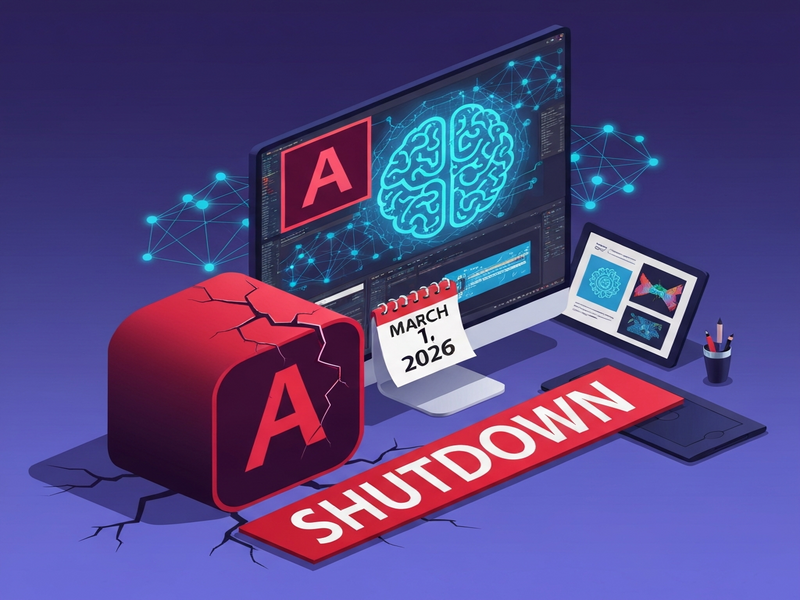
The graphic depicts Adobe’s legacy Animate toolbox fading into a vibrant AI‑powered cloud, symbolizing the transition to generative creative workflows.
Source & Further Reading
For the original announcement and community chatter, see the TechCrunch article. Additional insights on AI tools can be found in the UBOS AI tools newsroom and the animation software resource hub.
Conclusion: What This Means for Creators and Marketers
Adobe’s decision to retire Animate marks a decisive move toward an AI‑first future. While the loss of a beloved 2‑D animation platform will be felt across studios, the emergence of generative tools—both within Adobe’s ecosystem and on platforms like UBOS—offers new pathways for faster, smarter content creation. Marketers should begin evaluating AI‑enhanced alternatives now, leveraging UBOS’s templates for quick start and the UBOS pricing plans to align budgets with next‑gen creative workflows.
Stay ahead of the curve: adopt AI‑driven animation, automate repetitive tasks, and future‑proof your creative pipeline.