

- Updated: January 28, 2026
- 7 min read
Lunar Radio Telescope to Probe Cosmic Dark Ages from the Moon’s Far Side
The Lunar Radio Telescope project, called **LuSEE‑Night**, is a low‑frequency radio observatory that will land on the Moon’s far side in early 2027 to listen for the faint signals from the Universe’s “Cosmic Dark Ages,” a period never observed before.
A New Frontier in Space Science
When humanity looks up at the night sky, we see stars that have already died, galaxies that are billions of light‑years away, and a universe that is still whispering its earliest secrets. The IEEE Spectrum article highlighted the growing excitement around a lunar‑based radio telescope that could finally hear those whispers. By moving the instrument to the Moon’s far side—an environment free from Earth‑generated radio interference—scientists hope to capture the elusive 21‑cm hydrogen line stretched to wavelengths of tens of meters, a direct probe of the Universe just 380,000 years after the Big Bang.
UBOS, a leading UBOS homepage platform for AI‑driven development, has been tracking this mission closely, because the data pipeline and real‑time analysis required for LuSEE‑Night perfectly illustrate the power of modern AI integration in space science.
Why the Moon? The History of Lunar Radio Astronomy
Radio astronomers have long struggled with Earth’s ionosphere, which blocks frequencies below ~30 MHz, and with the ever‑growing cacophony of terrestrial transmitters. The Moon offers two unique advantages:
- Complete shielding from Earth‑based radio frequency interference (RFI) on its far side.
- Extended periods of electromagnetic darkness during the lunar night, lasting up to 14 Earth days.
Early concepts date back to the 1970s, when pioneers like Karl Jansky first detected “star noise.” Decades later, missions such as China’s Chang’e‑4 carried low‑frequency spectrometers, but the instruments were hampered by self‑generated noise. The next logical step—placing a dedicated, low‑noise antenna array on the Moon—has finally materialized as LuSEE‑Night.
For a deeper dive into the technical ecosystem that makes such missions possible, see the UBOS platform overview, which explains how modular AI services can be deployed in extreme environments.
LuSEE‑Night: Design, Goals, and Partners
LuSEE‑Night (Lunar Surface Electromagnetics Experiment – Night) is a compact, 108 kg payload that will ride aboard Firefly Aerospace’s Blue Ghost 2 lander. The instrument’s core consists of two 6‑meter dipole antennas mounted on a motorized turntable, a high‑impedance JFET pre‑amplifier, and a custom spectrometer sampling at 102.4 MS/s.
Key partners include:
- University of California, Berkeley – scientific lead and hardware integration.
- Firefly Aerospace – lander design, launch services, and mission operations.
- NASA’s Goddard Space Flight Center – data relay via the Lunar Gateway.
- Caltech’s Hallinan Group – scientific advisory on exoplanet radio signatures.
The primary scientific objectives are:
- Detect the global 21‑cm absorption feature from the Cosmic Dark Ages.
- Map the low‑frequency radio sky (0.1–50 MHz) with unprecedented sensitivity.
- Characterize lunar surface plasma interactions that could affect future radio arrays.
To illustrate how AI can accelerate data interpretation, the mission will use AI marketing agents—repurposed here as autonomous data‑filtering bots that flag candidate dark‑age signals in near‑real time.
Scientific Significance and Expected Discoveries
The Cosmic Dark Ages represent the interval between recombination (when the Universe became transparent) and the formation of the first stars. No direct observations exist for this epoch, yet theory predicts a faint dip in the cosmic microwave background caused by neutral hydrogen absorbing background photons.
If LuSEE‑Night successfully measures this dip, it will:
- Validate or refute competing models of early‑Universe heating (e.g., dark‑matter annihilation vs. early black‑hole accretion).
- Provide a new benchmark for cosmological simulations, tightening constraints on the timing of the first luminous objects.
- Open a new window for studying exoplanet magnetospheres via low‑frequency radio bursts, a key habitability indicator.
The data will be processed through a pipeline that includes the AI SEO Analyzer—here used as a metaphor for a machine‑learning model that automatically cleans RFI, calibrates antenna gain, and extracts the cosmological signal.
“We are listening for a whisper that has traveled 13 billion years,” says Dr. Gregg Hallinan of Caltech. “The Moon gives us the quietest room in the solar system to hear it.”
Technical Challenges and Ingenious Solutions
Operating a radio telescope on the Moon is not a simple “drop‑and‑listen” mission. The primary hurdles include:
1. Extreme Thermal Cycling
Lunar surface temperatures swing from +120 °C to –130 °C. LuSEE‑Night mitigates this with a multi‑layer insulation blanket, a parabolic radiator to reject daytime heat, and a 7,160 Wh lithium‑ion battery pack that powers heaters during the night.
2. Radio Frequency Interference from the Lander
Even the lander’s own electronics can generate spurious signals. The solution: a Workflow automation studio that sequences instrument activation only after the lander has entered a low‑power “quiet” mode, and a shielded antenna mast that extends 2 m above the spacecraft.
3. Data Transmission Across the Lunar Far Side
Since direct line‑of‑sight to Earth is impossible, LuSEE‑Night will relay data via NASA’s Lunar Gateway and a dedicated S‑band transmitter. The transmission protocol is optimized by the Web app editor on UBOS, which auto‑generates error‑correcting code for low‑bandwidth links.
4. Longevity of Sensitive Electronics
Radiation hardening is achieved through a combination of shielding, redundant circuitry, and a self‑diagnostic AI routine that can re‑configure the signal chain if a component degrades. This routine was prototyped using the AI Article Copywriter template, demonstrating how UBOS templates accelerate the creation of robust, mission‑critical software.
Illustration of LuSEE‑Night on the Lunar Far Side
Below is a generated illustration that captures the lander, the dipole antennas, and the surrounding terrain during the two‑week lunar night.
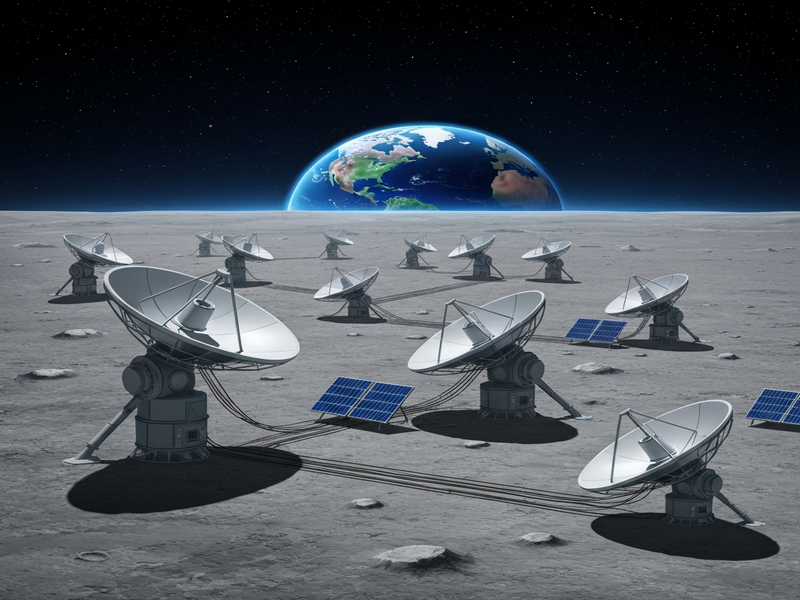
The image emphasizes the quiet electromagnetic environment that makes the far side ideal for low‑frequency observations. Notice the turntable mechanism that allows the antennas to rotate, a critical feature for distinguishing isotropic cosmic signals from directional local noise.
How UBOS Powers the Next Generation of Space Science
UBOS’s suite of AI‑enabled tools can be leveraged throughout the mission lifecycle:
- Rapid prototyping of data‑processing pipelines using UBOS templates for quick start.
- Scalable cloud‑edge deployment via the Enterprise AI platform by UBOS, ensuring low‑latency analysis even when bandwidth is limited.
- Collaboration with the UBOS partner program to integrate third‑party scientific instruments.
- Cost‑effective scaling for startups and research groups through UBOS for startups and UBOS solutions for SMBs.
For developers interested in building similar lunar‑compatible AI agents, the Talk with Claude AI app template demonstrates how to integrate large language models with low‑power hardware, a skill set directly transferable to the LuSEE‑Night data‑analysis stack.
Looking Ahead: From LuSEE‑Night to a Lunar Radio Array
If LuSEE‑Night validates its design and returns a clear detection of the Cosmic Dark Ages, it will pave the way for the ambitious FarView array—an interferometric network of up to 100,000 dipole antennas spread across 200 km² of the lunar far side. Such a facility could map the early Universe with angular resolution comparable to today’s ground‑based radio telescopes, but without Earth’s RFI.
The next steps involve:
- Securing additional funding through NASA’s UBOS partner program and international collaborations.
- Developing modular antenna “tiles” that can be 3‑D printed from lunar regolith, a concept explored in the UBOS portfolio examples.
- Integrating next‑generation AI models (e.g., Claude 3, GPT‑4) for real‑time signal classification, using templates like AI YouTube Comment Analysis tool as a proof‑of‑concept for large‑scale data mining.
The era of lunar radio astronomy is dawning, and with it a new class of scientific discovery that could rewrite our understanding of the Universe’s first billion years. As the instrument settles into the silent lunar night, the world will be listening—thanks to a blend of pioneering engineering, AI‑driven analytics, and the unique quiet of the Moon’s far side.