

- Updated: January 7, 2026
- 8 min read
Building Ultra‑Low‑Latency Voice Agents with NVIDIA Open Models
Answer: By combining NVIDIA’s open‑source Nemotron Speech ASR, Nemotron 3 Nano LLM, and Magpie TTS models with a cache‑aware streaming architecture, developers can create ultra‑low‑latency voice agents that transcribe speech in under 25 ms, generate responses in a few hundred milliseconds, and deliver natural‑sounding audio in real time.
Building Ultra‑Low‑Latency Voice Agents with NVIDIA Open Models
The AI landscape is witnessing a paradigm shift: open‑source models are finally matching, and in some cases surpassing, the performance of proprietary solutions. NVIDIA’s latest open‑model suite—Nemotron Speech ASR, Nemotron 3 Nano and Magpie TTS—delivers sub‑25 ms transcription, high‑quality text generation, and streaming text‑to‑speech, all under a permissive license that enables commercial use. This breakthrough empowers tech enthusiasts, AI developers, and enterprise decision‑makers to build voice agents that feel instantaneous, cost‑effective, and fully customizable.
In this article we dissect the architecture, benchmark results, deployment options, and developer benefits of these models. We also show how UBOS’s platform and marketplace accelerate the creation of production‑ready voice agents, linking directly to relevant resources throughout the guide.
1. Overview of NVIDIA Open Models
Nemotron Speech ASR – Real‑Time Transcription
Nemotron Speech ASR is a cache‑aware streaming automatic speech recognition (ASR) model designed for ultra‑low latency. In benchmark tests it consistently produces final transcripts in under 24 ms, a dramatic improvement over Whisper (600‑800 ms) and most commercial services (200‑400 ms). Accuracy is measured by word error rate (WER), where Nemotron matches or exceeds the best commercial ASR solutions.
Nemotron 3 Nano – Compact Yet Powerful LLM
Nemotron 3 Nano is a 30‑billion‑parameter large language model (LLM) that balances size and speed. Built on a hybrid Mamba‑Transformer MoE architecture, it delivers the highest ground‑pass rate among 30B‑class models, with average time‑to‑first‑byte (TTFB) of ≈170 ms on an RTX 5090. Its open‑model license permits unrestricted commercial deployment and fine‑tuning on proprietary data.
Magpie TTS – Streaming Text‑to‑Speech
Magpie is NVIDIA’s next‑generation TTS engine, optimized for streaming output. The preview checkpoint used in voice‑agent prototypes can synthesize the first audio chunk in as little as 90 ms on an RTX 5090, achieving a three‑fold latency reduction compared with batch‑mode inference. While the early streaming implementation introduces minor stitching artifacts, the overall naturalness rivals commercial TTS services.
2. Architecture & Streaming Transcription
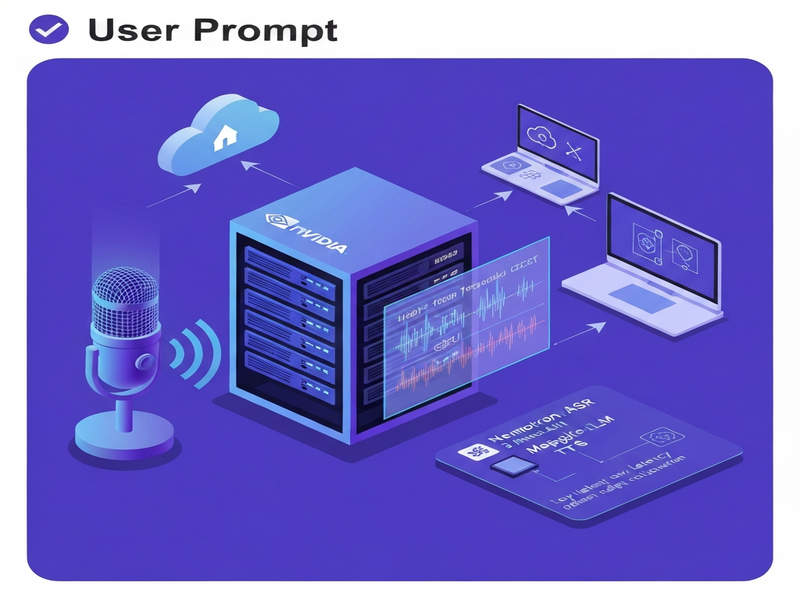
The voice‑agent pipeline follows a classic “speech‑to‑text → LLM → text‑to‑speech” design, but each component runs in a streaming, cache‑aware mode that minimizes idle time. Below is a high‑level diagram of the data flow:
User Audio → WebSocket → Audio Accumulator → Mel‑Spectrogram → Nemotron Speech ASR (streaming encoder) → Greedy Decoder → Transcript
                ↘︎ Parallel Smart Turn Detector (CPU) ↗︎
Transcript → Nemotron 3 Nano (LLM) → Token Stream → Magpie TTS (streaming) → Audio Output
Cache‑Aware Context Windows
Nemotron Speech ASR offers four context sizes (80 ms, 160 ms, 560 ms, 1.2 s). The 160 ms window aligns perfectly with the Workflow automation studio turn‑detection logic, allowing the system to finalize a transcript after a 200 ms pause in speech. An additional 120 ms of synthetic silence is appended to guarantee immediate finalization, keeping the total latency under 350 ms from voice end‑point to transcript availability.
Interleaved LLM & TTS Inference
When running locally on a single GPU, the pipeline interleaves small LLM token batches with TTS audio chunks. This “ping‑pong” scheduling ensures the GPU focuses on one model at a time, reducing contention and shaving 50‑100 ms off the overall voice‑to‑voice latency. The Smart Turn model runs on the CPU, freeing GPU cycles for the high‑throughput ASR and LLM stages.
Observability & Metrics
Each stage emits detailed logs (TTFB, token‑generation time, audio buffer latency). For example, a typical RTX 5090 run logs:
- ASR finalization: 19 ms (P50)
- LLM first token: 71 ms (P50)
- TTS first audio chunk: 99 ms (P50)
- End‑to‑end voice‑to‑voice: 415 ms (P50)
These metrics are visualized in the UBOS portfolio examples dashboard, enabling developers to pinpoint bottlenecks and iterate quickly.
3. Performance & Latency Benchmarks
Below is a consolidated benchmark table comparing NVIDIA open models against leading commercial alternatives on two hardware configurations: an RTX 5090 (consumer‑grade) and an NVIDIA DGX Spark (enterprise‑grade).
| Component | RTX 5090 (ms) | DGX Spark (ms) | Commercial Avg. (ms) |
|---|---|---|---|
| ASR (final transcript) | 19 (P50) | 27 (P50) | 200‑400 |
| LLM first token | 71 (P50) | 343 (P50) | 300‑800 |
| TTS first audio chunk | 99 (P50) | 158 (P50) | 300‑600 |
| End‑to‑end voice‑to‑voice | 415 (P50) | 759 (P50) | 800‑1500 |
The sub‑25 ms ASR latency is the most striking figure, enabling near‑instantaneous turn‑taking. Combined with the LLM and TTS latencies, the total voice‑to‑voice round‑trip stays comfortably below half a second on consumer hardware—well within the threshold for natural conversation.
4. Deployment Options: Cloud vs. Local GPU
Developers can choose between two primary deployment strategies, each with distinct trade‑offs in cost, scalability, and data sovereignty.
Cloud (Serverless GPU)
Platforms like NVIDIA open models can be hosted on serverless GPU services such as Modal, AWS Inferentia, or Azure NC-series. Benefits include:
- Automatic scaling for multi‑user workloads.
- Zero‑maintenance GPU provisioning.
- Geographically distributed endpoints to reduce network latency.
The UBOS pricing plans offer a pay‑as‑you‑go tier that aligns with serverless consumption, making it easy for startups to experiment without upfront hardware costs.
Local GPU (On‑Premise)
For enterprises with strict data‑privacy requirements, deploying the models on an on‑premise NVIDIA DGX Spark or a high‑end RTX 5090 workstation provides:
- Full control over model weights and inference pipelines.
- Zero egress latency for internal applications.
- Compliance with regulations such as GDPR and HIPAA.
UBOS’s Enterprise AI platform includes Docker images pre‑configured for DGX Spark, simplifying on‑premise rollout.
5. Benefits of Using Open Models for Developers
- Full Customizability: Open weights let you fine‑tune on domain‑specific data, improving accuracy for niche vocabularies (e.g., medical terminology).
- Cost Efficiency: No licensing fees; you only pay for compute. This dramatically lowers the total cost of ownership compared with SaaS ASR/TTS APIs.
- Latency‑First Design: The cache‑aware streaming architecture is built for sub‑30 ms response times, a critical metric for voice‑first applications.
- Observability & Debugging: Access to the full inference stack enables detailed logging, profiling, and rapid iteration.
- Regulatory Compliance: Hosting models within your VPC satisfies data‑privacy mandates without sacrificing performance.
UBOS amplifies these advantages with ready‑made integrations. For instance, the ChatGPT and Telegram integration demonstrates how a voice‑enabled chatbot can be extended to messaging platforms with minimal code. Similarly, the ElevenLabs AI voice integration offers an alternative TTS option for developers seeking diverse vocal styles.
6. Real‑World Use Cases Powered by Ultra‑Low‑Latency Voice Agents
The speed and flexibility of NVIDIA’s open models unlock new possibilities across industries:
Customer Support & Call Centers
Voice agents can answer inbound calls, route queries, and even perform real‑time sentiment analysis. The sub‑500 ms round‑trip ensures callers never perceive a lag, boosting satisfaction scores.
Healthcare Appointment Scheduling
Secure, on‑premise deployment on a DGX Spark lets hospitals keep patient data in‑house while offering a conversational assistant that confirms appointments in under a second.
Retail & Restaurant Ordering
Integrate with the UBOS solutions for SMBs to provide voice‑driven ordering kiosks that respond instantly, reducing queue times.
Financial Services Verification
Voice agents can guide users through loan‑application verification steps, leveraging the LLM’s reasoning capabilities while maintaining compliance through local GPU deployment.
7. How UBOS Accelerates Voice‑Agent Development
UBOS provides a full‑stack environment that abstracts away the heavy lifting of model orchestration, allowing developers to focus on business logic.
- Web App Editor: The Web app editor on UBOS lets you drag‑and‑drop components such as ASR, LLM, and TTS into a visual workflow.
- Workflow Automation Studio: Use the Workflow automation studio to define turn‑detection rules, fallback strategies, and multi‑modal branching without writing boilerplate code.
- Template Marketplace: Jump‑start projects with pre‑built templates like the AI Chatbot template or the GPT‑Powered Telegram Bot, which already integrate Nemotron models.
- Partner Program: Join the UBOS partner program to receive dedicated support, co‑marketing, and early access to upcoming model releases.
8. Conclusion & Next Steps
NVIDIA’s open‑model trio—Nemotron Speech ASR, Nemotron 3 Nano, and Magpie TTS—delivers the performance envelope required for truly conversational, real‑time voice agents. By leveraging cache‑aware streaming, interleaved inference, and UBOS’s low‑code platform, developers can launch production‑grade agents in days rather than months, all while retaining full control over data and costs.
Ready to prototype your own ultra‑low‑latency voice assistant? Explore the UBOS templates for quick start, spin up a cloud instance via the UBOS pricing plans, or dive straight into the code on GitHub. For a deeper dive into the underlying research, read the original announcement on NVIDIA’s blog here.
Whether you’re a startup building the next voice‑first app or an enterprise modernizing call‑center workflows, the combination of NVIDIA open models and UBOS’s end‑to‑end platform gives you the speed, flexibility, and scalability to stay ahead of the competition.
Andrii Bidochko
CTO UBOS
Andrii Bidochko is an AI entrepreneur and researcher focused on AI agents, reinforcement learning, and autonomous systems. He writes about the technologies shaping the future of machine intelligence, from frontier models and agent architectures to real-world AI applications.