

- Updated: December 30, 2025
- 6 min read
AI ARR vs GMV: Unmasking the Illusion in Startup Financial Reporting
ARR (Annual Recurring Revenue) and GMV (Gross Merchandise Value) are fundamentally different metrics: ARR measures the predictable, subscription‑based revenue a company actually retains, while GMV tracks the total transaction volume flowing through a platform, regardless of the company’s take rate.
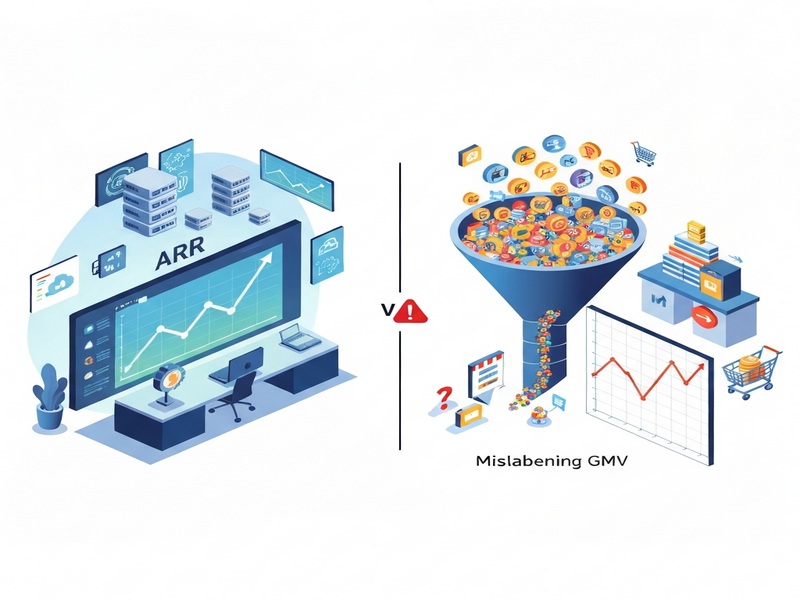
Why the “ARR Illusion” Is Undermining AI Startup Valuations
In the fast‑moving world of AI‑driven businesses, headlines like “$50 M ARR in 6 months” grab attention. Yet, a closer look often reveals that the figure being touted is not true ARR but GMV masquerading as recurring revenue. For tech‑savvy investors and founders, distinguishing these metrics is crucial to avoid over‑valued deals, misallocated capital, and unsustainable growth strategies.
ARR vs. GMV: Definitions and Core Differences
What Is Annual Recurring Revenue (ARR)?
ARR is the annualized value of contracts that are guaranteed to recur. It requires two conditions:
- A full year of service must be contractually secured, or the revenue must have proven repeatability.
- The revenue is earned by the company, not merely passed through to a third‑party provider.
In SaaS, ARR is the gold standard for stability, predictability, and valuation multiples.
What Is Gross Merchandise Value (GMV)?
GMV represents the total monetary value of all transactions processed on a platform. It is a flow metric, not a profit metric:
- It includes every dollar a buyer spends, even if the platform only keeps a small commission.
- GMV does not account for costs, refunds, or the actual revenue retained.
Key Distinctions at a Glance
| Metric | ARR | GMV |
|---|---|---|
| What it measures | Recurring, retained revenue | Total transaction volume |
| Profit relevance | Directly tied to profit | Often unrelated to profit |
| Valuation impact | High‑multiple SaaS valuations | Low‑multiple, broker‑type valuations |
The Problem: Mislabeling GMV as ARR
Many AI startups adopt the ARR label for GMV because it sounds impressive to investors and aligns with the SaaS narrative. This practice creates several hidden risks:
Why Startups Do It
- Investor pressure to showcase “recurring” growth.
- Ease of communicating large numbers (e.g., “$200 M GMV = $200 M ARR”).
- Lack of internal finance expertise to differentiate the metrics.
Impact on Margins
When GMV is presented as ARR, the underlying cost structure is obscured. AI platforms typically incur:
- High GPU and compute fees from LLM providers.
- Human‑in‑the‑loop contractor expenses.
- Infrastructure and data‑pipeline costs.
Because these costs flow directly out of the transaction value, the net take rate can be as low as 5‑10 %, turning a seemingly massive “ARR” into a thin profit margin.
Valuation Distortion
Investors often apply SaaS‑style multiples (8‑12×) to inflated ARR figures, leading to over‑valuation. In reality, a company with $100 M GMV and a 7 % take rate generates only $7 M of true revenue, which would merit a much lower multiple.
“Labeling GMV as ARR is like counting the water flowing through a pipe as the amount you keep in a bucket.” – original analysis
Implications for Margins and Valuations
Understanding the true economics of AI‑driven platforms is essential for both founders and investors.
Margin Analysis
- Gross margin: Often appears high when only the platform fee is considered, but after subtracting compute costs it can drop below 20 %.
- Contribution margin: The real driver of profitability; must be tracked against GMV, not ARR.
- Operating leverage: Achievable only when the take rate improves or when cost per transaction declines faster than volume grows.
Valuation Multiples: A Reality Check
Below is a simplified comparison of valuation approaches:
| Metric Used | Typical Multiple | Resulting Valuation (Example) |
|---|---|---|
| True ARR ($7 M) | 9× | $63 M |
| Inflated GMV‑as‑ARR ($100 M) | 9× | $900 M |
The disparity illustrates why accurate terminology protects both parties from unrealistic expectations.
Recommendations: Speak the Right Numbers
Adopting transparent financial language benefits fundraising, strategic planning, and long‑term sustainability.
1. Use the Correct Metric for the Right Context
- Report ARR only when you have signed, recurring contracts that have proven repeatability.
- Report GMV as a growth indicator, but always disclose the take rate and net revenue.
- Introduce Net Revenue Retention (NRR) and Gross Margin alongside ARR for SaaS‑style clarity.
2. Build Financial Controls with Modern AI Platforms
Leverage tools that separate transaction flow from retained revenue. The UBOS platform overview offers built‑in dashboards that can track both GMV and ARR side‑by‑side, ensuring you never conflate the two.
3. Automate Reporting and Auditing
Use the Workflow automation studio to schedule nightly reconciliations between your payment processor and your revenue ledger. Automation reduces human error and provides a clear audit trail for investors.
4. Communicate Transparently with Stakeholders
- Include a “Metrics Glossary” in pitch decks.
- Show side‑by‑side charts of GMV vs. Net Revenue over the same period.
- Explain any changes in take rate or cost structure openly.
5. Leverage Ready‑Made Templates for Faster Adoption
UBOS’s UBOS templates for quick start include an AI SEO Analyzer and an AI Article Copywriter that can generate investor‑ready financial narratives in minutes.
6. Choose the Right Partner for AI‑Enabled Financial Ops
Startups can accelerate compliance and reporting by integrating with proven services:
- OpenAI ChatGPT integration for natural‑language query of financial data.
- Chroma DB integration for vector‑based analytics on transaction logs.
- ChatGPT and Telegram integration to receive real‑time alerts on margin breaches.
7. Scale with the Right Architecture
For enterprises, the Enterprise AI platform by UBOS provides multi‑tenant security, role‑based access, and compliance reporting needed for public‑company disclosures.
Take the Next Step: Build Transparent, Scalable AI Revenue Models
If you’re a founder or investor looking to demystify your financial metrics, explore how UBOS can help you:
- Start with the UBOS for startups free tier to prototype accurate ARR/GMV dashboards.
- Upgrade to UBOS solutions for SMBs for deeper margin analytics.
- Join the UBOS partner program to co‑create industry‑specific financial templates.
Accurate metrics are the foundation of sustainable growth. Stop building on sand—anchor your business with real ARR, transparent GMV, and the right AI tools.
Further Reading & Tools
Explore these UBOS resources to deepen your understanding:
- AI marketing agents – automate campaign performance reporting.
- Web app editor on UBOS – build custom financial dashboards without code.
- UBOS pricing plans – find a plan that matches your data volume.
- UBOS portfolio examples – see how other AI companies visualize ARR vs. GMV.
- Talk with Claude AI app – experiment with conversational analytics on your financial data.
- Your Speaking Avatar template – create interactive demos for investor pitches.
© 2025 UBOS. All rights reserved.
Andrii Bidochko
CTO UBOS
Andrii Bidochko is an AI entrepreneur and researcher focused on AI agents, reinforcement learning, and autonomous systems. He writes about the technologies shaping the future of machine intelligence, from frontier models and agent architectures to real-world AI applications.