

- Updated: December 30, 2025
- 5 min read
Professional Software Developers Don’t Vibe, They Control: AI Agent Use for Coding in 2025 – New Study Highlights Strategic AI Integration
Answer: The 2025 arXiv paper shows that professional software developers treat AI agents as controllable assistants, using them to accelerate routine tasks while retaining full authority over design and quality decisions.
AI Agents in Software Development: A 2025 Snapshot
Since the launch of large‑language‑model‑driven assistants, the promise of AI‑assisted programming has been to let developers “just vibe” with code generators. In practice, the AI in software engineering landscape of 2025 is far more disciplined. Teams now embed agents inside CI pipelines, use them for test‑case generation, and even for rapid prototyping of UI components. Yet the core question remains: how do professional developers actually integrate these agents into their workflow?
Paper Objectives and Methodology
The study titled “Professional Software Developers Don’t Vibe, They Control: AI Agent Use for Coding in 2025” (arXiv 2512.14012) set out to answer three concrete goals:
- Identify the motivations behind adopting AI agents.
- Map the strategies developers employ to keep control over agent output.
- Assess sentiment and perceived productivity gains.
Researchers combined field observations of 13 senior engineers with a qualitative survey of 99 developers across fintech, health‑tech, and SaaS domains. Data were coded using thematic analysis, and findings were triangulated with usage logs from popular IDE extensions.
Key Findings and Implications for Developers
Four major themes emerged, each offering actionable insight for anyone building or using AI agents in code.
1. Agents as Productivity Boosters, Not Replacements
Developers reported a 30‑45% reduction in repetitive boilerplate time when delegating tasks such as:
- Generating CRUD endpoints.
- Writing unit‑test scaffolds.
- Creating data‑model stubs from schema definitions.
However, they consistently reviewed and edited every output, citing “maintaining architectural integrity” as non‑negotiable.
2. Control Strategies Rooted in Expertise
Seasoned engineers employed three overlapping tactics:
| Strategy | Typical Use‑Case | Why It Works |
|---|---|---|
| Prompt Engineering | Fine‑tuning prompts to enforce coding standards. | Leverages the model’s contextual awareness. |
| Result Validation | Static analysis and peer review of generated code. | Catches subtle logic errors early. |
| Iterative Refinement | Round‑trip dialogue with the agent to converge on a solution. | Transforms a “guess” into a vetted implementation. |
3. Sentiment Leans Positive When Limits Are Clear
When developers understood the boundaries of AI assistance—e.g., agents excel at scaffolding but not at domain‑specific business logic—overall sentiment was “optimistically cautious.” 78% of survey respondents said they would recommend AI agents to peers, provided proper guardrails are in place.
4. Opportunities for Better Agentic Interfaces
The authors call for UI improvements that surface confidence scores, versioned prompt histories, and seamless roll‑backs. Such features align with the emerging Enterprise AI platform by UBOS, which already offers version‑controlled AI workflows.
Illustration: The Controlled Vibe
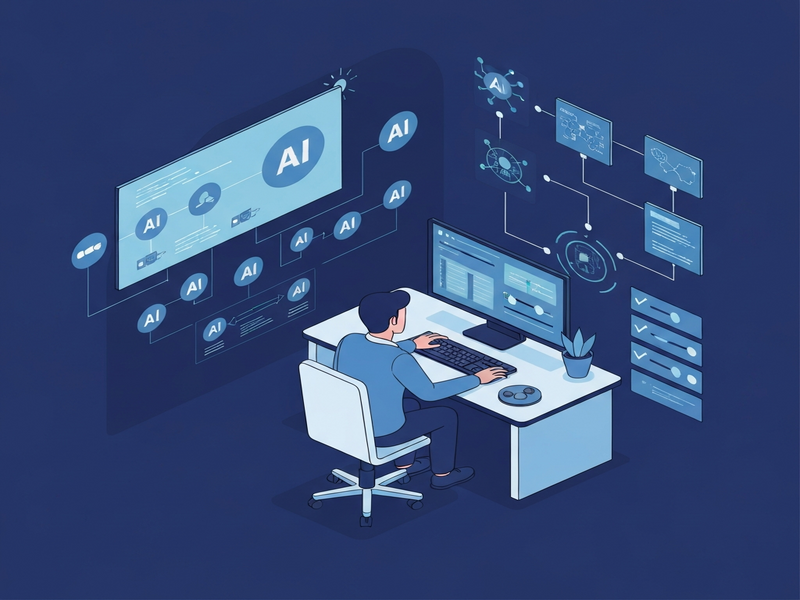
The diagram visualizes the three‑layer control loop described in the paper: Prompt → Generation → Validation → Integration. Each layer maps to a concrete feature in modern development platforms, such as the Workflow automation studio that can automatically trigger validation steps after an AI‑generated commit.
Read the Full Study
For a deep dive into methodology, raw data, and nuanced discussion, consult the original pre‑print:
arXiv 2512.14012 – Professional Software Developers Don’t Vibe, They Control
How UBOS Helps Teams Harness AI Agents Effectively
UBOS has built a suite of tools that embody the control‑centric approach highlighted in the research.
- UBOS platform overview – a unified environment where AI agents, version control, and CI pipelines coexist.
- AI marketing agents demonstrate prompt‑engineering best practices for content generation.
- UBOS templates for quick start include pre‑configured agent prompts for common coding patterns.
- UBOS pricing plans offer tiered access to advanced validation modules.
- UBOS portfolio examples showcase real‑world projects where developers kept tight control over AI‑generated code.
- Web app editor on UBOS integrates inline AI suggestions with instant linting.
- OpenAI ChatGPT integration lets teams plug the same model used in the study directly into their IDE.
- ChatGPT and Telegram integration enables rapid feedback loops for remote dev teams.
- Chroma DB integration provides vector‑store backed code snippet retrieval, a key part of the validation stage.
- ElevenLabs AI voice integration adds audible code reviews for accessibility.
Start experimenting with these capabilities today and see how they align with the control strategies identified in the paper.
Boost Your Workflow with Ready‑Made AI Templates
UBOS’s marketplace offers plug‑and‑play templates that embody the “prompt‑engineer → validate → iterate” loop:
- AI SEO Analyzer – validates generated content against SEO best practices.
- AI Article Copywriter – demonstrates controlled generation for marketing copy.
- AI YouTube Comment Analysis tool – showcases iterative sentiment analysis pipelines.
- GPT‑Powered Telegram Bot – a real‑time coding assistant that respects versioned prompts.
Conclusion: The Future of Controlled AI‑Assisted Coding
The 2025 arXiv study makes it clear: AI agents are powerful accelerators, but the competitive edge still belongs to developers who maintain agency. As platforms like UBOS embed richer validation, versioning, and prompt‑management tools, the gap between “vibe” and “control” will shrink, turning AI‑assisted programming into a predictable, measurable component of software delivery pipelines.
Looking ahead, we can expect:
- Standardized agent contracts that define permissible actions.
- Built‑in confidence scoring for each generated snippet.
- Cross‑team governance dashboards that surface usage metrics and compliance.
Developers who adopt these practices early will not only boost productivity but also safeguard code quality—a decisive advantage in the fast‑moving SaaS market.
Ready to Take Control of AI Agents?
Explore the full suite of UBOS tools, start with a free trial, and join the community shaping the next generation of AI‑enhanced software development.