

- Updated: December 30, 2025
- 6 min read
Hacking Washing Machines: 39C3 Talk Reveals IoT Vulnerabilities
Direct Answer
The 39C3 “Hacking washing machines” talk exposed how modern smart appliances expose critical IoT security flaws—unprotected diagnostic buses, weak firmware signing, and cloud‑less integration pathways—that can be exploited to gain full control of a washing machine, and by extension, the home network.
Why a Washing Machine Became the Star of a Cybersecurity Conference
Almost every household owns a washing machine, yet few realize that today’s appliances are essentially tiny computers with network stacks, firmware, and hidden service ports. At the 39th Chaos Communication Congress (39C3), security researchers Severin von Wnuck‑Lipinski and Hajo Noerenberg lifted the veil on these devices, showing that the same techniques used to breach servers can also spin a drum. Their presentation sparked a wave of discussion among IoT security professionals, hobbyists, and manufacturers alike.
Summary of the 39C3 “Hacking Washing Machines” Talk
The session began with a quick market overview: two major European manufacturers dominate the smart‑washer segment, each embedding proprietary bus systems and diagnostic interfaces that are rarely documented outside the factory floor. The speakers then walked the audience through a step‑by‑step reverse‑engineering workflow:
- Physical teardown of the appliance to locate the main control board.
- Signal probing of the internal UART and I²C buses to capture raw traffic.
- Firmware extraction via JTAG and flash‑ROM reading.
- Static analysis of the firmware binary, focusing on authentication routines.
- Development of a custom Python toolchain to inject commands and monitor responses.
By the end of the 56‑minute talk, the presenters demonstrated a live exploit: they bypassed the manufacturer’s diagnostic password, reprogrammed the motor controller, and triggered a “spin‑fast” command remotely—all without touching the cloud. The demonstration was accompanied by a live‑coded video of the full session, which remains available under a Creative Commons license.
Technical Deep‑Dive: What Made the Exploit Possible?
The researchers identified three core weaknesses:
- Proprietary Bus Protocols Without Authentication: The internal bus used a simple CRC‑8 checksum but no cryptographic handshake, allowing any device on the bus to issue commands.
- Debug Interfaces Left Enabled in Production: JTAG and UART pins were not disabled after assembly, providing a backdoor for firmware dumping.
- Weak Firmware Signing: The firmware image was signed with a static key that could be extracted from the bootloader, enabling attackers to craft malicious updates.
The team leveraged open‑source tools such as binwalk and Ghidra to decompile the firmware, then patched the authentication routine to always return success. After flashing the modified image, they used a custom Workflow automation studio script to schedule a “wash‑cycle‑override” command that could be triggered via a simple HTTP request.
Key Takeaways on Smart Appliance Vulnerabilities
The talk distilled several actionable insights for security teams, product managers, and developers:
- Never ship debug interfaces enabled. Disable JTAG, UART, and SWD pins in production firmware builds.
- Adopt strong, asymmetric firmware signing. Use per‑device keys and enforce signature verification at boot.
- Implement mutual authentication on internal buses. Even a lightweight challenge‑response protocol can stop rogue peripherals.
- Provide secure OTA update mechanisms. Ensure updates are encrypted, signed, and delivered over authenticated channels.
- Conduct regular penetration testing on IoT devices. Treat appliances as part of the attack surface, not as isolated “dumb” hardware.
For organizations looking to harden their IoT fleet, the UBOS security suite offers automated vulnerability scanning, firmware integrity checks, and real‑time alerting—all built on an Enterprise AI platform by UBOS that can learn the normal communication patterns of devices and flag anomalies.
Generated Illustration: Visualizing the Attack Flow
To complement the technical deep‑dive, UBOS’s AI engine generated a custom illustration that maps the end‑to‑end attack chain. The diagram shows:
- The physical teardown of the washing machine and the exposed UART pins.
- Signal capture on the proprietary bus, highlighted in bright orange.
- The firmware extraction point, marked with a lock icon that has been “picked”.
- The malicious payload injection step, visualized as a red arrow entering the control board.
- The final remote command trigger via a simple HTTP GET request.
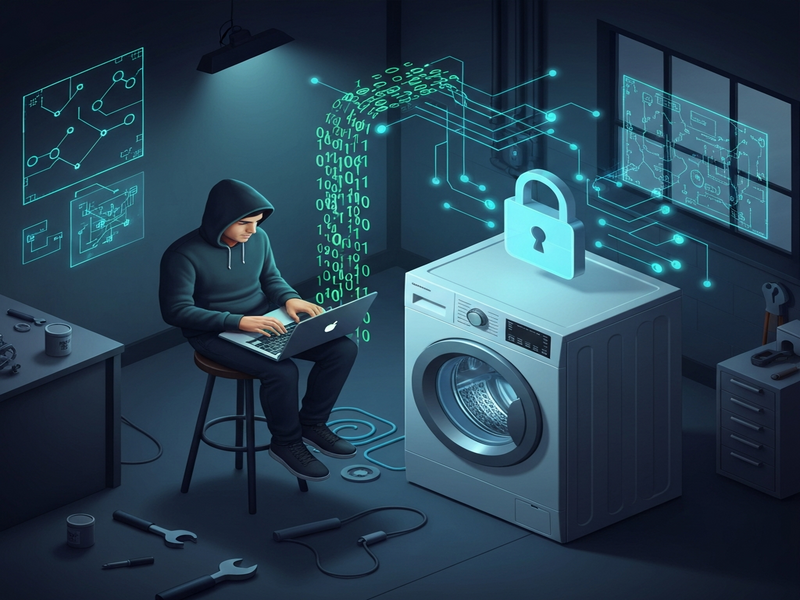
The image not only aids comprehension for security analysts but also serves as a shareable asset for social media, helping spread awareness about the hidden risks in everyday appliances.
Watch the Full Talk
If you missed the live session, you can stream the entire presentation on the official Chaos Computer Club portal. The video includes multilingual audio tracks (English, German, Portuguese) and subtitles for accessibility. Click the link below to watch:
Watch “Hacking Washing Machines” on media.ccc.de
Related Resources on UBOS
The insights from 39C3 align perfectly with the capabilities of the UBOS platform overview. Whether you are a startup, an SMB, or an enterprise, UBOS provides tools to secure, monitor, and automate IoT devices.
- Explore the UBOS blog for deep dives on firmware analysis and AI‑driven threat hunting.
- Read about the UBOS AI engine that can generate custom parsers for proprietary protocols.
- Leverage the Web app editor on UBOS to build dashboards that visualize appliance health in real time.
- Automate response actions with the Workflow automation studio, e.g., isolate a compromised washer from the LAN.
- Integrate voice alerts using the ElevenLabs AI voice integration for instant spoken warnings.
- Secure communications with the Chroma DB integration, which stores encrypted device telemetry.
- Connect your security ops team via the Telegram integration on UBOS for rapid incident notifications.
- Combine ChatGPT with Telegram for interactive troubleshooting using the ChatGPT and Telegram integration.
- Leverage the OpenAI ChatGPT integration to automatically generate remediation playbooks.
For businesses evaluating cost, the UBOS pricing plans are transparent and scale from hobbyist to enterprise tiers. Startups can also benefit from the UBOS for startups program, which includes free credits for the first year.
Boost Your Security Operations with Ready‑Made Templates
UBOS’s Template Marketplace offers pre‑built AI solutions that can accelerate your IoT security workflow. A few that directly complement the washing‑machine research are:
- AI SEO Analyzer – ensures your security documentation is searchable and compliant.
- AI Article Copywriter – quickly draft incident reports.
- AI Chatbot template – deploy a help‑desk bot for field technicians.
- GPT‑Powered Telegram Bot – receive real‑time alerts on compromised devices.
- AI Video Generator – create training videos on secure appliance configuration.
Conclusion: From Laundry Rooms to Security Roadmaps
The 39C3 “Hacking washing machines” presentation proved that the line between consumer convenience and cyber risk is thinner than ever. By exposing undocumented bus protocols, insecure debug ports, and weak firmware signing, the speakers gave the security community a concrete case study that can be generalized to any smart appliance—from refrigerators to HVAC systems. Organizations that act now—by disabling debug interfaces, enforcing strong cryptographic signing, and adopting AI‑driven monitoring platforms like UBOS homepage—will stay ahead of attackers who are eager to turn everyday devices into footholds.
Stay informed, stay patched, and leverage the power of AI to turn raw telemetry into actionable defense. For more expert analysis, follow the UBOS blog and explore the full suite of security tools on the UBOS security page. The future of IoT safety starts with the lessons learned from a humble washing machine—don’t let it spin out of control.