

- Updated: April 3, 2025
- 3 min read
Enhancing Strategic Decision-Making in Gomoku with AI
Revolutionizing Strategic Decision-Making in Gomoku with AI: A New Frontier
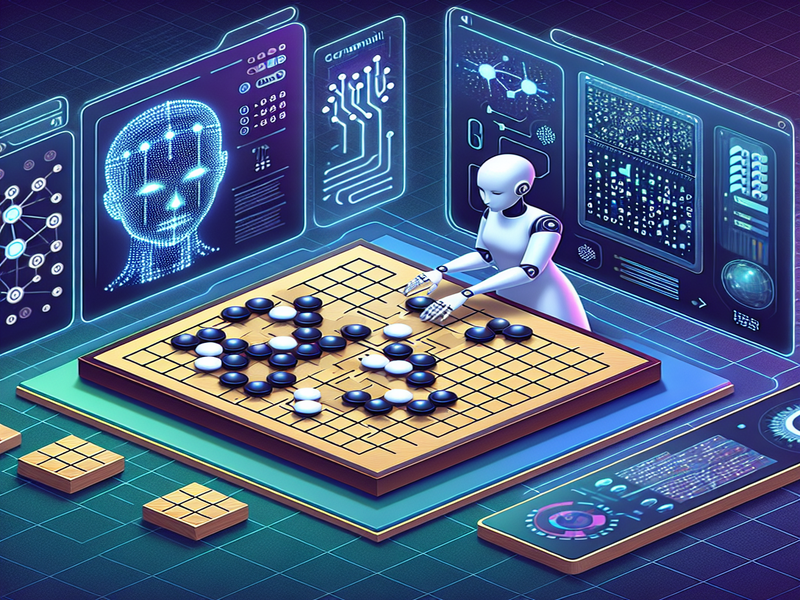
In the ever-evolving landscape of artificial intelligence (AI), strategic decision-making in games like Gomoku has emerged as a fascinating arena for innovation. By integrating OpenAI ChatGPT integration with reinforcement learning, researchers are pushing the boundaries of AI’s capabilities, enhancing not only gameplay but also providing insights into complex problem-solving.
Integrating Large Language Models and Reinforcement Learning
Large language models (LLMs) have made significant strides in natural language processing (NLP), showcasing robust text generation and reasoning abilities. Their integration with reinforcement learning is paving the way for advancements in strategic decision-making, particularly in games like Gomoku. This classic board game, known for its simple rules yet deep strategic complexity, presents a unique challenge for AI.
Traditional methods, reliant on computationally expensive search algorithms, often fall short in efficiency. However, combining LLMs with reinforcement learning offers a promising solution. This integration allows AI to mimic human learning processes, enhancing its ability to interpret board states, understand game rules, and select optimal strategies.
Key Findings and Implications
Recent research from Peking University has developed a Gomoku AI system leveraging LLMs and reinforcement learning. This system demonstrates a significant improvement in strategic decision-making by incorporating self-play and reinforcement learning techniques. The AI refines its move selection, avoids illegal moves, and enhances efficiency through parallel position evaluation.
“The implementation of the Gomoku AI system is structured into five key components: prompt design, strategy selection, position evaluation, self-play, and reinforcement learning.”
These components work in tandem to simulate human decision-making, allowing the AI to adapt strategies dynamically. The use of a specialized prompt template enables the model to incorporate board state, game rules, and strategic logic, thereby refining its gameplay.
Related AI Advancements and Articles
The integration of AI in strategic games is part of a broader trend in AI advancements. For instance, the ChatGPT and Telegram integration exemplifies how AI is being utilized to enhance communication platforms. Similarly, the AI-powered chatbot solutions are revolutionizing customer service by providing more responsive and intelligent interactions.
Moreover, the revolutionizing marketing with generative AI highlights how AI agents are transforming marketing strategies, offering personalized and efficient solutions. These advancements underscore the potential of AI to drive innovation across various sectors.
Conclusion: The Impact of AI in Strategic Games
The integration of LLMs and reinforcement learning in Gomoku marks a significant milestone in AI’s evolution. By enhancing strategic decision-making, AI not only improves gameplay but also offers valuable insights into complex problem-solving. This development opens new avenues for research and application, paving the way for AI to become an indispensable tool in strategic games.
As AI continues to evolve, its impact on strategic decision-making will only grow. Future research will focus on optimizing strategy selection and integrating vision-language models for enhanced performance. For more insights into AI advancements, explore the UBOS homepage and discover how AI is transforming industries.
Stay informed about the latest in AI by exploring related articles such as the AI in stock market trading and the AI-infused CRM systems on UBOS. These resources provide a deeper understanding of how AI is reshaping various sectors, offering innovative solutions and driving growth.
For those interested in further exploring the capabilities of AI in games and beyond, the UBOS platform overview offers a comprehensive look at the tools and technologies available to harness AI’s potential.
Andrii Bidochko
CTO UBOS
Andrii Bidochko is an AI entrepreneur and researcher focused on AI agents, reinforcement learning, and autonomous systems. He writes about the technologies shaping the future of machine intelligence, from frontier models and agent architectures to real-world AI applications.