

- Updated: February 21, 2026
- 6 min read
Understanding Trunk‑Based Development: Benefits, Practices, and Implementation
Trunk‑Based Development (TBD) is a version‑control strategy where all developers commit to a single, continuously integrated main branch, enabling rapid CI/CD cycles and reducing merge‑conflict overhead.
What Is Trunk‑Based Development?
Trunk‑Based Development (often abbreviated as TBD) is a branching model that encourages teams to work off a single trunk (or main branch) rather than maintaining long‑lived feature or release branches. By committing frequently—sometimes dozens of times per day—developers keep the codebase in a releasable state, which directly supports continuous integration and continuous delivery pipelines.
Core Principles and Practices
The TBD model is built on a handful of clear, MECE‑structured principles:
- Single‑line development: All work converges on the trunk, eliminating divergent histories.
- Short‑lived feature branches: If branches are used, they exist only for a few hours and are merged back via fast‑forward or pull‑request workflows.
- Feature flags & branch‑by‑abstraction: Complex or risky changes are hidden behind runtime toggles, allowing incomplete work to coexist safely.
- Automated CI checks: Every commit triggers a full build, unit tests, and integration tests before it lands on the trunk.
- Release from trunk: Production releases are cut directly from the main branch, often using a “fix‑forward” strategy for hot‑fixes.
Short‑Lived Feature Branch Workflow
When a developer needs isolation, they create a branch that lives for a single task. The workflow typically looks like this:
- Branch from
main(e.g.,feat/login‑ui). - Develop locally, run
pre‑commitlinting, and execute the CI suite. - Open a pull request; reviewers provide rapid feedback.
- Merge with a fast‑forward or squash, then delete the branch.
Feature Flags & Branch‑by‑Abstraction
Feature flags let teams ship incomplete functionality behind a toggle, while branch‑by‑abstraction refactors code in a way that both old and new implementations coexist safely. These techniques are essential for large teams that need to hedge releases without breaking the build.
Benefits and Trade‑offs
Adopting TBD brings measurable advantages, but it also introduces considerations that teams must manage.
Key Benefits
- Reduced merge hell: With fewer long‑lived branches, conflict resolution becomes trivial.
- Faster feedback loops: CI runs on every commit, surfacing bugs within minutes.
- Higher release frequency: Teams can ship daily or even multiple times per day.
- Scalable collaboration: Large monorepos (e.g., Google’s) thrive on this model.
- Improved code quality: Continuous code review and automated testing enforce standards.
Potential Trade‑offs
- Discipline required: Developers must avoid committing broken code; robust CI pipelines are non‑negotiable.
- Feature‑flag fatigue: Overuse of flags can clutter the codebase; proper flag lifecycle management is essential.
- Tooling investment: Automated testing, static analysis, and deployment pipelines need upfront effort.
- Learning curve: Teams accustomed to GitFlow may need cultural change and training.
Illustration: Visualizing the Trunk‑Based Flow
Below is a custom illustration that captures the essence of Trunk‑Based Development. The diagram shows a single trunk, short‑lived branches, CI checks, and a direct release path.
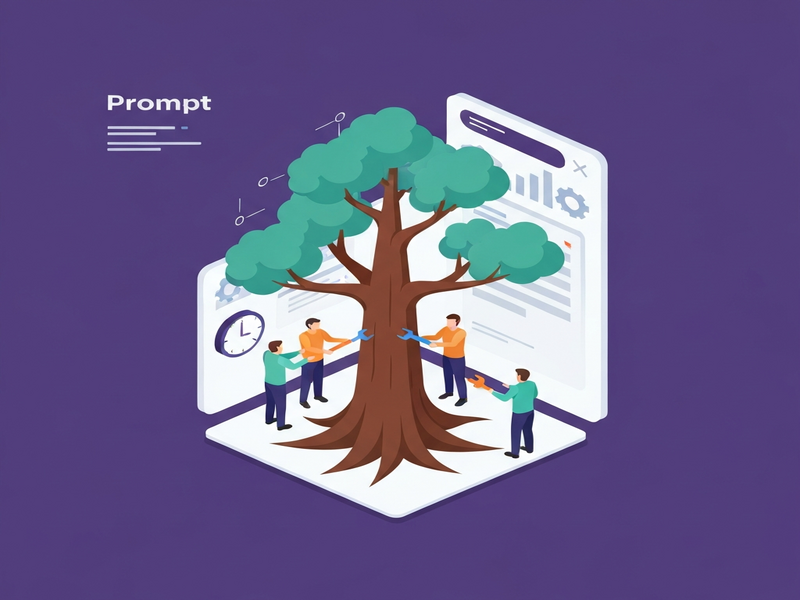
Figure: A streamlined workflow where every commit travels through automated CI before merging into the trunk, enabling instant releases.
How UBOS Supports Trunk‑Based Development
UBOS provides a suite of tools that align perfectly with TBD principles, helping teams accelerate CI/CD while maintaining high code quality.
Integrated CI/CD Pipelines
Our UBOS platform overview includes built‑in pipeline orchestration that automatically triggers builds, unit tests, and integration tests on every push to main. This eliminates the need for separate CI servers and ensures that the trunk never breaks.
Feature‑Flag Management
Leverage the ChatGPT and Telegram integration to toggle feature flags in real time, giving product owners instant control over what reaches production.
Low‑Code Automation
The Workflow automation studio lets you model release pipelines visually, ensuring that every commit follows the same validation steps before merging.
Rapid Prototyping with Templates
Start new TBD‑friendly services using ready‑made UBOS templates for quick start. For example, the AI SEO Analyzer template includes a pre‑configured CI pipeline that enforces linting and test coverage on every commit.
Real‑World Use Cases
Many industry leaders have adopted TBD to power their DevOps transformations. Below are three illustrative scenarios:
Scenario 1: Startup Accelerating Feature Delivery
A fintech startup uses the UBOS for startups package to spin up a microservice architecture. By committing to a single trunk and employing feature flags, the team releases new payment features every two days without risking regression.
Scenario 2: SMB Scaling Its E‑Commerce Platform
An SMB leverages UBOS solutions for SMBs to integrate the OpenAI ChatGPT integration for customer support. The trunk‑based workflow ensures that every AI model update passes automated regression tests before going live.
Scenario 3: Enterprise‑Level Data Platform
A multinational corporation adopts the Enterprise AI platform by UBOS. With a monorepo containing dozens of data pipelines, the team relies on TBD to keep the codebase stable while multiple squads push changes daily.
Getting Started with Trunk‑Based Development on UBOS
Follow these actionable steps to transition your team to TBD using UBOS tools:
- Set up a new repository on the UBOS homepage and designate
mainas the trunk. - Configure the UBOS pricing plans that include CI/CD minutes suitable for your commit frequency.
- Enable the Chroma DB integration for fast vector search in your feature‑flag service.
- Adopt the Web app editor on UBOS to prototype UI changes behind feature flags.
- Use the UBOS partner program to get consulting on scaling your monorepo.
- Reference the UBOS portfolio examples for real‑world TBD implementations.
Further Reading and Resources
Deepen your understanding of modern version‑control strategies with these curated internal resources:
- UBOS article on Trunk‑Based Development
- DevOps practices guide
- Software engineering blog
- AI marketing agents
- AI Article Copywriter
- Talk with Claude AI app
Conclusion: Why Trunk‑Based Development Is a Future‑Proof Choice
For software developers, DevOps engineers, and engineering leaders seeking a resilient, high‑velocity workflow, Trunk‑Based Development offers a clear path to continuous delivery. By committing to a single trunk, leveraging feature flags, and automating quality gates, teams eliminate merge bottlenecks and accelerate innovation. UBOS’s integrated platform—spanning CI/CD, low‑code automation, and AI‑enhanced tooling—makes the transition to TBD seamless, whether you’re a startup, an SMB, or an enterprise.
Adopt Trunk‑Based Development today, and let your organization reap the benefits of faster releases, higher code quality, and a culture of collaboration that scales with your ambitions.