

- Updated: February 28, 2026
- 9 min read
Understanding the Complete Life Cycle of Money
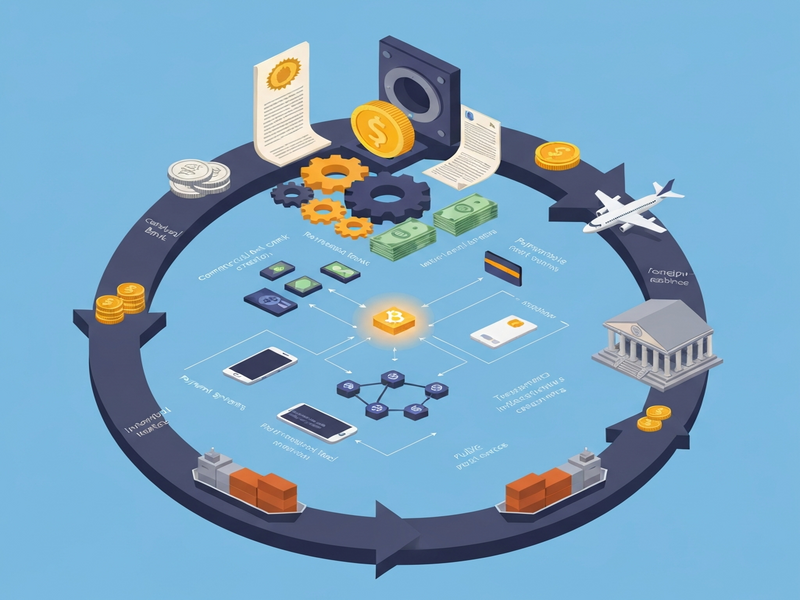
The complete life cycle of money starts with sovereign authority creating base money, moves through commercial‑bank credit creation, circulates via payment systems, is amplified by fiscal deficits, travels abroad through trade, returns as foreign‑reserve holdings, and finally recycles back into Treasury debt, while contraction mechanisms such as loan repayment and quantitative tightening shrink the supply.
1. Money Ontology & Legal Authority
Money is not a physical commodity; it is a legal claim recorded on balance sheets. In modern economies it appears in three distinct layers:
- Base Money (Monetary Base) – the central bank’s liabilities, comprising physical currency and reserve balances held by commercial banks.
- Broad Money (M2, M3) – base money plus deposits created by commercial banks, which are liabilities of those banks.
- Credit Money – promises to deliver future output or assets, such as corporate bonds or personal IOUs.
The legal authority to issue base money in the United States is split between the About UBOS‑style institutions: the Federal Reserve (monetary authority) and the Treasury (fiscal authority). The Fed creates reserves under the Federal Reserve Act, while the Treasury issues debt and collects taxes under congressional statutes. This separation mirrors the UBOS partner program model, where governance and execution are deliberately decoupled to preserve credibility.
2. Creation of Base Money
Base money is generated when the central bank conducts open‑market operations (OMOs). The Fed purchases Treasury securities, crediting the seller’s reserve account and simultaneously expanding its liability side (reserve balances). The balance‑sheet entry looks like this:
| Assets | Liabilities |
|---|---|
| Treasury securities + $1 bn | Reserve balances + $1 bn |
When the Fed pays interest on reserves (IOR), it can tighten or loosen credit conditions. A high IOR encourages banks to hold reserves rather than lend, while a low IOR pushes banks toward loan creation. This mechanism is analogous to the way Enterprise AI platform by UBOS adjusts compute pricing based on demand.
3. Commercial‑Bank Credit Creation
The most powerful engine of broad‑money growth is the loan‑creates‑deposit process. When a bank approves a $100 million mortgage, it simultaneously records a $100 million asset (the loan) and a $100 million liability (the deposit). No pre‑existing reserves are required; reserves are settled only after the loan’s proceeds move between banks.
“Loans create deposits, not the other way around.” – Modern monetary economics
Constraints on lending arise from capital adequacy, liquidity coverage ratios, and credit risk, not from reserve availability. This mirrors the way Workflow automation studio enforces resource limits based on CPU and memory quotas rather than on the mere existence of a VM.
When borrowers repay principal, the mirror image occurs: the loan asset shrinks and the deposit liability disappears, contracting the money supply. Massive repayment cycles, such as those after the 2008 crisis, can outweigh even aggressive QE, leading to a net decline in broad money.
4. Payment & Settlement Infrastructure
Once money exists as a deposit or reserve, it must move through payment systems. These systems do not create money; they merely transfer ownership.
Core Interbank Systems
- Fedwire – real‑time gross settlement for high‑value transfers.
- ACH – batch‑processed, low‑value transactions (payroll, bill pay).
- FedNow – 24/7 instant retail payments launched in 2023.
Private Clearing Networks
- CHIPS – private large‑value clearing for international payments.
- Visa / Mastercard – card networks that authorize and settle via the underlying ACH/Fedwire rails.
Settlement risk (the chance a transaction fails) is distinct from credit risk (the chance a borrower defaults). The Fed guarantees finality on reserve transfers, eliminating settlement risk for interbank payments.
5. Fiscal Deficits & Deposit Injection
When the government spends more than it taxes, it must finance the shortfall by issuing Treasury securities. The sequence is:
- Congress authorizes spending that exceeds tax revenue.
- The Treasury issues debt (bills, notes, bonds).
- Primary dealers and the public purchase the securities using bank deposits.
- Proceeds are deposited in the Treasury General Account (TGA) at the Fed.
- The Treasury instructs the Fed to transfer reserves to the accounts of contractors, employees, and suppliers.
- Receiving banks credit customer deposits, increasing private‑sector wealth.
The net effect is an injection of deposits equal to the deficit amount, while government debt rises by the same figure. This accounting identity—government deficit = private‑sector surplus—holds in a closed economy and is the engine behind the “money‑creation” narrative often mis‑attributed to “printing money.”
For a practical illustration, see the UBOS pricing plans page, where the “Free Tier” demonstrates how a platform can inject value (features) without charging, analogous to a fiscal stimulus that adds purchasing power without immediate tax collection.
6. International Trade & Dollar Outflows
U.S. imports exceed exports, creating a current‑account deficit. Importers pay foreign exporters in dollars, which travel abroad via correspondent‑bank relationships. The dollars do not disappear; they become liabilities of foreign banks or are held as reserves by foreign central banks.
Step‑by‑Step Example
- U.S. importer instructs its bank (Bank A) to pay a Chinese exporter’s bank (Bank B).
- Bank A debits the importer’s deposit and uses its Fedwire reserve account to settle with a correspondent bank in Shanghai.
- The Shanghai correspondent credits Bank B, which then credits the exporter’s account.
- The exporter now holds a dollar deposit abroad, which can be kept, converted to local currency, or invested in U.S. assets.
This process fuels the accumulation of foreign dollar reserves, a cornerstone of the global financial system. The phenomenon is why the United States can run persistent deficits without “running out of money.”
To see how a modern SaaS platform visualizes such flows, explore the UBOS portfolio examples, which showcase data pipelines that mirror cross‑border payment streams.
7. Foreign‑Reserve Accumulation & Treasury Investment
Foreign central banks accumulate dollars to stabilize their own exchange rates, provide a buffer against capital flight, and earn safe‑asset returns. The typical allocation is heavily weighted toward U.S. Treasury securities because they combine:
- Zero default risk – the U.S. can always create dollars to meet obligations.
- Deep liquidity – the Treasury market is the world’s most liquid.
- Predictable returns – modest yields with minimal volatility.
Foreign reserves are held electronically in the Federal Reserve’s System Open Market Account (SOMA). When a central bank wishes to sell Treasuries, it instructs the Fed, which executes the trade and transfers the proceeds. This custodial arrangement is similar to how the Web app editor on UBOS lets users edit code directly in a secure, cloud‑hosted environment.
Because Treasuries are the default safe asset, the United States enjoys a “seigniorage” advantage: the ability to finance deficits at historically low rates while the rest of the world holds its debt as a reserve asset.
8. Contraction Mechanisms
Money exits the system through several channels:
- Loan repayment – destroys the corresponding deposit.
- Loan defaults – write‑downs reduce bank capital and can erase deposits.
- Quantitative tightening (QT) – the Fed lets securities mature without reinvestment, shrinking reserve balances.
- Currency hoarding – conversion of deposits to physical cash, which temporarily reduces the circulating supply.
During the 2007‑2009 financial crisis, massive mortgage repayments and defaults contracted broad money faster than QE could expand reserves, leading to a net deflationary pressure despite a record‑high monetary base.
Modern central banks now use QT as a deliberate policy tool, mirroring how UBOS templates for quick start can be retired once a project graduates to production, thereby freeing resources.
9. Systemic Feedback Loops
The money system is a network of reinforcing and stabilizing loops:
Positive Expansion Loop
- Government deficit → private‑sector deposits rise.
- Higher deposits fuel bank lending → credit expands.
- Economic activity grows → tax revenues increase, temporarily narrowing the deficit.
- Trade surplus of foreign dollar holders → more Treasuries purchased → interest rates fall → credit expands further.
Negative Contraction Loop
- Recession → loan defaults rise.
- Deposits contract as loans are repaid or written down.
- Credit shrinks → economic activity falls → tax revenues drop, widening the deficit.
- Foreign demand for Treasuries wanes → yields rise → borrowing costs increase, reinforcing contraction.
Stabilizers such as automatic fiscal stabilizers, Fed rate cuts, and continued foreign demand for safe assets act as shock absorbers. However, structural fragilities—excessive foreign‑reserve accumulation, fiscal imbalances, or a loss of dollar dominance—can break these loops.
For a concrete illustration of feedback in a tech context, see how AI marketing agents adjust spend based on real‑time performance data, creating a micro‑feedback loop that mirrors macro‑economic dynamics.
10. Conclusion & Outlook
Money is a creature of law, accounting, and policy. Its life cycle—creation by sovereign authority, amplification through bank credit, movement via payment rails, expansion via fiscal deficits, export through trade, recycling as foreign reserves, and re‑investment in Treasury debt—forms a self‑reinforcing loop that sustains the modern economy.
As long as the United States retains the credibility of its institutions, foreign central banks continue to hoard dollars, and the Federal Reserve can supply reserves on demand, the system remains robust. Yet the loop is not immutable: a sudden shift in global reserve preferences, a fiscal crisis that erodes confidence, or a technological disruption to payment infrastructure could trigger a rapid re‑balancing.
Understanding each stage equips policymakers, analysts, and business leaders to anticipate stress points and design mitigations—whether that means tightening capital requirements, diversifying reserve holdings, or leveraging AI‑driven analytics to monitor credit cycles.
Take the Next Step
If you’re a tech‑savvy professional looking to apply these insights to your organization, explore how UBOS can accelerate your AI‑enabled workflows:
- UBOS homepage – discover the full platform.
- UBOS platform overview – see how the architecture mirrors the money‑system layers.
- UBOS for startups – fast‑track your MVP with built‑in credit‑like resource allocation.
- UBOS solutions for SMBs – scale your finance operations with automated settlement.
- Enterprise AI platform by UBOS – manage large‑scale data flows akin to central‑bank reserves.
- UBOS partner program – collaborate on integrations such as Telegram integration on UBOS or OpenAI ChatGPT integration.
- UBOS templates for quick start – jump‑start projects like the AI SEO Analyzer or AI Article Copywriter.
For a deeper dive into the monetary mechanics discussed here, read the original research article: Complete Life Cycle of Money.
Andrii Bidochko
CTO UBOS
Andrii Bidochko is an AI entrepreneur and researcher focused on AI agents, reinforcement learning, and autonomous systems. He writes about the technologies shaping the future of machine intelligence, from frontier models and agent architectures to real-world AI applications.