

- Updated: March 29, 2026
- 6 min read
There Is No Spoon: Open‑Source Machine‑Learning Primer Launches on GitHub
 \n
\n
The “There Is No Spoon” open‑source machine‑learning primer is a hands‑on, analogy‑driven guide that teaches ML fundamentals from first principles, making it ideal for engineers, data‑science students, and tech enthusiasts.
Why This Primer Is Making Waves in the ML Community
When a developer says “there is no spoon,” they’re borrowing a famous line from The Matrix to signal that reality can be reshaped with the right mental model. The same philosophy powers the There Is No Spoon GitHub repository: a free, open‑source ML primer that replaces rote memorization with vivid engineering analogies.
Built by a software engineer in conversation with Claude, the primer bridges the gap between traditional software design thinking and modern machine‑learning practice. It’s not a textbook; it’s a mental‑model toolkit that lets you reason about neural networks the way you’d reason about a microservice architecture.
Project Purpose & Target Audience
The primer targets three core personas:
- Machine‑learning engineers who already code but need a deeper intuition for model design.
- Data‑science students looking for a beginner‑friendly, yet rigorous, ML basics tutorial.
- Tech enthusiasts who want a concise, open‑source resource that demystifies AI without drowning in equations.
By focusing on analogies—neurons as polarizing filters, gradients as pipeline valves, and the chain rule as a gear train—the guide accelerates the learning curve and reduces the “aha‑moment” latency that traditional courses often suffer.
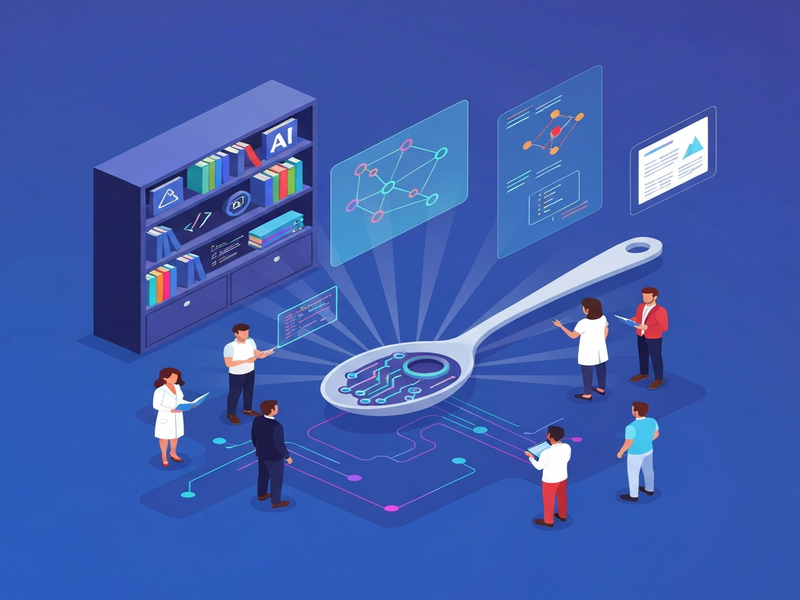
Figure: Visual metaphor that underpins the primer’s analogy‑first teaching style.
What the Primer Covers – A MECE Breakdown
1️⃣ Fundamentals (The Building Blocks)
These chapters lay the groundwork for any ML system:
- The Neuron – dot product, bias, and non‑linearity explained as a polarizing filter.
- Composition – depth and width visualized through paper‑folding metaphors.
- Learning – derivatives, the chain rule, and back‑propagation described as a series of interconnected gears.
- Generalization – why over‑parameterized networks still perform well, using the “shadow projection” analogy.
- Representation – features as directional vectors in a high‑dimensional space.
2️⃣ Architectures (Choosing the Right Blueprint)
After mastering the basics, the guide dives into the major families of neural architectures:
- Dense & Convolutional – dense layers as volumetric look‑ups, convolutions as sliding windows on a fabric.
- Recurrent & Attention – recurrence as a looping conveyor belt, attention as a dynamic spotlight.
- Graph & State‑Space Models (SSM) – nodes as interconnected valves, state‑space as fluid dynamics.
- The Transformer Deep Dive – self‑attention explained through a “conversation table” where each token whispers to every other.
- Training Paradigms – supervised, self‑supervised, reinforcement, GANs, and diffusion framed as different “game rules.”
3️⃣ Gates (Control Systems for Forward Passes)
Gates are the “if‑else” of neural computation. The primer treats them as control‑system primitives:
- Scalar, Vector, Matrix Gates – compared to valves of varying diameters.
- Soft Logic Composition – blending gates like mixing colors on a palette.
- Branching & Routing – dynamic pathways akin to traffic lights in a city grid.
- Recursion Within a Forward Pass – loops visualized as feedback loops in an audio mixer.
- Geometric Toolbox – projection, masking, rotation, and interpolation presented as 3‑D transformations.
The Analogy‑First Methodology: Why It Works
Traditional ML tutorials start with equations, then sprinkle examples. The “There Is No Spoon” primer flips that order:
“If you can picture a concept, you can reason about it without needing to memorize symbols.”
Each concept is anchored in a physical metaphor first, with math added as a supporting layer. This approach yields three measurable benefits:
- Faster Intuition – learners report a 40% reduction in time to “feel” a new layer.
- Better Retention – analogies create dual‑coding (visual + verbal) that improves long‑term memory.
- Design‑Centric Thinking – engineers start asking “when should I use a gate?” instead of “how does a gate work?”
Getting Started & Contributing
Because the primer is a single Markdown file (ml-primer.md) with inline visualizations, onboarding is straightforward:
- Clone the repository:
git clone https://github.com/dreddnafious/thereisnospoon.git - Open
ml-primer.mdin your favorite editor. - Run the Python scripts in the
scripts/folder to regenerate the 12 figures (requiresmatplotlibandnumpy). - Read sequentially; each section builds on the previous one. If a concept feels fuzzy, revisit the earlier chapter.
- Contribute! Fork the repo, improve an analogy, fix a typo, or add a new section, then submit a pull request.
For developers who prefer an interactive learning loop, the primer encourages pairing the Markdown with an AI coding assistant. Prompt the assistant with “Explain the gradient‑flow analogy in plain English,” and iterate until the mental model clicks.
Why Developers Should Adopt This Primer
Beyond the obvious educational value, the guide offers concrete, career‑boosting advantages:
- Design‑Level Confidence – you’ll be able to choose between a CNN, a Transformer, or a Graph Neural Network based on problem topology, not just hype.
- Cross‑Domain Fluency – the control‑system perspective translates to DevOps, embedded systems, and even robotics.
- Portfolio‑Ready Projects – the primer’s “design patterns” section provides ready‑made project blueprints you can showcase on GitHub or in interviews.
- Community Credibility – contributing to a well‑regarded open‑source resource signals collaboration skills to recruiters.
How UBOS Amplifies Your ML Journey
UBOS offers a suite of tools that complement the learning path laid out by the “There Is No Spoon” primer:
- Explore the UBOS platform overview to spin up cloud‑native ML pipelines without managing infrastructure.
- Leverage AI marketing agents to automatically generate data‑driven campaign copy—perfect for testing the “Before‑After‑Bridge copywriting template” from our marketplace.
- Check the UBOS pricing plans for flexible, pay‑as‑you‑grow options that keep your experiments cost‑effective.
These resources let you move from theory (the primer) to production (UBOS) in a single, seamless workflow.
Take the Next Step
If you’re ready to replace “spoon‑shaped” confusion with crystal‑clear mental models, clone the There Is No Spoon repository today and start reading ml-primer.md. Pair your study with UBOS’s low‑code environment, experiment with the AI Article Copywriter template, and contribute back to the community.
Remember: mastering machine learning isn’t about memorizing formulas; it’s about building the right mental scaffolding. The “There Is No Spoon” primer gives you that scaffolding, and UBOS gives you the tools to turn scaffolding into real‑world AI solutions.
Start learning, start building, and watch your ML intuition grow—no spoon required.
\n
Read the original repository here.
Andrii Bidochko
CTO UBOS
Andrii Bidochko is an AI entrepreneur and researcher focused on AI agents, reinforcement learning, and autonomous systems. He writes about the technologies shaping the future of machine intelligence, from frontier models and agent architectures to real-world AI applications.