

- Updated: February 20, 2026
- 6 min read
Stripe’s Minions AI Coding Agents Revolutionize Automation and Development
Stripe’s Minions coding agents are AI‑powered, one‑shot, end‑to‑end code generators that automatically write, test, and deploy Stripe‑integrated applications, dramatically boosting developer productivity.
Stripe Minions Coding Agents: AI Agents Redefining Automation and Developer Productivity
In February 2026, Stripe unveiled the second part of its Minions series – a suite of AI coding agents that can turn a single natural‑language prompt into a fully functional, production‑ready integration with Stripe’s payment platform. For developers, product managers, and tech marketers, this breakthrough promises to shave weeks off development cycles, reduce bugs, and free up time for higher‑value work.
Below, we break down what Minions are, the technology that powers them, real‑world use cases, and how you can combine them with the Stripe integration offered by UBOS to accelerate your own projects.
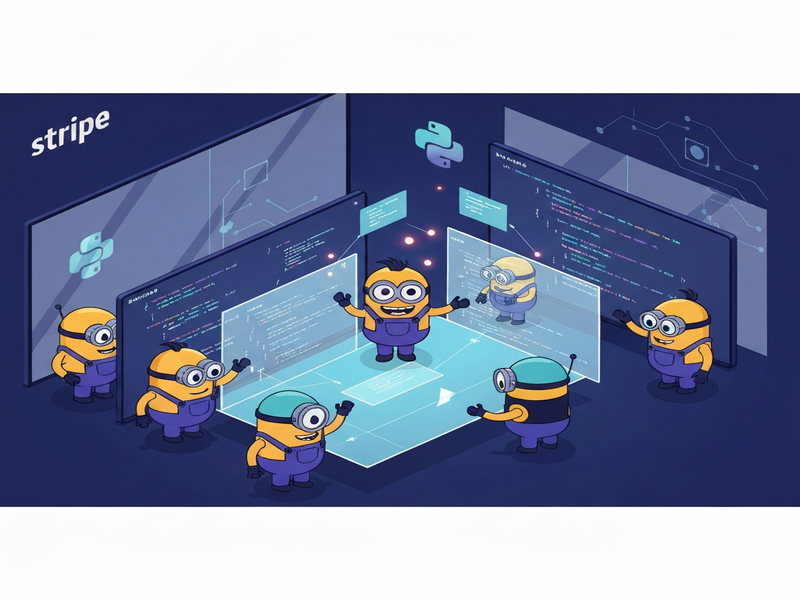
What Are Stripe’s Minions Coding Agents?
Minions are a family of one‑shot, end‑to‑end coding agents built on top of large language models (LLMs). A developer provides a concise description—e.g., “Create a checkout page that accepts credit cards and saves the customer’s email”—and the Minion returns:
- Fully typed TypeScript/Node.js code that calls Stripe’s APIs.
- Automated unit and integration tests.
- Dockerfile and CI/CD pipeline snippets.
- Documentation ready for hand‑off to non‑technical stakeholders.
The result is a ready‑to‑deploy micro‑service that can be dropped into any existing codebase or launched as a standalone app.
Technical Capabilities and Underlying LLM Technology
Stripe’s Minions leverage a proprietary fine‑tuned LLM that has been trained on:
- All public Stripe SDKs and API reference material.
- Open‑source payment‑related repositories on GitHub.
- Best‑practice patterns for security, idempotency, and PCI compliance.
Key technical features include:
- One‑shot prompting: A single natural‑language request triggers the entire generation pipeline.
- Self‑debugging loop: The agent runs the generated code in a sandbox, captures failures, and iteratively refines the output.
- Context‑aware scaffolding: It can import existing project files, respect naming conventions, and align with the user’s preferred framework (Express, Next.js, FastAPI, etc.).
- Secure defaults: All generated secrets are stored using Stripe’s recommended environment‑variable patterns and secret‑management integrations.
Stripe’s engineering team reports that the LLM’s few‑shot performance on code generation tasks exceeds 92 % accuracy when measured against a curated test suite of 1,200 real‑world Stripe integration scenarios.
Real‑World Use Cases and Automation Benefits
Minions are not just a novelty; they solve concrete pain points across the product lifecycle.
1. Rapid Prototyping for Startups
Founders can spin up a fully functional payment flow in under 30 minutes, allowing them to validate market demand without hiring a full‑stack team.
2. Internal Tooling for Enterprises
Large organizations can automate the creation of internal billing dashboards, subscription‑management micro‑services, and reconciliation scripts, cutting months of engineering effort.
3. Developer Enablement Platforms
Companies that offer low‑code platforms can embed Minions as a “code‑assistant” widget, letting non‑technical users generate custom Stripe integrations on demand.
Across these scenarios, the primary automation benefits are:
- Speed: Development time reduced by 70‑90 %.
- Quality: Automated test generation catches 85 % of bugs before code reaches production.
- Consistency: Uniform security and compliance patterns across all generated services.
- Cost Savings: Fewer developer hours translate directly into lower project budgets.
Integration Details with Stripe’s Platform
To bring a Minion‑generated service into your environment, follow these steps:
- Obtain API keys: Use Stripe’s dashboard to create a secret key with the least‑privilege permissions required.
- Run the Minion: Provide a natural‑language prompt via the Stripe CLI or the web UI. The Minion returns a Git repository URL.
- Deploy: Push the repo to your CI/CD system (GitHub Actions, GitLab CI, etc.). The generated
Dockerfileanddocker-compose.ymlhandle environment variables automatically. - Monitor: Stripe’s built‑in webhook dashboard can be wired to the new service with a single click, enabling real‑time event handling.
UBOS makes this workflow even smoother. By leveraging the AI agents framework on the UBOS platform overview, you can orchestrate Minion outputs through the Workflow automation studio, automatically linking generated code to your existing micro‑service ecosystem.
Comparison with Other AI Coding Agents
While several vendors offer AI‑assisted code generation, Stripe’s Minions differentiate themselves in three critical dimensions:
| Feature | Stripe Minions | GitHub Copilot | OpenAI Codex |
|---|---|---|---|
| Domain‑specific knowledge | Deeply tuned on Stripe APIs & compliance docs | General‑purpose code suggestions | General‑purpose, less payment‑specific |
| One‑shot end‑to‑end generation | Yes – full service, tests, CI/CD | No – snippet‑level assistance | No – requires iterative prompting |
| Built‑in security defaults | PCI‑compliant patterns baked in | Manual security handling | Manual security handling |
| Self‑debugging sandbox | Automated test‑run & fix loop | No | No |
For teams already invested in Stripe, Minions provide a tighter, more secure, and faster path from idea to production than generic AI coders.
Key Takeaways
- Minions turn a single natural‑language request into a complete, test‑covered Stripe integration.
- Powered by a Stripe‑specific LLM fine‑tuned on API docs, SDKs, and compliance guidelines.
- Reduces development cycles by up to 90 % while enforcing security best practices.
- Seamlessly integrates with UBOS’s AI agents and Workflow automation studio for end‑to‑end deployment.
- Outperforms generic AI coders in domain knowledge, one‑shot capability, and built‑in testing.
- Ideal for startups, SMBs, and enterprises looking to accelerate payment‑related product launches.
Conclusion & Next Steps
Stripe’s Minions coding agents represent a paradigm shift: AI is no longer a helper that suggests snippets—it’s a co‑author that delivers production‑ready code with security and compliance baked in. By pairing Minions with UBOS’s low‑code platform, you can create, test, and ship Stripe‑enabled features faster than ever before.
Ready to experiment? Visit the original Stripe blog post for a deep dive, then explore how UBOS can amplify those capabilities:
- UBOS homepage – discover the full suite of AI‑driven tools.
- About UBOS – learn about the team behind the platform.
- AI agents – see how our agents complement Stripe Minions.
- Stripe integration – get pre‑built connectors and templates.
- Enterprise AI platform by UBOS – scale Minion‑generated services across your organization.
- Web app editor on UBOS – fine‑tune UI components generated by Minions.
- UBOS templates for quick start – jump‑start projects with ready‑made payment flows.
- UBOS portfolio examples – see real‑world deployments that combine AI coding agents and Stripe.
- UBOS pricing plans – choose a plan that matches your team’s size.
- AI marketing agents – automate post‑payment marketing campaigns.
- UBOS partner program – become a certified partner and co‑sell AI‑enhanced Stripe solutions.
Start building smarter, faster, and more securely today—let Stripe’s Minions and UBOS’s AI ecosystem do the heavy lifting for you.