

- Updated: March 31, 2026
- 6 min read
Starlink Satellite Explosion Highlights Space Safety Concerns
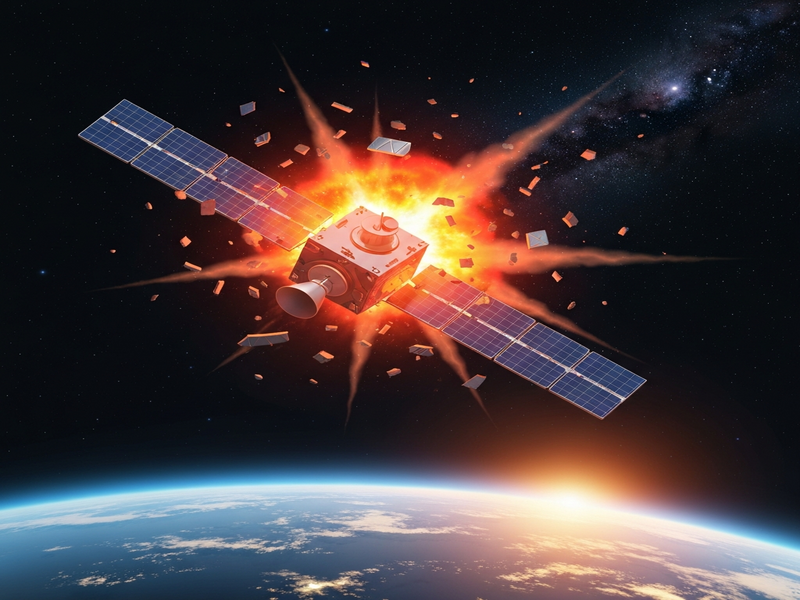
A Starlink satellite (ID 34343) suffered an unexplained explosion on 30 March 2026 at roughly 560 km altitude, prompting SpaceX to confirm the loss, assess debris, and reassure that the incident poses no immediate risk to the International Space Station or upcoming missions.
What happened? A concise overview
On the evening of 30 March 2026, SpaceX reported an “anomaly” with one of its Starlink satellites, later identified as Starlink‑34343. The satellite abruptly ceased telemetry, and tracking stations detected a cloud of fragments spreading over a few hundred kilometers. Within minutes, the commercial tracking firm Leo Labs confirmed the presence of multiple debris objects, all of which are expected to re‑enter Earth’s atmosphere and burn up within the next few weeks.
Explosion details: date, orbit, and tracking data
Key technical specifics of the event are summarized below:
- Date & Time: 30 March 2026, 19:42 UTC.
- Orbital altitude: Approximately 560 km, within the low‑Earth orbit (LEO) band heavily populated by Starlink constellations.
- Inclination: 53.2°, matching the standard Starlink deployment plane.
- Fragment count: Leo Labs recorded 12 distinct debris objects ranging from 5 cm to 30 cm in size.
- Decay timeline: All fragments are projected to de‑orbit by early May 2026, based on atmospheric drag models.
The satellite’s sudden loss of contact and the rapid appearance of debris suggest a high‑energy event, possibly a battery rupture, propulsion malfunction, or a collision with a micrometeoroid. SpaceX has not disclosed the exact cause, stating that a detailed investigation is underway.
SpaceX’s official response and public statements
SpaceX posted a concise update on its X (formerly Twitter) account shortly after the anomaly was detected:
“Latest analysis shows the event poses no new risk to the @Space_Station, its crew, or to the upcoming launch of NASA’s Artemis II mission. The satellite and fragments are expected to burn up in the atmosphere within a few weeks. We are working to determine the root cause.” – SpaceX
In a follow‑up press release, SpaceX’s President and COO Gwynne Shotwell emphasized the company’s commitment to safety and transparency:
“We take any anomaly seriously. Our teams are collaborating with regulatory agencies and independent tracking networks to understand what happened and to mitigate any future risk.” – Gwynne Shotwell
SpaceX also reassured investors and partners that the incident does not affect the broader Starlink rollout schedule, which continues to expand with a target of up to one million satellites in the coming decade.
Historical context: prior Starlink anomalies
While the March 2026 explosion is the latest high‑profile event, it is not the first time a Starlink satellite has behaved unexpectedly:
- December 2025: A Starlink unit (ID 33211) lost telemetry and was later confirmed to have fragmented, similar to the March incident.
- July 2025: A near‑miss with a Chinese BeiDou satellite prompted SpaceX to execute an emergency maneuver, highlighting the growing congestion in LEO.
- January 2025: SpaceX filed an FCC request for “up to one million AI‑enabled satellites,” sparking debate about the long‑term sustainability of mega‑constellations.
These events collectively underscore the challenges of operating at scale in an increasingly crowded orbital environment.
Implications for space safety and satellite constellations
The March 2026 explosion raises several critical considerations for the aerospace community, regulators, and commercial operators:
Orbital debris mitigation
Even small fragments can threaten operational spacecraft. The incident reinforces the need for robust end‑of‑life de‑orbit mechanisms and real‑time debris tracking.
Regulatory scrutiny
National and international bodies, such as the FCC and the United Nations Office for Outer Space Affairs (UNOOSA), may tighten licensing requirements for mega‑constellations.
Design resilience
Manufacturers are likely to revisit battery safety, propulsion redundancy, and shielding against micrometeoroids to reduce failure rates.
Data‑driven monitoring
AI‑powered analytics platforms, such as those offered by Enterprise AI platform by UBOS, can ingest telemetry and tracking data to predict anomalies before they become catastrophic.
Expert perspective
Dr. Elena Martínez, senior analyst at the Space Safety Institute, provided her assessment in a recent interview:
“The fragmentation of Starlink‑34343 is a reminder that even mature constellations are vulnerable to single‑point failures. Continuous monitoring, rapid data sharing, and international cooperation will be essential to keep LEO sustainable.” – Dr. Elena Martínez
How UBOS technologies help monitor and mitigate satellite anomalies
UBOS offers a suite of AI‑driven tools that can enhance space‑asset management and debris analysis:
- UBOS platform overview – a unified environment for ingesting telemetry, visualizing orbital paths, and running predictive models.
- Chroma DB integration – enables fast similarity search across massive datasets of satellite health metrics.
- AI marketing agents – while focused on commercial outreach, the underlying language models can be repurposed for automated incident reporting.
- Workflow automation studio – lets engineers build custom alerts that trigger when telemetry deviates from baseline patterns.
- UBOS templates for quick start – includes pre‑built dashboards for space‑debris monitoring.
For startups and SMBs looking to enter the space‑analytics market, the UBOS for startups program provides discounted access to compute resources and mentorship.
Read the original coverage
For a full account of the incident, see the original Verge article, which includes live tracking maps and additional commentary from SpaceX engineers.
Further reading and tools on UBOS
Explore these related resources to deepen your understanding of satellite safety and AI‑enhanced monitoring:
- Starlink overview on UBOS – a technical breakdown of the constellation architecture.
- SpaceX news hub – curated updates on launches, anomalies, and regulatory filings.
- Satellite technology insights – articles on propulsion, power systems, and debris mitigation.
- AI SEO Analyzer – optimize your own space‑industry content for search engines.
- AI Video Generator – create visual explanations of orbital mechanics.
Conclusion
The March 2026 Starlink explosion is a stark reminder that even the most advanced satellite constellations are not immune to sudden failures. While SpaceX’s rapid response and transparent communication have helped contain immediate risks, the event amplifies the urgency for industry‑wide standards on debris mitigation, AI‑driven anomaly detection, and international coordination. Companies like UBOS are already equipping operators with the data‑centric tools needed to anticipate and address such incidents, paving the way for a safer, more sustainable low‑Earth orbit.
Suggested meta description: A Starlink satellite exploded on 30 March 2026, prompting SpaceX to confirm debris tracking and reassure no risk to the ISS. Learn the cause, impact on space safety, expert insights, and how UBOS AI tools help monitor satellite health.
Andrii Bidochko
CTO UBOS
Andrii Bidochko is an AI entrepreneur and researcher focused on AI agents, reinforcement learning, and autonomous systems. He writes about the technologies shaping the future of machine intelligence, from frontier models and agent architectures to real-world AI applications.