

- Updated: March 29, 2026
- 6 min read
South Korea Mandates Solar Panels on Public Parking Lots – ubos.tech News
South Korea Mandates Solar Panels on All Public Parking Lots – A Leap Toward Clean Energy
Meta Description: South Korea’s new public‑parking solar mandate accelerates renewable energy goals, reshapes infrastructure, and sets a global benchmark for clean energy policy.
Keywords: South Korea solar panels, public parking solar mandate, renewable energy policy, clean energy South Korea, solar power infrastructure
South Korea has officially required that every new public parking lot install solar panels, a policy designed to boost the nation’s renewable‑energy capacity and accelerate its clean‑energy transition.
Why This News Matters
In a bold move that blends urban planning with climate ambition, the South Korean government announced a nationwide mandate that all newly constructed public parking facilities must be equipped with photovoltaic (PV) systems. The decision arrives at a critical juncture: the country is racing to meet its 2030 carbon‑neutral targets while grappling with limited land for large‑scale solar farms. By turning parking lots—often underutilized concrete expanses—into power‑generating assets, Seoul aims to unlock gigawatts of clean electricity without sacrificing valuable real estate.
For environmentally‑conscious professionals and tech‑savvy readers, this policy signals a shift toward integrated, data‑driven infrastructure. It also opens doors for AI‑enabled energy management platforms—like those offered by UBOS platform overview—to optimize solar output, predict maintenance, and align generation with grid demand.
Mandate Details: What, Why, and When
What the Regulation Requires
- All public parking structures built after January 1, 2025 must allocate at least 60% of their roof area to solar PV modules.
- Existing parking lots are encouraged to retrofit, with a government‑backed subsidy covering up to 30% of installation costs.
- Solar installations must integrate smart‑metering and real‑time monitoring to feed data into the national grid management system.
Why the Government Is Acting
The Ministry of Trade, Industry and Energy (MOTIE) cites three core motivations:
- Land Efficiency: Urban density leaves little room for sprawling solar farms.
- Grid Stability: Distributed generation reduces transmission losses and eases peak‑load pressures.
- Economic Incentives: Solar‑powered parking lots can generate revenue through feed‑in tariffs and offer lower electricity rates for adjacent businesses.
Implementation Timeline
| Phase | Key Milestones | Deadline |
|---|---|---|
| Policy Publication | Official decree released, guidelines drafted | June 2024 |
| Subsidy Program Launch | Funding mechanisms activated for retrofits | September 2024 |
| Construction Commences | First solar‑enabled parking structures break ground | January 2025 |
| Full Compliance | All new public parking lots meet the 60% roof‑coverage rule | December 2027 |
Projected Impact on South Korea’s Renewable Energy Targets
According to MOTIE’s internal forecasts, the parking‑lot solar mandate could add up to 3.2 GW of clean capacity by 2030—equivalent to powering roughly 1.5 million households. This contribution would represent:
- 12% of the nation’s 2030 renewable‑energy goal of 30 GW.
- A reduction of 5.8 million tons of CO₂ emissions annually.
- Enhanced resilience for the national grid, especially during summer peak demand.
Moreover, the distributed nature of these installations aligns with South Korea’s “Smart Grid 2030” roadmap, which emphasizes real‑time data exchange and AI‑driven load balancing. Platforms like AI marketing agents can be repurposed to analyze solar generation patterns, predict maintenance windows, and even suggest dynamic pricing for electricity sold back to the grid.
Official Perspective
“Integrating solar power into everyday infrastructure is not just an environmental imperative; it is an economic opportunity for our cities,” said Minister Lee Jae‑ho of MOTIE during the policy unveiling. “By turning parking roofs into power plants, we can meet our clean‑energy commitments while fostering local jobs in the renewable‑tech sector.”
The minister’s remarks underscore a broader strategy: leveraging public assets to accelerate the transition without imposing excessive costs on taxpayers. The government’s subsidy scheme, combined with private‑sector participation, is expected to catalyze a wave of innovation in solar‑panel mounting systems, energy‑storage solutions, and AI‑based monitoring tools.
How South Korea Stacks Up Against Global Trends
While several nations have experimented with solar‑covered parking, South Korea’s mandate is among the most comprehensive. A quick glance at comparable policies reveals:
| Country | Policy Scope | Target Year |
|---|---|---|
| Germany | Incentive‑based retrofits for public parking | 2025 |
| United States (California) | Voluntary solar parking programs, tax credits | 2026 |
| Australia | Mandatory for new government facilities | 2027 |
| South Korea | Mandatory 60% roof coverage for all new public parking | 2025‑2027 rollout |
The Korean approach stands out for its uniformity and clear compliance timeline, positioning the nation as a potential model for other densely populated economies seeking to maximize rooftop real estate.
Beyond Energy: Added Value for Parking Facilities
Embedding solar panels into parking structures yields a suite of ancillary benefits:
- Shade and Comfort: Solar canopies reduce surface temperatures, improving driver comfort and extending vehicle lifespan.
- Security Enhancements: Integrated LED lighting powered by solar reduces electricity costs and improves night‑time safety.
- Revenue Streams: Operators can sell excess electricity to the grid or offer discounted charging for electric vehicles (EVs).
- Data Integration: Smart sensors can monitor occupancy, enabling dynamic pricing and better space utilization.
Companies looking to capitalize on these advantages can turn to the Workflow automation studio to orchestrate sensor data, billing, and maintenance alerts—all within a single low‑code environment.
What This Means for Innovators and Investors
The solar‑parking mandate creates a fertile ground for startups, AI developers, and infrastructure investors. If you’re building a SaaS solution that monitors PV performance, integrates with municipal dashboards, or offers predictive maintenance, now is the time to prototype on the UBOS for startups platform. Its modular architecture lets you spin up a pilot in weeks, connect to the national grid API, and scale across dozens of municipalities.
Ready to explore how AI can supercharge solar‑powered parking? Dive into our UBOS templates for quick start, which include pre‑built data pipelines for solar‑generation analytics and EV‑charging management.
Read the Full Report
For a comprehensive account of the policy announcement, see the original Reuters coverage:
South Korea mandates solar panels on public parking lots – Reuters.
Visualizing the Future
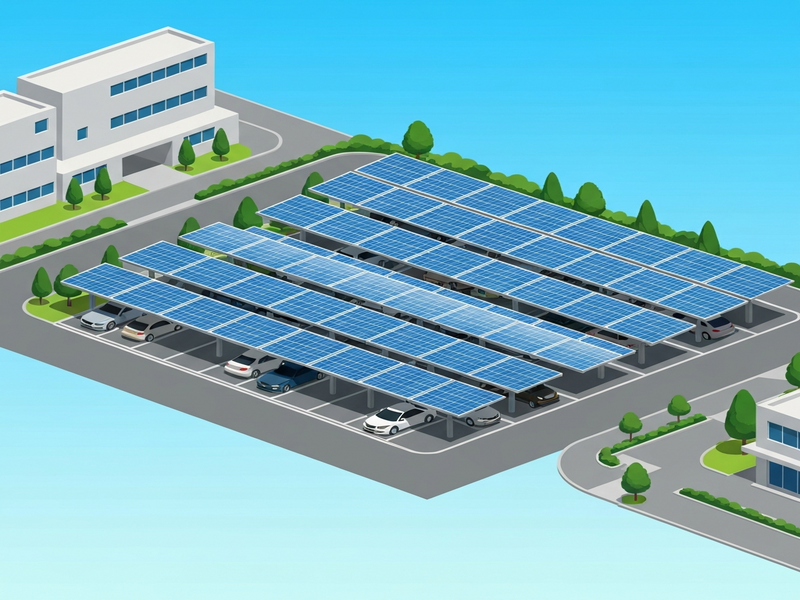
An artist’s rendering of a South Korean public parking lot transformed into a solar power hub.
Bottom Line
South Korea’s public‑parking solar mandate is a decisive step toward meeting its clean‑energy ambitions while delivering tangible benefits to urban infrastructure. By converting idle roof space into productive PV arrays, the nation not only accelerates its renewable‑energy targets but also creates new revenue channels, improves driver comfort, and paves the way for AI‑driven grid optimization. Stakeholders—from municipal planners to AI SaaS innovators—have a clear signal: the future of sustainable mobility is already being built, one solar‑covered parking spot at a time.
Andrii Bidochko
CTO UBOS
Andrii Bidochko is an AI entrepreneur and researcher focused on AI agents, reinforcement learning, and autonomous systems. He writes about the technologies shaping the future of machine intelligence, from frontier models and agent architectures to real-world AI applications.