

- Updated: March 18, 2026
- 6 min read
Solar Flare Surge on March 18 2026 Boosts Aurora Forecast – Space Weather Update
On 18 March 2026 SpaceWeather.com reported a moderate solar‑wind stream, an M2‑class X‑ray flare, and a “beta‑gamma” sunspot (AR 4392) that together raised the short‑term probability of a G2‑level geomagnetic storm and a visible aurora at mid‑latitudes.
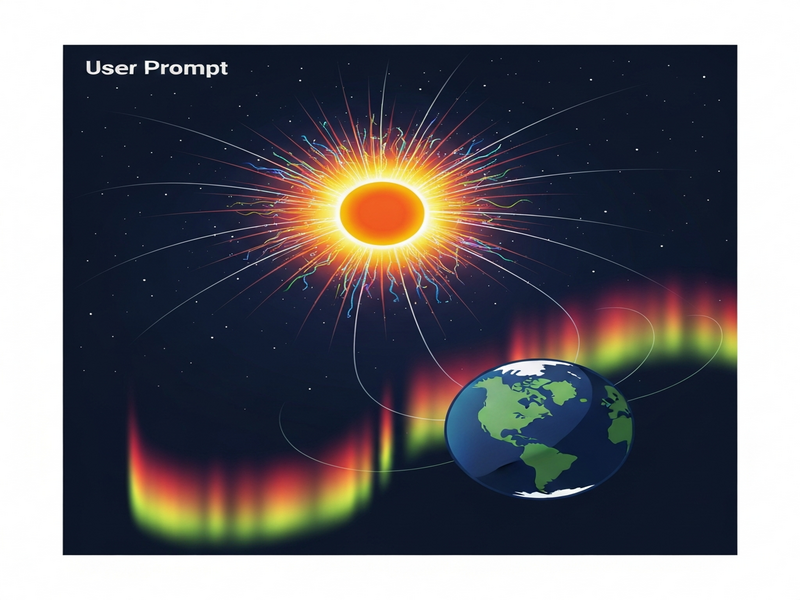
Solar Wind Speed & Density
The ACE and DSCOVR spacecraft measured a solar‑wind speed of 404.7 km s⁻¹ with a proton density of 1.94 cm⁻³. This is a modest increase over the previous 48‑hour average (≈ 380 km s⁻¹) and signals the arrival of a high‑speed stream emanating from a newly identified coronal hole (see the “Coronal Hole Activity” section).
- Speed: 404.7 km s⁻¹ (peak)
- Density: 1.94 protons cm⁻³
- Source: ACE & DSCOVR real‑time data
X‑ray Flare Classification
The GOES‑16 satellite recorded a six‑hour maximum X‑ray flux of M2 at 08:42 UT. This is the strongest flare of the current solar‑cycle 25 peak so far and matches the forecast of a 35 % chance of an M‑class flare within the next 24 hours.
| Time (UT) | Class | Peak Flux (W m⁻²) |
|---|---|---|
| 08:42 | M2 | 2.0 × 10⁻⁵ |
Sunspot AR 4392 – “Beta‑Gamma” Magnetic Complexity
NOAA’s Solar Region Summary highlighted AR 4392 as a “beta‑gamma” configuration, meaning its magnetic field lines are interwoven enough to produce powerful eruptions. The spot’s sunspot number stood at 72, well above the monthly average of 45, and it is the primary source of the M2 flare.
Researchers at the Solar Dynamics Observatory (SDO) noted that the region’s magnetic shear is increasing, a classic precursor to M‑class flares. Continuous monitoring is advised for satellite operators and HF‑radio users.
Aurora Forecast & Planetary K‑index
NOAA’s Space Weather Prediction Center (SWPC) projected a Kp = 1.67 for the next 24 hours, classifying the geomagnetic conditions as “quiet.” However, the forecast model predicts a possible rise to Kp ≈ 3 on 19 March, coinciding with the expected arrival of the high‑speed stream from the coronal hole.
“If the CME impact aligns with the Russell‑McPherron effect, a G2‑class storm could illuminate mid‑latitude skies on the night of 19 March.”
- Current Kp: 1.67 (quiet)
- 24‑hr max forecast: 1.67 (quiet)
- Potential rise: Kp ≈ 3 (active) on 19 Mar
Interplanetary Magnetic Field (IMF) Data
The IMF measured by ACE showed a total field strength of 4.33 nT** with a northward Bz component of **+2.89 nT**. A northward Bz typically suppresses geomagnetic activity, but the upcoming high‑speed stream may rotate the field southward, increasing storm potential.
Continuous monitoring of Bz orientation is crucial for power‑grid operators, as a sustained southward Bz > ‑5 nT for more than three hours can trigger severe geomagnetic disturbances.
Coronal Hole Activity & Expected Earth Impact
SDO imagery identified a new low‑latitude coronal hole on 18 Mar 2026. The associated high‑speed solar wind is forecast to reach Earth on **22‑23 March**, potentially raising the solar‑wind speed to > 500 km s⁻¹.
This delayed impact could extend the period of elevated geomagnetic activity into the following week, a factor to consider for satellite drag calculations and radio‑communication planning.
Milestone: Over 10 000 Starlink Satellites in Orbit
On 16 Mar 2026 a Falcon 9 launch from Vandenberg injected 25 new Starlink satellites, pushing the total active constellation past **10 000**. This marks a historic threshold for low‑Earth‑orbit (LEO) traffic density.
“The sheer number of satellites now rivals the total of all pre‑2019 LEO objects combined, reshaping the orbital environment for both astronomy and space‑weather monitoring.” – Dr. Sarah Thiele, Princeton University
The increased satellite population adds a new variable to space‑weather forecasting: reflected radio emissions from the megaconstellation can interfere with ground‑based magnetometer networks, potentially biasing IMF measurements.
Other Key Metrics from the March 18 Report
- Thermosphere Climate Index: 20.53 × 10¹⁰ W (moderately warm)
- 10.7 cm Radio Flux: 111 sfu (quiet solar radio background)
- Cosmic‑Ray Neutron Count (Oulu): –6 % relative to the Space‑Age average, indicating a slight suppression due to the solar‑cycle peak.
- Spotless Days: 0 (continuous sunspot activity)
- Geomagnetic Storm Probabilities (24‑48 hr): Active 20 %, Minor 5 %, Severe 1 % for mid‑latitudes.
Implications for AI‑Powered Platforms and Enterprises
Real‑time space‑weather data feeds are increasingly integrated into AI decision‑making pipelines. For example, Enterprise AI platform by UBOS can ingest solar‑wind and IMF metrics to adjust predictive maintenance schedules for satellite‑ground‑station networks.
Moreover, AI marketing agents can leverage aurora forecasts to schedule geo‑targeted campaigns for outdoor events, boosting engagement when the night sky is expected to glow.
Developers building custom dashboards can use the Web app editor on UBOS to visualize K‑index trends, while the Workflow automation studio enables automated alerts when Bz turns southward.
Stay Ahead with UBOS Space‑Weather Tools
UBOS offers a suite of ready‑made templates that accelerate the creation of space‑weather monitoring apps:
- AI SEO Analyzer – adapt your content strategy to solar‑activity‑driven traffic spikes.
- AI YouTube Comment Analysis tool – gauge audience sentiment during aurora‑watch livestreams.
- AI Article Copywriter – generate timely space‑weather briefs for newsletters.
Explore the UBOS templates for quick start and launch your own real‑time space‑weather portal in minutes.
Pricing & How to Get Started
Whether you are a startup, an SMB, or an enterprise, UBOS provides flexible plans. Review the UBOS pricing plans to find a tier that matches your data‑ingestion needs.
New users can sign up via the UBOS homepage and immediately access the UBOS platform overview for a walkthrough of API connectors, including the OpenAI ChatGPT integration for natural‑language querying of space‑weather datasets.
Join the UBOS Community
Developers and researchers can deepen collaboration through the UBOS partner program. Partner resources include co‑branding opportunities for space‑weather dashboards and joint webinars with the About UBOS team.
For the full technical details, see the original SpaceWeather.com report.
Conclusion
The March 18 2026 space‑weather snapshot underscores a dynamic solar environment: a moderate‑speed wind, an M2 flare, and a magnetically complex sunspot combine to raise short‑term geomagnetic storm odds. The emerging coronal hole promises a secondary high‑speed stream later in the month, while the historic Starlink milestone adds a new layer of complexity to space‑weather monitoring.
By integrating these data streams into AI‑driven workflows—whether through UBOS’s Enterprise AI platform, the Workflow automation studio, or custom web apps built with the Web app editor—organizations can turn volatile solar conditions into actionable intelligence.
Stay ahead of the next solar event: Explore UBOS today and empower your team with real‑time space‑weather insights.
Andrii Bidochko
CTO UBOS
Andrii Bidochko is an AI entrepreneur and researcher focused on AI agents, reinforcement learning, and autonomous systems. He writes about the technologies shaping the future of machine intelligence, from frontier models and agent architectures to real-world AI applications.