

- Updated: February 18, 2026
- 6 min read
Sarvam AI Expands Edge AI to Feature Phones, Cars, and Smart Glasses
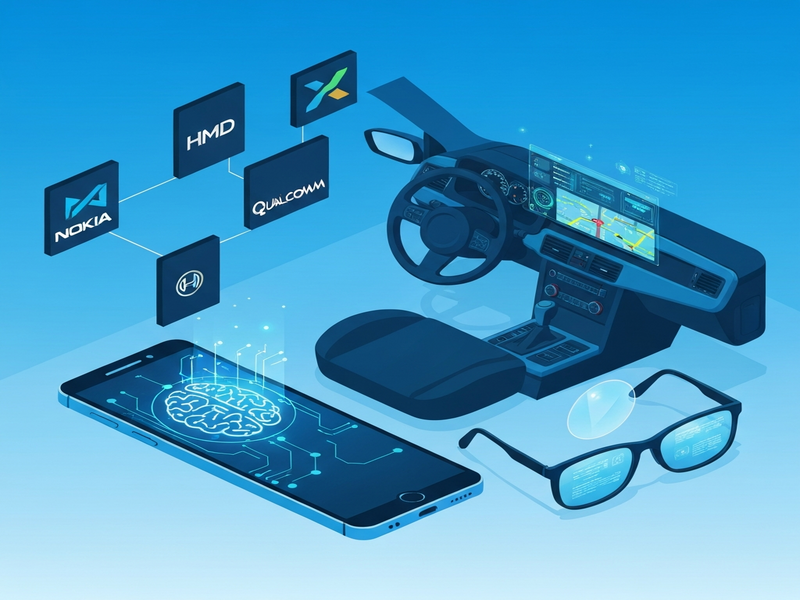
Sarvam AI is rolling out ultra‑light edge‑AI models to feature phones, connected cars, and smart glasses, backed by strategic partnerships with Nokia, HMD Global, Qualcomm and Bosch.
Sarvam Announces Aggressive Edge‑AI Expansion at India AI Impact Summit
At the India AI Impact Summit in New Delhi, Indian AI startup Sarvam unveiled a roadmap to bring its newly‑released AI models to three previously underserved device categories: low‑cost feature phones, automotive infotainment systems, and home‑grown smart glasses. The announcement signals a shift from a primarily enterprise‑focused portfolio toward mass‑consumer experiences, leveraging edge computing to deliver offline, low‑latency intelligence.
Edge‑AI Models Tailored for Feature Phones, Cars, and Smart Glasses
Sarvam’s engineers have compressed their voice‑centric models to a few megabytes, enabling them to run on devices with modest CPUs and limited memory. The models are designed to operate without a constant internet connection, preserving user privacy and reducing data‑plan costs.
Feature Phones – AI for the Masses
By integrating with Nokia’s legacy feature‑phone line, Sarvam will embed a dedicated AI button that activates a conversational assistant in regional languages. Users can ask about government schemes, local market prices, or health tips, receiving spoken answers generated entirely on‑device. This approach mirrors the Telegram integration on UBOS, where lightweight bots run locally to reduce latency.
Connected Cars – Smarter In‑Cabin Experiences
Through a partnership with Bosch, Sarvam plans to embed its AI engine into next‑generation infotainment units. The assistant will handle voice‑controlled navigation, predictive maintenance alerts, and contextual recommendations (e.g., nearby charging stations for electric vehicles). The collaboration leverages Bosch’s sensor suite and Sarvam’s edge‑optimized speech models, echoing the synergy seen in the Enterprise AI platform by UBOS, which unifies data streams from disparate hardware.
Smart Glasses – A New “Builder’s Device”
Sarvam’s “Kaze” smart glasses, manufactured in India, will feature on‑device transcription, real‑time translation, and visual search powered by the same compact models. Early demos showed users receiving spoken summaries of printed text simply by looking at it. This capability aligns with the vision of the AI solutions hub, where multimodal AI bridges the gap between visual and auditory data.
Strategic Partnerships Powering the Rollout
Sarvam’s expansion is underpinned by four marquee alliances, each contributing a unique technology stack and market reach.
| Partner | Role | Strategic Value |
|---|---|---|
| Nokia & HMD Global | Hardware & Distribution | Access to 300 M feature‑phone users across emerging markets. |
| Qualcomm | Chipset Optimization | Tailored model tuning for Snapdragon processors, ensuring sub‑second inference. |
| Bosch | Automotive Integration | Leverages Bosch’s sensor ecosystem for context‑aware car assistants. |
| Lightspeed, PeakXV & Khosla Ventures | Funding & Go‑to‑Market Support | Provides capital and strategic guidance for rapid scaling. |
Nokia & HMD Global – Reviving Feature‑Phone Relevance
The collaboration will embed Sarvam’s AI directly into Nokia’s classic “feature‑first” devices, turning a simple keypad into a conversational portal. By leveraging HMD’s software stack, the AI button can trigger localized language models, a capability reminiscent of the AI marketing agents that personalize outreach without cloud dependence.
Qualcomm – The “Sovereign AI Experience Suite”
Qualcomm’s “Sovereign AI Experience Suite” will serve as the firmware layer that hosts Sarvam’s models across smartphones, laptops, and IoT devices. This partnership accelerates the transition from research prototypes to production‑grade deployments, echoing the philosophy behind the UBOS platform overview, where modular AI components can be swapped without rewriting core logic.
Bosch – Bringing Voice Assistants to the Dashboard
Bosch’s automotive division will integrate Sarvam’s voice assistant into next‑gen infotainment units, enabling drivers to query traffic, control climate, or receive safety alerts without leaving the road. The synergy mirrors the Workflow automation studio, which orchestrates complex actions across heterogeneous hardware.
Market Impact and Real‑World Use Cases
Sarvam’s edge‑AI push could reshape how billions of users interact with technology in emerging economies. By eliminating reliance on high‑speed data, the company addresses two critical barriers: cost and connectivity.
- **Financial Inclusion** – Voice‑driven loan eligibility checks on feature phones, reducing paperwork for rural borrowers.
- **Agricultural Advisory** – Real‑time crop disease identification via smart‑glass camera feeds, with instant spoken guidance.
- **Smart Mobility** – In‑car voice assistants that adapt to regional dialects, improving safety and user comfort.
- **Government Services** – Offline access to welfare scheme details, boosting outreach in low‑connectivity zones.
- **Education** – AI‑powered language tutoring on low‑cost devices, expanding digital literacy.
Analysts predict that the Indian market alone could see a 30 % increase in AI‑enabled device adoption within the next 18 months, a trend that aligns with global forecasts for edge AI growth. Companies looking to replicate Sarvam’s model can explore the UBOS templates for quick start, which include pre‑built pipelines for voice‑to‑text, language translation, and on‑device inference.
Leadership Perspective
“Through edge AI, we want to bring intelligence to every phone, laptop, car, and even a new generation of devices,” said Tushar Goswamy, Head of Edge AI at Sarvam, during the summit. “Our collaborations with Qualcomm, Nokia and Bosch accelerate this vision, ensuring that AI runs where the data lives—on the device.”
Why This Matters for the Wider AI Ecosystem
Sarvam’s strategy exemplifies a broader industry shift toward privacy‑first, on‑device intelligence. As regulators tighten data‑localization rules, startups that can deliver high‑quality AI without cloud dependence will gain a competitive edge. The AI solutions hub at UBOS showcases similar capabilities, offering developers a sandbox to test edge models before full deployment.
For developers interested in building comparable experiences, the Web app editor on UBOS provides a drag‑and‑drop environment to prototype voice assistants, while the AI YouTube Comment Analysis tool demonstrates how large language models can be fine‑tuned for niche domains.
UBOS Resources to Accelerate Your Edge‑AI Projects
If you’re an AI developer or enterprise decision‑maker looking to replicate Sarvam’s edge‑AI approach, consider exploring the following UBOS offerings:
- AI Article Copywriter – Generates documentation for model APIs.
- AI Survey Generator – Quickly gathers user feedback on new AI features.
- AI Video Generator – Creates demo videos for device‑level AI interactions.
- AI LinkedIn Post Optimization – Helps market your edge‑AI launch.
- AI Audio Transcription and Analysis – Perfect for building voice assistants on low‑spec hardware.
These tools integrate seamlessly with the Enterprise AI platform by UBOS, allowing you to scale from a single prototype to a fleet of devices across multiple verticals.
Read the Full Announcement
For the original coverage and additional technical details, see the TechCrunch story on Sarvam’s AI expansion.
Conclusion: Edge AI Is Becoming Mainstream
Sarvam’s partnership‑driven rollout demonstrates that edge AI is no longer a niche experiment—it’s a viable path to democratize intelligent experiences across affordable hardware. Companies that act now can capture early‑adopter advantage in markets where connectivity is a premium.
Ready to build your own edge‑AI solution? Visit the UBOS homepage to explore pricing plans, templates, and a vibrant partner ecosystem that can accelerate your journey from concept to market.