

- Updated: February 4, 2026
- 5 min read
Roblox Launches Open‑Beta 4D Creation Feature Powered by AI
Roblox’s new 4D creation feature, now in open beta, lets developers build interactive, physics‑enabled objects that move, react, and evolve inside virtual worlds.
Roblox launches an open‑beta 4D creation tool that adds interactivity to 3D assets, powered by generative AI. Learn how the technology works, its benefits for creators, and what the future holds for immersive game development.
Roblox pushes the envelope of virtual creation
At the recent TechCrunch announcement, Roblox unveiled the open‑beta of its long‑awaited 4D creation feature. The rollout follows a year of AI‑driven experimentation, including the open‑source Cube 3D model generator that has already produced more than 1.8 million assets. This new tool moves beyond static geometry, enabling creators to embed behavior, physics, and real‑time interaction directly into their models.
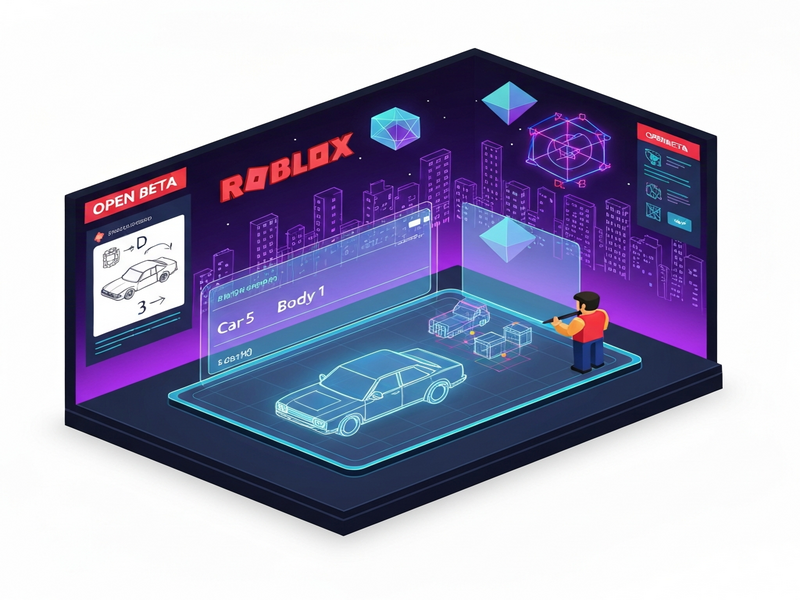
Image: Concept art of a 4D‑enabled vehicle in Roblox.
What is the 4D creation feature?
The 4D creation suite introduces “schemas” – predefined templates that break a model into functional parts and assign interactive behaviors. Two schemas are available at launch:
- Car‑5 schema: Splits a vehicle into a chassis and four wheels, allowing each wheel to spin and respond to player input.
- Body‑1 schema: Generates single‑piece objects (e.g., boxes, sculptures) that can still host scripted events such as color changes or particle effects.
Developers can now drop a 4D‑enabled car into a game, and it will automatically drive, collide, and emit sound without writing a single line of code. The first showcase, the “Wish Master” experience, demonstrates cars, planes, and even dragons that users can summon and control on the fly.
AI at the core of 4D generation
Roblox leverages its proprietary generative AI pipeline, originally built for the Cube 3D model generator, to power 4D creation. The workflow consists of three stages:
- Prompt interpretation: Creators describe the desired object and behavior in natural language.
- 3D mesh synthesis: The AI produces a high‑resolution mesh that respects the chosen schema.
- Behavior attachment: A secondary model predicts physics parameters (mass, friction, joint limits) and auto‑generates scripts that drive interactivity.
This pipeline mirrors the approach used in OpenAI ChatGPT integration on the UBOS platform, where natural‑language prompts are turned into functional code snippets. By reusing a similar architecture, Roblox can keep the generation loop fast (under 5 seconds for most assets) while maintaining high fidelity.
Why developers and players should care
For developers:
- Speed to market: Reduce asset creation time by up to 80 % compared with manual modeling and scripting.
- Lower technical barrier: No need for deep knowledge of physics engines; the schema handles joint constraints automatically.
- Scalable pipelines: Bulk‑generate variations (different colors, sizes, or performance stats) with a single prompt, ideal for large‑scale worlds.
For players:
- Richer interactivity: Objects feel alive—cars drive, doors open, and tools respond to gestures.
- Personalized experiences: Users can request custom items via in‑game chat, leveraging the same AI that powers the creator tools.
- Dynamic worlds: Game designers can script emergent gameplay where objects evolve based on player actions.
These advantages echo the benefits seen by enterprises using the Enterprise AI platform by UBOS, where AI‑generated components accelerate product development cycles.
Looking ahead: custom schemas and real‑time dreaming
Roblox’s roadmap promises creator‑defined schemas, giving developers the freedom to design bespoke interaction models. Imagine a “Pet‑3” schema where a creature has a head, torso, and tail, each with independent AI‑driven behaviors (e.g., following, wagging, reacting to sound).
Another upcoming project, dubbed “real‑time dreaming,” will let creators type natural‑language prompts that instantly reshape entire worlds, similar to the AI news feed on UBOS that showcases live AI‑generated content.
Technical milestones include:
- Reference‑image‑to‑3D conversion, allowing a single sketch to become a fully rigged 4D asset.
- Cross‑platform schema sharing, so a creator can export a schema from Roblox and import it into other engines via the Web app editor on UBOS.
- Integration with voice‑enabled AI agents like the ElevenLabs AI voice integration for in‑game narration of object states.
What this means for the Roblox ecosystem
The open‑beta of 4D creation marks a pivotal shift from static asset libraries to living, programmable objects. As more creators adopt the tool, we can expect a surge of user‑generated experiences that feel more immersive and responsive than ever before.
For developers looking to experiment with AI‑driven workflows beyond Roblox, the UBOS homepage offers a suite of services that complement this new paradigm:
- UBOS platform overview – a low‑code environment for rapid AI integration.
- AI marketing agents that can promote your Roblox games across channels.
- UBOS partner program – collaborate with AI experts to extend your game’s capabilities.
- UBOS pricing plans tailored for indie creators and studios.
- UBOS templates for quick start that include pre‑built 4D‑ready components.
- Explore the AI SEO Analyzer to boost discoverability of your Roblox experiences.
- Try the Talk with Claude AI app for brainstorming game narratives.
- Leverage the AI Video Generator to create promotional trailers for your new 4D assets.
- Use the AI Image Generator for concept art and marketing visuals.
- Automate repetitive tasks with the Workflow automation studio.
Ready to dive in? Sign up for the open beta on Roblox, experiment with the 4D schemas, and consider extending your workflow with UBOS’s AI‑powered tools. The future of interactive virtual worlds is being built today—be part of it.