

- Updated: February 24, 2026
- 6 min read
Pentagon Pushes Defense Production Act Over Anthropic AI Dispute
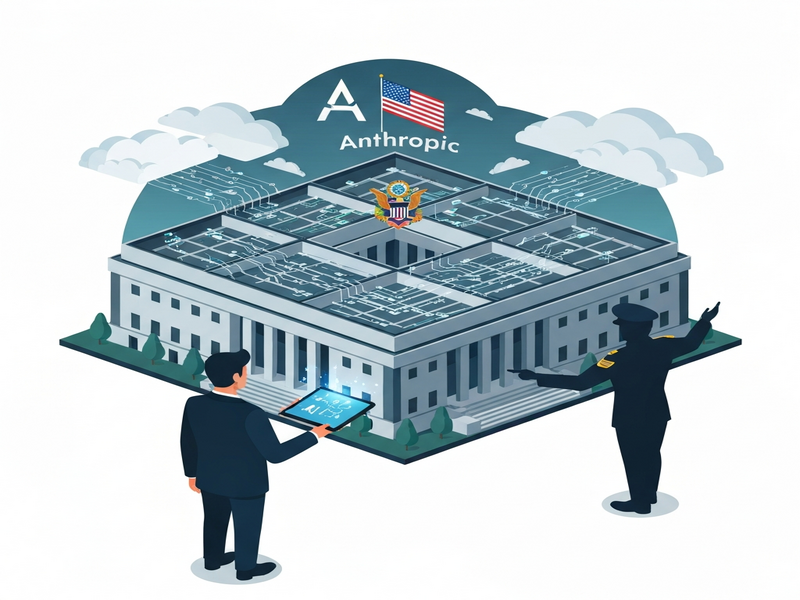
The Pentagon is threatening to invoke the Defense Production Act to force Anthropic to give the U.S. military unrestricted access to its AI model, while Anthropic is standing firm on ethical guardrails that prohibit mass surveillance and fully autonomous weapons.
Context: Why the Anthropic‑Pentagon Standoff Matters
In late February 2026, a high‑stakes dispute erupted between Anthropic, one of the world’s leading frontier AI labs, and the United States Department of Defense (DoD). The Pentagon demanded “unrestricted” access to Anthropic’s flagship model, arguing that national‑security imperatives outweigh the company’s internal safety policies. Anthropic’s CEO, Dario Amodei, responded that the company will not compromise on safeguards that prevent its technology from being weaponized or used for mass surveillance of American citizens.
The clash is more than a contractual disagreement; it is a flashpoint in the broader debate over AI governance, private‑sector autonomy, and the reach of the Defense Production Act (DPA)—a law historically reserved for manufacturing critical wartime equipment, but now being eyed for AI‑related production.
Pentagon’s Demand and Anthropic’s Stance
What the DoD is asking for
- Full, unrestricted API access to Anthropic’s latest model for classified military projects.
- A custom‑built version of the model that can be deployed on isolated DoD networks without the company’s safety‑layer filters.
- Legal language that would label Anthropic a “supply chain risk” if it refuses, a designation traditionally applied to foreign adversaries.
Anthropic’s ethical red line
Anthropic has publicly stated that it will not enable its technology for:
- Mass surveillance of U.S. residents.
- Fully autonomous weapons systems that can select and engage targets without human oversight.
CEO Dario Amodei told reporters that “the risk of eroding civil liberties and creating a new class of AI‑driven weapons outweighs any short‑term operational advantage.” The company’s stance aligns with its broader mission to develop “aligned, interpretable, and safe AI.”
The Defense Production Act as a lever
Secretary of Defense Pete Hegseth warned Anthropic that the Pentagon could invoke the DPA to compel compliance. The DPA gives the President authority to prioritize production for national defense, and it was famously used during the COVID‑19 pandemic to force companies like General Motors and 3M to produce ventilators and masks. Applying the DPA to AI software would be a historic expansion of the law’s modern use.
Implications for the AI Industry
The dispute signals several possible trajectories for AI governance in the United States:
- Precedent for government‑mandated AI access: If the DPA is used, future agencies may feel empowered to demand similar concessions from other AI firms.
- Shift in private‑sector risk calculations: Companies may reassess the cost‑benefit of working with the DoD, especially if “supply chain risk” labels threaten market reputation.
- Acceleration of AI diversification: The Pentagon’s reliance on a single vendor (Anthropic) has already prompted talks of backup contracts with xAI’s Grok, highlighting the need for multi‑vendor strategies.
- Regulatory ripple effects: Congress could introduce new legislation clarifying the limits of the DPA for software, potentially shaping the next wave of AI policy.
For AI startups and established firms alike, the lesson is clear: aligning product roadmaps with both ethical standards and national‑security expectations is no longer optional.
Quotes and Perspectives from Key Stakeholders
“If the government says ‘you disagree with us politically, we’ll put you out of business,’ it undermines the stability that makes America a hub for global commerce.” – Dean Ball, senior fellow, Foundation for American Innovation
“Our mission is to build AI that is safe for humanity. Compromising on guardrails for a single customer, even a government one, would betray that mission.” – Dario Amodei, CEO of Anthropic
“The DoD’s reliance on a single classified‑ready AI system violates the National Security Memorandum that calls for redundancy across vendors.” – Rebecca Bellan, senior reporter, TechCrunch
How UBOS Helps Organizations Navigate AI Governance Challenges
Companies facing similar regulatory pressure can leverage the UBOS platform overview to build compliant AI solutions without sacrificing innovation. UBOS offers a suite of tools that address the exact concerns raised in the Pentagon‑Anthropic dispute:
- Secure model deployment: The Telegram integration on UBOS enables encrypted communication channels for AI‑driven workflows, ensuring data never leaves a controlled environment.
- Ethical guardrails: With the OpenAI ChatGPT integration, developers can embed policy‑enforced filters that block disallowed content before it reaches end‑users.
- Voice‑first compliance: The ElevenLabs AI voice integration adds a layer of auditable voice interaction, useful for regulated sectors like defense.
- Data governance: Chroma DB integration provides vector‑search capabilities with fine‑grained access controls, helping organizations meet DoD data‑handling standards.
For startups looking to accelerate AI adoption while staying compliant, the UBOS for startups program offers mentorship, discounted UBOS pricing plans, and access to a library of pre‑built templates such as the AI SEO Analyzer and the AI Article Copywriter. These tools let teams focus on policy‑compliant product features rather than reinventing the wheel.
SMBs can also benefit from the UBOS solutions for SMBs, which include the Workflow automation studio for building audit‑ready pipelines, and the Web app editor on UBOS for rapid prototyping of secure AI interfaces.
Enterprise‑grade AI with UBOS
Large organizations can explore the Enterprise AI platform by UBOS, which supports multi‑tenant deployments, role‑based access control, and integration with government‑grade security frameworks. The platform’s modular architecture makes it easy to swap out a model provider—whether Anthropic, OpenAI, or a custom‑trained solution—without breaking compliance pipelines.
AI marketing agents for outreach
Even defense contractors need to market their capabilities responsibly. UBOS’s AI marketing agents can generate compliant messaging, leveraging templates like the AIDA Marketing Template or the Elevate Your Brand with AI while ensuring no disallowed content slips through.
Future Outlook: What Comes Next?
Analysts predict three possible scenarios for the Pentagon‑Anthropic dispute:
- Negotiated compromise: The DoD may agree to a limited‑scope API that respects Anthropic’s safety filters, possibly in exchange for a joint research program on “ethical autonomous systems.”
- Legal escalation: If the DPA is invoked, the case could wind up in federal court, setting a legal precedent for AI‑related procurement.
- Strategic diversification: The Pentagon could accelerate contracts with alternative vendors like xAI’s Grok, reducing reliance on a single supplier and prompting Anthropic to reconsider its stance to retain market share.
Regardless of the outcome, the dispute underscores the urgent need for clear, technology‑agnostic policies that balance national security with civil liberties. Stakeholders—from AI startups to defense contractors—must invest in governance frameworks that can adapt to evolving legal landscapes.
What You Can Do Today
- Review your organization’s AI usage policies against the About UBOS best‑practice guide.
- Explore the UBOS templates for quick start to prototype compliant AI workflows.
- Join the UBOS partner program to stay ahead of regulatory changes.
- Leverage the UBOS portfolio examples for inspiration on secure AI product design.
For the original reporting, see the TechCrunch article on the Anthropic‑Pentagon dispute.
Andrii Bidochko
CTO UBOS
Andrii Bidochko is an AI entrepreneur and researcher focused on AI agents, reinforcement learning, and autonomous systems. He writes about the technologies shaping the future of machine intelligence, from frontier models and agent architectures to real-world AI applications.