

- Updated: February 27, 2026
- 6 min read
Palantir AI Drives Humanitarian Aid Tracking in Gaza – New Insights
Palantir Technologies is using its Gaia, Gotham, and Foundry platforms to collect, visualize, and coordinate humanitarian aid deliveries in Gaza, while private‑sector data tools raise profound ethical, legal, and governance questions for NGOs, policymakers, and tech‑savvy professionals.
Why Palantir’s AI Matters for Gaza’s Humanitarian Crisis
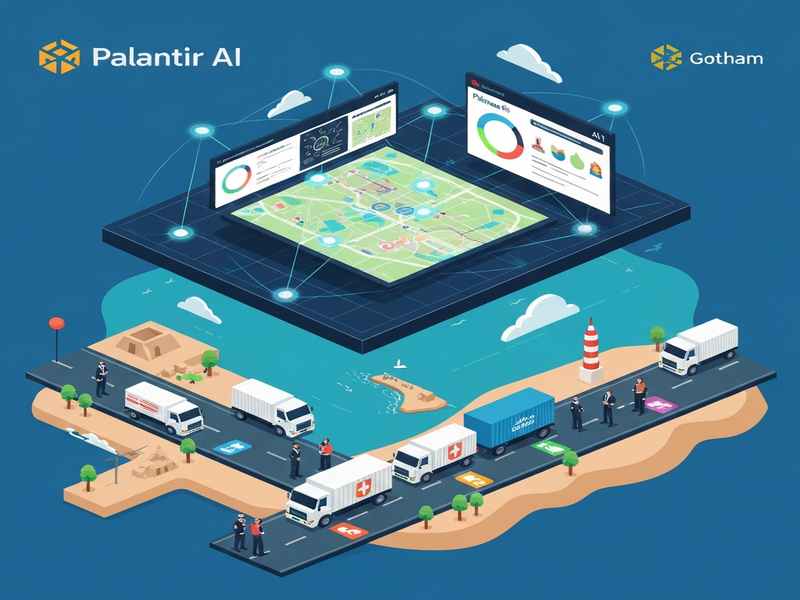
Since the establishment of the U.S.–led Civil‑Military Coordination Center (CMCC) in southern Israel, Palantir has placed a permanent desk inside the operations room. Its data‑analytics architecture powers real‑time tracking of trucks, drone surveillance, and distribution points, promising a “single source of truth” for aid convoys. The move reflects a broader trend: private AI firms are becoming indispensable partners in conflict‑zone logistics, yet their involvement also blurs the line between life‑saving assistance and military intelligence.
For tech‑savvy professionals and NGOs looking to harness AI for humanitarian work, understanding Palantir’s toolkit—and the surrounding policy debate—is essential. Below we break down the platforms, the ethical stakes, the impact on NGOs, and what the future may hold for reconstruction and AI governance.
AI Platforms Powering Aid Tracking
Gaia: Visualizing the Battlefield‑Aid Interface
Gaia, originally marketed as a “battlefield‑view” solution, now ingests satellite imagery, drone feeds, and logistics data to create an interactive map of aid routes. Operators at the CMCC can click a convoy icon, see its cargo manifest, and monitor real‑time status updates. The platform’s UBOS platform overview shows a similar capability for integrating disparate data streams, highlighting how modern AI stacks can be repurposed for humanitarian contexts.
Foundry: Supply‑Chain Resilience for NGOs
Foundry is Palantir’s flagship supply‑chain engine. It normalizes data from NGOs, government agencies, and private contractors, then runs optimization algorithms to suggest the most efficient loading plans and routing schedules. In practice, this means fewer bottlenecks at border crossings and better alignment with UBOS solutions for SMBs that need to scale quickly under pressure.
Gotham: The Dual‑Use Targeting Engine
Gotham powers Palantir’s “kill‑chain” analytics for military customers. Through a feature called Type Mapping, data entered in Foundry can be instantly queried by Gotham, raising the specter of aid‑logistics data feeding into targeting decisions. This dual‑use capability is why Enterprise AI platform by UBOS stresses strict data‑segregation policies for civilian applications.
Supporting Integrations: From ChatGPT to Voice AI
Palantir’s ecosystem can be extended with modern generative tools. For example, the OpenAI ChatGPT integration enables natural‑language queries of logistics dashboards, while the ElevenLabs AI voice integration can broadcast real‑time alerts to field teams via voice assistants.
Ethical and Legal Considerations of Private‑Sector Involvement
Deploying commercial AI in a war zone triggers a cascade of legal and moral questions. International humanitarian law (IHL) requires that aid be delivered impartially, without favoring any party to the conflict. When a private firm that also supplies the Israeli military processes the same data, the risk of “mission creep” becomes tangible.
- Data sovereignty: NGOs must share detailed convoy manifests with the CMCC, potentially exposing vulnerable populations to surveillance.
- Dual‑use risk: As noted, Gotham can ingest aid data for targeting, blurring the line between humanitarian assistance and combat operations.
- Accountability gaps: Private contracts often lack the transparency required by UN‑mandated reporting standards.
These concerns echo the warnings of UN Special Rapporteur Francesca Albanese, who called the profit‑driven parallel system a “monstrosity.” To mitigate risk, the AI marketing agents framework proposes built‑in audit trails and ethical guardrails for every data pipeline.
How NGOs and Private Contractors Are Adapting
Regulatory Shifts Push NGOs Out of the Field
New Israeli registration rules require NGOs to disclose staff identities and funding sources. Organizations that refuse are barred from operating in Gaza, effectively handing the logistics baton to approved groups and private firms. This shift has accelerated the adoption of platforms like Workflow automation studio, which lets approved NGOs automate reporting to both the CMCC and their donors.
Private Contractors Fill the Vacuum
U.S. firms such as Safe Reach Solutions (SRS) and Arkel International now occupy seats that were once reserved for UN agencies. Their presence underscores a broader trend: security‑focused contractors are becoming de‑facto logistics managers. The UBOS partner program illustrates how technology platforms can certify contractors, but it also raises questions about who ultimately controls aid distribution.
Template‑Driven Speed for NGOs
UBOS’s marketplace offers ready‑made templates that NGOs can deploy in hours rather than weeks. For instance, the AI SEO Analyzer helps NGOs optimize their public communications, while the AI Article Copywriter accelerates the production of impact reports. These tools illustrate how a “quick‑start” approach can keep NGOs competitive in a data‑rich environment.
Future Outlook: Reconstruction, AI Governance, and Sustainable Aid
Beyond immediate relief, the reconstruction of Gaza is being framed as a multi‑trillion‑dollar investment opportunity. Private developers envision a “Mediterranean Riviera,” while AI platforms promise to monitor construction progress, allocate resources, and even predict future maintenance needs.
AI‑Enabled Reconstruction Planning
Foundry’s predictive analytics can model supply‑chain disruptions for building materials, while Gaia‑style visualizations help stakeholders coordinate on‑site safety. The UBOS for startups initiative encourages new AI‑driven ventures to prototype these solutions, ensuring that the next generation of tools is built with humanitarian safeguards from day one.
Governance Frameworks and Transparency
Effective AI governance will require:
- Independent oversight bodies that audit data flows between civilian and military systems.
- Open‑source audit logs accessible to NGOs and the public.
- Legal clauses that prohibit the repurposing of aid data for targeting.
UBOS’s Web app editor on UBOS already supports role‑based access controls that could be adapted for these governance needs.
Scaling Ethical AI with Community‑Built Templates
Community contributors have published templates such as AI Video Generator for transparent reporting, and AI Image Generator for visual documentation of reconstruction milestones. By sharing these assets openly, the ecosystem can collectively raise the bar for ethical AI use.
Conclusion: Balancing Innovation with Responsibility
Palantir’s AI tools have undeniably improved the speed and visibility of humanitarian aid in Gaza, yet the same technology can be weaponized if left unchecked. For policymakers, NGOs, and tech innovators, the challenge is to embed robust ethical safeguards while leveraging the efficiency gains that platforms like Gaia, Foundry, and Gotham provide.
Ready to explore AI solutions that prioritize transparency and humanitarian impact? Visit the UBOS homepage for a suite of compliant tools, review the UBOS pricing plans for budget‑friendly options, and browse the UBOS portfolio examples to see real‑world deployments.
For a deeper dive into the original reporting, read the Drop Site News article that first highlighted Palantir’s role in Gaza.
Andrii Bidochko
CTO UBOS
Andrii Bidochko is an AI entrepreneur and researcher focused on AI agents, reinforcement learning, and autonomous systems. He writes about the technologies shaping the future of machine intelligence, from frontier models and agent architectures to real-world AI applications.