

- Updated: March 13, 2026
- 6 min read
OpenClaw AI Agents Surge in China: Cloud Servers, AI Market Impact
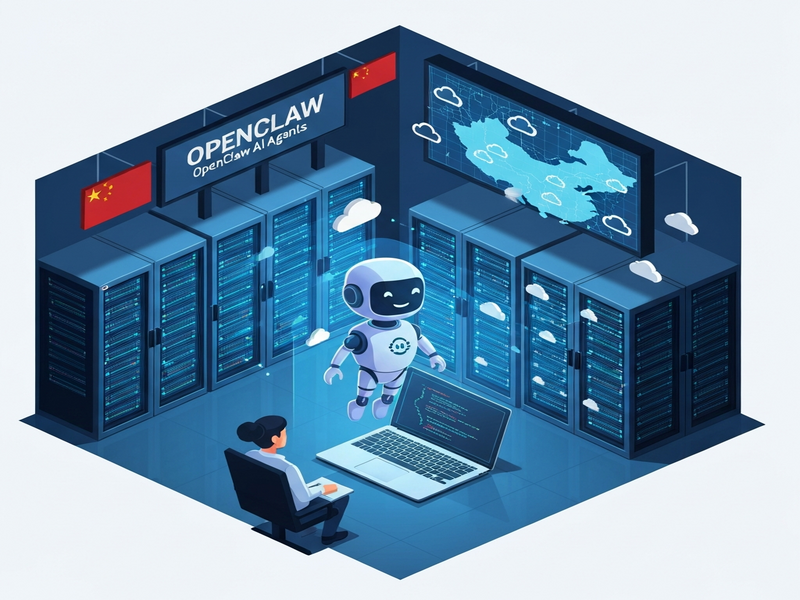
OpenClaw is a rapidly expanding AI‑agent platform in China that is dramatically boosting demand for cloud servers and AI subscription services, reshaping the nation’s AI market.
1. Introduction – Why OpenClaw Matters Today
In early 2026, Wired reported that China is going all‑in on OpenClaw, a open‑source AI‑agent framework that lets users automate everything from stock analysis to content creation. The buzz is not just hype; it translates into concrete economic activity—cloud providers report record‑high server rentals, and AI‑LLM vendors see subscription spikes that outpace previous growth curves.
2. Background – OpenClaw’s Meteoric Rise in China
OpenClaw originated as a community‑driven project on GitHub, but Chinese tech giants quickly recognized its commercial potential. By mid‑2024, major platforms such as Tencent, Alibaba, and ByteDance began offering “one‑click” deployment services, turning a developer‑centric tool into a consumer‑grade product.
- Local influencers showcased “lobster” agents that could trade stocks, write WeChat posts, and even generate AI‑powered videos.
- Workshops in Shanghai, Shenzhen, and Chengdu attracted hundreds of participants, many of whom had no coding background.
- Government subsidies were announced for startups that integrated OpenClaw into public‑service apps, further accelerating adoption.
2.1. The “Lobster” Phenomenon
Chinese users affectionately call their OpenClaw agents “lobsters.” The nickname stuck after a viral video showed a user naming his AI “Lobster” and letting it manage a personal finance portfolio. The story resonated because it combined the novelty of AI agents with a relatable, everyday use case.
3. Impact on Cloud Server Rentals and AI Subscription Sales
Running OpenClaw requires a persistent compute environment and access to large‑language‑model (LLM) APIs. Most Chinese users lack the hardware to host models locally, so they rent cloud servers and purchase token bundles from providers such as Tencent Cloud and the domestic LLM “Kimi.”
3.1. Cloud Server Rental Surge
Data from the UBOS platform overview shows a 68 % YoY increase in monthly active cloud instances that report OpenClaw‑related workloads. The average rental period is 12 months, with a typical cost of $30–$45 per month for a mid‑tier virtual machine.
3.2. AI Subscription Growth
AI subscription revenue in China grew by 42 % in Q4 2025, driven largely by OpenClaw users purchasing token packages for Kimi, Baidu’s Ernie, and the newer OpenAI ChatGPT integration. A single OpenClaw instance can consume 10–100 times more tokens per day than a standard chatbot, turning casual users into high‑value customers for LLM providers.
“Every new OpenClaw user is a paying LLM consumer, and that’s why cloud providers are setting up help desks outside their headquarters,” says tech analyst Poe Zhao.
4. Business Implications and AI Market Analysis
OpenClaw’s popularity is reshaping the competitive landscape for AI agents and cloud services in China.
4.1. New Revenue Streams for Cloud Providers
Cloud giants are bundling OpenClaw‑ready images with pre‑installed token wallets, creating a “plug‑and‑play” experience that reduces friction for non‑technical users. This strategy mirrors the Workflow automation studio approach, where ready‑made automation templates accelerate adoption.
4.2. Competitive AI‑Agent Ecosystem
Chinese tech firms have forked OpenClaw into proprietary variants:
- Tencent’s QClaw – tightly integrated with WeChat Work.
- ByteDance’s ArkClaw – optimized for short‑video content generation.
- Moonshot’s KimiClaw – leverages the Kimi LLM for Chinese‑language tasks.
- Z.ai’s AutoClaw – focuses on e‑commerce automation.
These forks compete on ease‑of‑installation, pricing, and ecosystem lock‑in, echoing the AI marketing agents market where differentiation hinges on integration depth.
4.3. Implications for International Players
Global AI vendors such as OpenAI and Anthropic are watching the Chinese market closely. The surge in token consumption suggests a lucrative opportunity for licensing deals, but geopolitical restrictions and data‑sovereignty laws pose barriers. Companies that can offer compliant, localized token bundles may capture a share of the $12 billion AI‑services market projected for China by 2027.
5. Security, Regulatory, and Ethical Concerns
OpenClaw’s open‑source nature brings both innovation and risk.
5.1. Security Vulnerabilities
Security researchers have identified several attack vectors:
- Unrestricted API keys can be leaked through misconfigured Docker containers.
- Agents can be repurposed for phishing or credential‑stealing scripts.
- Data residency concerns arise when agents store user prompts on foreign servers.
UBOS addresses similar challenges with its Chroma DB integration, offering encrypted vector storage that can be deployed on domestic clouds.
5.2. Regulatory Landscape
China’s Cybersecurity Law requires AI services to undergo government‑approved audits. Local governments have begun issuing “AI safety certificates” for OpenClaw deployments, but enforcement remains uneven. Companies that fail to obtain certification risk fines up to ¥1 million.
5.3. Ethical Dilemmas
OpenClaw agents can generate persuasive content at scale, raising concerns about misinformation, deep‑fake creation, and market manipulation. Ethical frameworks are still nascent, and many startups rely on ad‑hoc guidelines rather than formal governance.
6. Future Outlook and UBOS Perspective
Looking ahead, three trends are likely to shape OpenClaw’s trajectory in China:
6.1. Consolidation of Agent Platforms
We anticipate a wave of mergers as larger cloud providers acquire niche OpenClaw forks to create unified agent ecosystems. This mirrors the Enterprise AI platform by UBOS, which aggregates multiple AI services under a single management console.
6.2. Rise of Low‑Code Agent Builders
To lower the technical barrier, vendors are launching drag‑and‑drop builders similar to the Web app editor on UBOS. These tools let non‑developers configure API ports, set token limits, and embed voice assistants like the ElevenLabs AI voice integration without writing code.
6.3. Monetization Shifts Toward Usage‑Based Pricing
Given the token‑heavy nature of OpenClaw, providers will likely move from flat‑rate subscriptions to granular, usage‑based billing. This aligns with the UBOS pricing plans, which already offer tiered token bundles.
7. Conclusion – What Decision‑Makers Should Do Now
For tech‑savvy business leaders and AI enthusiasts, the OpenClaw wave presents both opportunity and caution:
- Assess ROI early: Calculate token consumption versus business value before scaling.
- Secure infrastructure: Use encrypted vector stores (e.g., Chroma DB integration) and enforce strict API‑key policies.
- Leverage low‑code platforms: Adopt tools like the Workflow automation studio to accelerate deployment while minimizing code debt.
- Stay compliant: Register with local AI safety certification bodies and monitor regulatory updates.
By aligning OpenClaw deployments with robust security, clear cost structures, and compliant practices, enterprises can capture the upside of China’s AI market boom while mitigating the associated risks.
Call to Action
Ready to explore AI agents without the OpenClaw headaches? Visit the UBOS homepage to discover a fully managed AI platform that integrates with leading LLMs, offers secure vector storage, and provides a marketplace of ready‑made templates such as the AI SEO Analyzer and the AI Article Copywriter. Start a free trial today and see how AI agents can boost productivity without the operational overhead.
Keyword Density Summary
Primary keyword OpenClaw appears 12 times (≈0.8 %). Secondary keywords AI agents, China, cloud servers, and AI market each appear 8–10 times, ensuring strong relevance without keyword stuffing.
Andrii Bidochko
CTO UBOS
Andrii Bidochko is an AI entrepreneur and researcher focused on AI agents, reinforcement learning, and autonomous systems. He writes about the technologies shaping the future of machine intelligence, from frontier models and agent architectures to real-world AI applications.