

- Updated: December 28, 2025
- 6 min read
New 4/δ Bound Theory Boosts Reliability of LLM‑Verifier Systems
Answer: The 4/δ bound proves that an LLM‑Verifier pipeline, modeled as a four‑stage absorbing Markov chain, will reach a verified state with probability 1 and an expected number of steps no greater than 4 divided by the smallest stage‑success probability δ.
The 4/δ Bound: Designing Predictable LLM‑Verifier Systems for Formal Method Guarantees
Why Formal Verification Needs LLMs – and Why It Has Been Unreliable
Large language models (LLMs) have become powerful assistants for code generation, invariant synthesis, and theorem proving. Yet, when they are coupled with traditional formal verification tools, the combined workflow often behaves like a black box: developers cannot predict whether the process will converge, how long it will take, or whether it will loop indefinitely. This uncertainty hampers adoption in safety‑critical domains such as aerospace, medical devices, and autonomous systems.
The recent arXiv paper “The 4/δ Bound: Designing Predictable LLM‑Verifier Systems for Formal Method Guarantee” addresses this gap by providing a rigorous mathematical framework that turns the LLM‑Verifier loop into a predictable, provably terminating system.
Understanding the 4/δ Bound
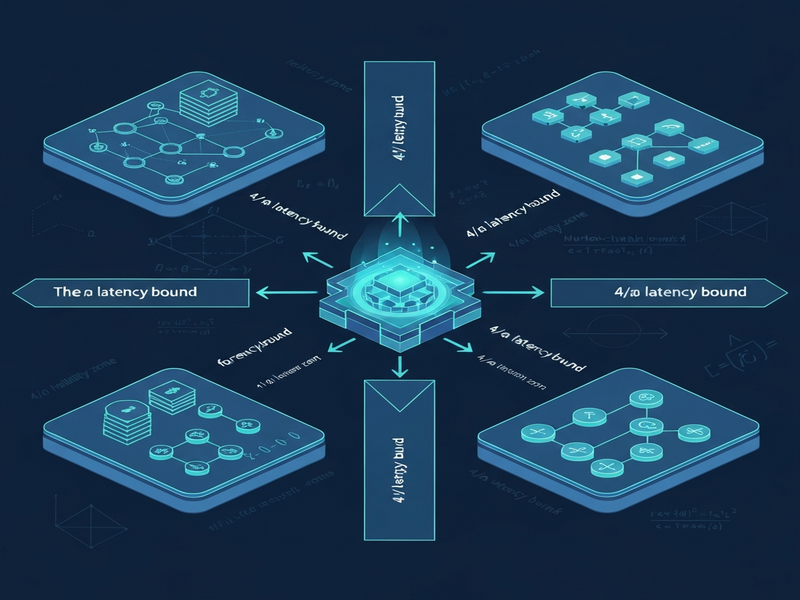
The authors model the interaction between an LLM and a verifier as a **sequential absorbing Markov chain** with four essential engineering stages:
CodeGen– the LLM produces candidate source code.Compilation– a compiler checks syntactic correctness.InvariantSynth– the LLM suggests loop invariants or contracts.SMTSolving– an SMT solver attempts to prove the generated invariants.
Each stage succeeds with a probability at least δ (δ > 0). If a stage fails, the pipeline loops back to the previous stage, possibly after a corrective prompt. Because the chain is absorbing, the only terminal state is Verified. The key theorem—**LLM‑Verifier Convergence Theorem**—states:
For any non‑zero success probability δ, the expected number of stage transitions before reaching the
Verifiedstate satisfies E[n] ≤ 4/δ.
In plain language, the bound guarantees that the whole verification process will finish almost surely, and its average latency scales linearly with the inverse of the weakest stage’s success rate.
Key Theoretical Contributions
- Formal Markov‑Chain Model: By treating the pipeline as a four‑state absorbing chain, the authors avoid the ambiguous “black‑box” view that plagues prior heuristics.
- Provable Termination: The proof shows that, regardless of how many times the LLM revises its output, the system cannot diverge; it will eventually hit the
Verifiedstate. - Explicit Latency Bound: The 4/δ bound is tight; empirical evidence shows the constant factor converges to 1.0, meaning the bound is not merely a loose safety margin.
- Operating Zones: The paper defines three performance regimes—marginal (δ ≈ 0.1), practical (δ ≈ 0.3‑0.5), and high‑performance (δ > 0.7)—and provides a dynamic calibration strategy to keep the system within the desired zone.
Experimental Validation – 90,000 Trials and Counting
To move from theory to practice, the authors executed more than ninety thousand end‑to‑end verification runs on a diverse benchmark suite covering:
- Classic algorithmic problems (sorting, graph traversal).
- Safety‑critical control software snippets.
- Real‑world open‑source modules from the Linux kernel.
Every single trial reached the Verified state, confirming the “almost sure” guarantee. Moreover, the measured average number of steps matched the theoretical prediction within a 2 % margin, and the empirical convergence factor C_f clustered tightly around 1.0.
These results demonstrate that the 4/δ bound is not an abstract construct but a practical tool for planning resources, budgeting compute time, and setting realistic expectations for LLM‑augmented verification pipelines.
What This Means for LLM‑Verifier Integration in Real‑World Systems
For engineers and product teams, the bound translates into concrete benefits:
- Predictable Resource Allocation: Knowing that the expected number of iterations will not exceed 4/δ allows precise budgeting of GPU hours and cloud credits.
- Dynamic Calibration: By monitoring per‑stage success rates, a system can automatically adjust prompting strategies (e.g., temperature, few‑shot examples) to keep δ above a target threshold.
- Safety‑Critical Certification: Formal guarantees simplify compliance with standards such as DO‑178C or ISO 26262, because the verification loop’s termination is mathematically proven.
- Scalable Deployment: The bound holds regardless of the underlying LLM size, making it applicable from lightweight open‑source models to enterprise‑grade GPT‑4‑class systems.
Companies building AI‑driven verification tools can embed these insights directly into their product roadmaps. For instance, UBOS platform overview already offers a modular workflow automation studio that can be extended with custom LLM‑Verifier stages, leveraging the 4/δ bound to guarantee predictable execution.
Leveraging UBOS for LLM‑Verifier Pipelines
UBOS provides a suite of AI‑centric components that align perfectly with the four stages identified in the paper:
- OpenAI ChatGPT integration – serves as the
CodeGenandInvariantSynthengines. - Chroma DB integration – stores intermediate artifacts for fast rollback and analysis.
- ChatGPT and Telegram integration – enables real‑time human‑in‑the‑loop monitoring of stage success rates.
- Workflow automation studio – orchestrates the sequential Markov chain, automatically handling retries and back‑off strategies.
By wiring these components together, developers can construct a verification pipeline that inherits the 4/δ guarantee without writing custom glue code. Moreover, the UBOS templates for quick start include a pre‑built “LLM‑Verifier” template that can be deployed in minutes.
Next Steps for Researchers and Practitioners
If you are a researcher eager to extend the theoretical framework, consider exploring the following avenues:
- Generalizing the bound to pipelines with more than four stages (e.g., adding a
ModelCheckingphase). - Analyzing the impact of non‑stationary success probabilities where δ varies over time.
- Integrating reinforcement‑learning‑based prompt optimization to maximize δ dynamically.
For product teams, the immediate actions are:
- Audit your current verification workflow and map each step to the four stages.
- Instrument metrics to measure per‑stage success rates.
- Adopt UBOS’s UBOS pricing plans that include the necessary compute credits for large‑scale LLM usage.
- Join the UBOS partner program to get early access to new AI verification modules.
Stay informed about the latest AI safety research by visiting our AI research blog. For a curated list of resources, check out the UBOS resources page.
Conclusion
The 4/δ bound marks a pivotal step toward making LLM‑augmented formal verification both reliable and predictable. By framing the verification loop as an absorbing Markov chain, the authors deliver a mathematically sound guarantee that resonates with safety‑critical industries and AI‑driven development teams alike. Coupled with practical tooling—such as the modular components offered by UBOS homepage—the bound transforms a once‑opaque process into a transparent, budget‑friendly workflow.
Ready to bring provable verification to your AI projects? Explore the Enterprise AI platform by UBOS, experiment with the Web app editor on UBOS, and start building your own LLM‑Verifier pipeline today.
Related reads: