

- Updated: March 13, 2026
- 5 min read
NASA Schedules Artemis II Crewed Lunar Flyby Launch for April 1, 2026
Artemis II Set for April 1 Launch: NASA’s Next Crewed Moon Mission
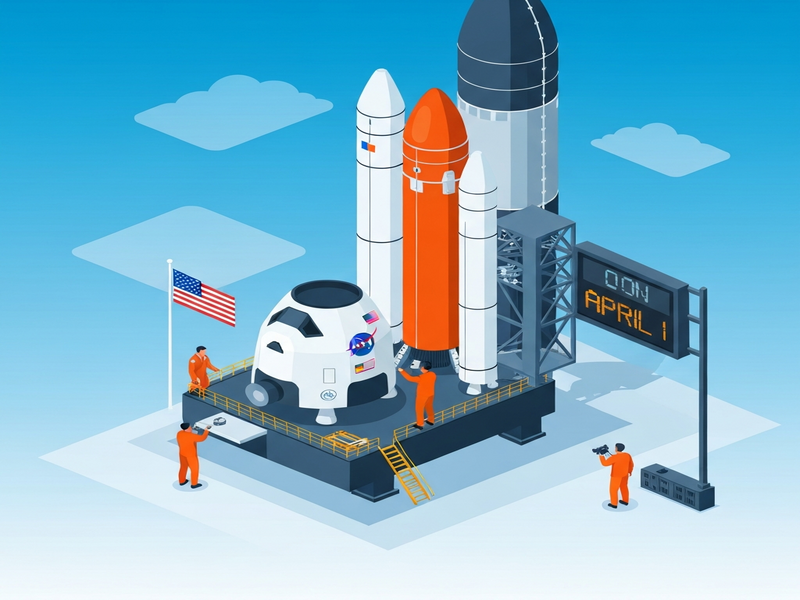
NASA plans to launch the Artemis II crewed lunar flyby on April 1, 2026, sending four astronauts on a ten‑day mission that will circle the Moon and return to Earth, marking the first human deep‑space flight since Apollo 17.
The excitement surrounding the upcoming launch has surged after a recent NPR report confirmed NASA’s confidence in an early‑April window. Space enthusiasts and technology readers alike are eager to learn how the mission’s timeline, crew composition, and technical fixes converge to reignite humanity’s lunar ambitions.
Mission Overview and Launch Window
Artemis II is the second flight in NASA’s Artemis program, designed to validate the Orion spacecraft’s life‑support, navigation, and re‑entry systems with a full crew aboard. The launch will occur from Launch Complex 39B at Kennedy Space Center, Florida, within a six‑day window (April 1‑6, 2026). NASA has selected the earliest slot—April 1—to maximize the mission’s alignment with the lunar orbital mechanics required for a free‑return trajectory.
- Launch vehicle: Space Launch System (SLS) Block 1
- Spacecraft: Orion crew capsule
- Mission duration: Approximately 10 days
- Trajectory: Lunar flyby with a free‑return path to Earth
Crew Details and Training
The historic crew comprises three NASA astronauts and one Canadian Space Agency astronaut, reflecting the program’s international partnership:
| Astronaut | Agency | Role |
|---|---|---|
| Reid Wiseman | NASA | Commander |
| Victor Glover | NASA | Pilot |
| Christina Koch | NASA | Mission Specialist |
| Jeremy Hansen | CSA | Mission Specialist |
All four crew members have completed a rigorous 12‑month training cycle that includes high‑G centrifuge tests, lunar surface simulations, and emergency abort drills. Their preparation underscores NASA’s “crew‑first” safety philosophy, ensuring that every contingency is rehearsed before the launch.
Technical Challenges and Recent Fixes
During a pre‑flight review in February, engineers identified a pressure‑regulation anomaly in the SLS’s helium system, which is critical for maintaining fuel‑tank stability during ascent. The issue was traced to a degraded seal that could have caused uneven pressure distribution.
“We replaced the faulty seal and performed a full system checkout before rolling the rocket back to the launch pad,” explained Lori Glaze, NASA’s Exploration Systems Development Mission Directorate chief.
The repair required moving the SLS back into the Vehicle Assembly Building (VAB) for a week‑long refurbishment. After the seal replacement, a series of hot‑fire tests confirmed that the helium system now operates within design tolerances. NASA’s decision to delay the launch by a few weeks reflects a “go‑when‑ready” approach rather than a “go‑by‑schedule” mindset.
- Seal replacement completed on March 22
- Full propulsion system checkout finished March 28
- Final integrated test scheduled for March 31
Pre‑Flight Preparations and Timeline
With the technical hurdle cleared, NASA’s ground teams have shifted focus to operational readiness. The pre‑flight timeline now looks like this:
- March 18: Crew enters quarantine at Johnson Space Center.
- March 27: Astronauts travel to Kennedy Space Center for final health checks.
- March 30: Orion is mated to the SLS core stage.
- April 1 (T‑0): Countdown begins; launch window opens at 07:30 UTC.
The quarantine protocol, a legacy of the COVID‑19 era, ensures that no pathogens are introduced to the spacecraft’s closed environment. Simultaneously, the Workflow automation studio at UBOS is being used by NASA contractors to synchronize logistics, documentation, and real‑time telemetry monitoring, illustrating how modern AI‑driven platforms can streamline complex aerospace projects.
Significance and Future Plans
Artemis II is more than a test flight; it is a pivotal step toward a sustainable lunar presence. The mission will:
- Validate Orion’s life‑support systems for multi‑day crewed missions.
- Demonstrate the SLS’s ability to deliver a fully‑fueled spacecraft to lunar orbit.
- Provide critical data for the upcoming Artemis III landing, scheduled for 2027.
- Strengthen international collaboration with the Canadian Space Agency and future partners.
The data harvested from Artemis II will feed directly into the design of the Enterprise AI platform by UBOS, where machine‑learning models will predict component wear, optimize crew schedules, and enhance mission‑control decision‑making. Moreover, the mission’s public outreach is expected to boost interest in STEM fields, echoing the impact of the original Apollo era.
How AI Tools Accelerate Space Exploration
While NASA leads the hardware effort, software partners like UBOS provide the digital backbone. For instance, the AI marketing agents are already being used to craft real‑time public‑relations content for the Artemis program, ensuring consistent messaging across social platforms. Meanwhile, the UBOS platform overview highlights a suite of APIs that enable rapid prototyping of telemetry dashboards, a capability that could be repurposed for future deep‑space missions.
Readers interested in how low‑code environments can accelerate mission planning may explore the Web app editor on UBOS, which allows engineers to build custom data visualizations without extensive coding. For startups aiming to enter the aerospace analytics market, the UBOS for startups page outlines partnership opportunities and sandbox environments.
Conclusion
NASA’s decision to target an April 1 launch for Artemis II reflects a careful balance of technical readiness, crew safety, and strategic timing. As the mission prepares to lift off, the world watches a new chapter of lunar exploration unfold—one that will set the stage for permanent bases, resource utilization, and perhaps the first human steps on Mars.
To stay updated on the latest space‑tech developments and see how AI platforms like UBOS are shaping the future, explore our UBOS portfolio examples, browse the UBOS templates for quick start, or learn more about our UBOS pricing plans. Whether you’re a space enthusiast, a tech entrepreneur, or a developer building the next generation of AI‑driven tools, the Artemis II launch offers a compelling glimpse of what’s possible when ambition meets cutting‑edge technology.
For more in‑depth analysis of AI‑enhanced mission planning, check out the AI SEO Analyzer or the AI YouTube Comment Analysis tool. These resources illustrate how data‑driven insights can be applied across industries—from space exploration to digital marketing.
Andrii Bidochko
CTO UBOS
Andrii Bidochko is an AI entrepreneur and researcher focused on AI agents, reinforcement learning, and autonomous systems. He writes about the technologies shaping the future of machine intelligence, from frontier models and agent architectures to real-world AI applications.