

- Updated: February 5, 2026
- 7 min read
Metaflow vs. Kubeflow: Comparing ML Workflow Platforms for Machine Learning Pipelines
Metaflow vs Kubeflow: Which ML Workflow Engine Fits Your AI Projects?
Direct answer: Metaflow and Kubeflow are both powerful ML workflow orchestration platforms, but they target different user needs and operational models—Metaflow emphasizes a Python‑first, developer‑friendly experience for rapid experimentation, while Kubeflow provides a full‑stack, cloud‑native ecosystem for large‑scale, production‑grade pipelines.
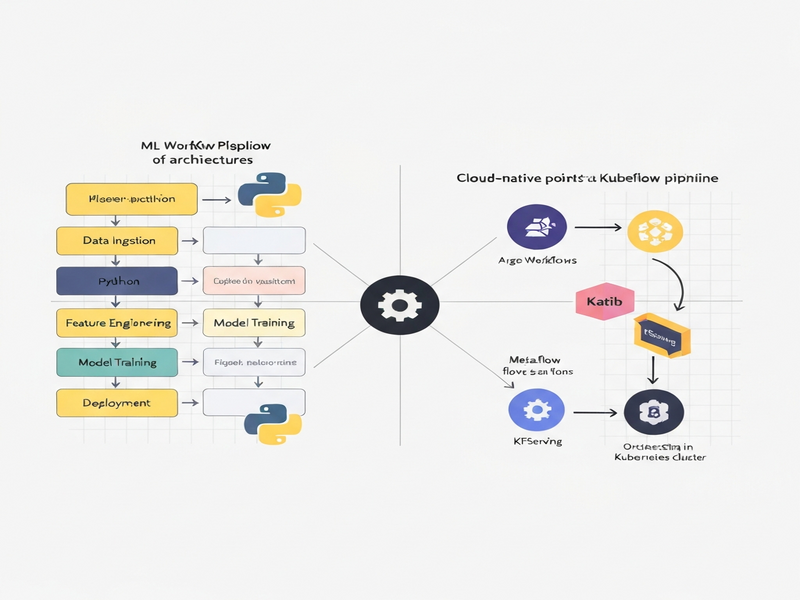
1. Introduction – Why Workflow Orchestration Matters
Modern data‑science teams juggle data ingestion, feature engineering, model training, validation, and deployment—all of which generate a tangled web of dependencies. A robust orchestration layer removes manual glue code, guarantees reproducibility, and enables seamless scaling from a laptop to a multi‑node Kubernetes cluster. For data scientists, ML engineers, and AI developers, choosing the right platform can shave weeks off a project’s time‑to‑value.
2. Overview of Metaflow
Born at Netflix in 2019, Metaflow is a Python library that abstracts away the complexities of distributed execution while keeping the codebase readable. Its core philosophy is “code first, config later.” Key pillars include:
- Simple API: Define steps with
@stepdecorators; the library handles state passing automatically. - Artifact management: Every step’s output is versioned in a durable store (S3, Azure Blob, GCS), enabling effortless rollback.
- Scalable back‑ends: Run locally, on AWS Batch, or on Kubernetes without changing the code.
- Built‑in visualisation: Real‑time cards let you inspect data, metrics, and logs directly from the notebook.
Metaflow’s design makes it ideal for teams that want to stay in pure Python, avoid YAML‑heavy pipelines, and iterate quickly. It also integrates with popular AI services—e.g., you can call ChatGPT and Telegram integration from any step to generate synthetic data or send alerts.
3. Overview of Kubeflow
Kubeflow started as a set of Kubernetes operators for TensorFlow and has evolved into a comprehensive Enterprise AI platform. It embraces the “cloud‑native” ethos, offering a modular stack that includes:
- Kubeflow Pipelines: Declarative YAML/DSL for end‑to‑end workflows.
- KServe: Model serving with auto‑scaling and canary rollouts.
- Katib: Hyper‑parameter tuning as a service.
- TFJob, PyTorchJob, Spark Operator: Distributed training primitives.
- Notebooks & Workspaces: Collaborative Jupyter environments that run inside the cluster.
Because everything runs on Kubernetes, Kubeflow shines when you already have a container‑orchestrated environment and need fine‑grained control over resources, security, and multi‑tenant governance.
4. Feature and Use‑Case Comparison
| Aspect | Metaflow | Kubeflow |
|---|---|---|
| Target Audience | Data scientists who prefer Python scripts and rapid prototyping. | ML engineers & DevOps teams needing production‑grade, cloud‑native pipelines. |
| Learning Curve | Low – familiar Python syntax, minimal YAML. | Medium‑High – requires Kubernetes knowledge and DSL configuration. |
| Scalability | Horizontal scaling via AWS Batch, Ray, or Kubernetes back‑ends. | Native horizontal pod autoscaling; supports massive distributed training. |
| Versioning & Reproducibility | Automatic artifact versioning; easy rollback. | Pipeline snapshots stored in the metadata service; reproducibility via container images. |
| Extensibility | Custom decorators, plug‑ins, and direct Python library calls. | Modular components (Katib, KServe, etc.) and SDK for custom operators. |
| Typical Use‑Cases | Exploratory model development, A/B testing, quick data pipelines. | Enterprise‑wide model training, hyper‑parameter search, serving at scale. |
In practice, many organisations blend the two: they prototype in Metaflow, then export stable flows to Kubeflow for production. This hybrid approach leverages Metaflow’s developer ergonomics while retaining Kubeflow’s operational robustness.
5. Integration Possibilities with UBOS
UBOS offers a suite of tools that can extend both Metaflow and Kubeflow without locking you into a single vendor. Below are three concrete integration patterns:
- Workflow Automation Studio: Use the Workflow automation studio to visually compose Metaflow steps and then generate Kubeflow pipeline YAMLs automatically.
- AI Marketing Agents: Deploy AI marketing agents as side‑car services that consume model predictions from either platform, enabling real‑time campaign optimisation.
- Template Marketplace: Jump‑start projects with ready‑made templates such as the AI SEO Analyzer or the AI Article Copywriter, which already embed Metaflow‑style step definitions and can be exported to Kubeflow.
These integrations are built on the UBOS platform overview, which abstracts cloud resources (AWS, GCP, Azure) behind a unified API, making it trivial to switch execution back‑ends without rewriting code.
6. Benefits and Limitations
Metaflow Benefits
- Fast onboarding for Python‑centric teams.
- Minimal infrastructure overhead for early‑stage projects.
- Rich visual debugging via cards.
Metaflow Limitations
- Less granular control over container resources.
- Feature gaps for complex conditional logic (e.g., recursive steps).
- Relies on external storage services for artifact persistence.
Kubeflow Benefits
- Full Kubernetes native lifecycle management.
- Built‑in components for hyper‑parameter tuning, serving, and monitoring.
- Enterprise‑grade security, RBAC, and multi‑tenant isolation.
Kubeflow Limitations
- Steeper learning curve; requires ops expertise.
- Higher operational cost for small teams.
- YAML‑centric definitions can feel verbose.
By pairing Metaflow’s developer agility with Kubeflow’s production muscle, you can achieve a “best‑of‑both‑worlds” workflow. UBOS’s pricing plans include a free tier for experimentation and a scalable enterprise tier that covers managed Kubernetes clusters, making the hybrid approach financially viable.
7. Real‑World Scenario: From Notebook to Production
Imagine a data‑science team building a recommendation engine:
- Exploration: In a Jupyter notebook, they write a Metaflow flow that pulls clickstream data, engineers features, and trains a LightGBM model. The
@stepAPI lets them iterate in minutes. - Validation: Using Metaflow cards, they visualise ROC curves and share results via the Telegram integration on UBOS for instant stakeholder feedback.
- Productionisation: With a single command, the flow is exported to a Kubeflow pipeline YAML. Kubeflow’s Katib runs a hyper‑parameter sweep across a GPU node pool.
- Serving: The trained model is handed off to KServe, which auto‑scales based on request volume. An AI marketing agent consumes predictions to personalise email campaigns.
This end‑to‑end path demonstrates how Metaflow accelerates the creative phase while Kubeflow guarantees reliability at scale.
8. Getting Started Quickly
Follow these three steps to try the hybrid workflow on your own environment:
- Install Metaflow:
pip install metaflow. - Deploy a minimal Kubeflow instance using UBOS’s UBOS templates for quick start (choose the “Kubeflow Starter” template).
- Run
pip install metaflow-kubeflowand setMETAFLOW_KUBEFLOW_PIPELINES_URLto point at your Kubeflow Pipelines endpoint.
After that, a single python my_flow.py kubeflow-pipelines create command will push your flow to the Kubeflow UI, where you can monitor execution, view logs, and trigger downstream services.
9. External Perspectives
For a deeper dive into the origins of the comparison, see the original discussion on the Kubeflow blog: Metaflow vs Kubeflow. The article outlines community feedback and roadmap ideas that continue to shape both ecosystems.
10. Next Steps – Choose Your Path
Whether you are a startup looking for a frictionless prototype environment or an enterprise needing rock‑solid scalability, the decision hinges on three questions:
- Do you prioritise rapid code iteration over infrastructure control? → Metaflow.
- Do you already run Kubernetes and need native CI/CD pipelines? → Kubeflow.
- Do you want the flexibility to move between the two? → Adopt UBOS’s integration layer and leverage the About UBOS story of unified AI platforms.
Ready to experiment? Visit the UBOS homepage for a free trial, explore the UBOS for startups program, or dive straight into the Enterprise AI platform by UBOS for large‑scale deployments.
Bottom line:
Metaflow gives you speed; Kubeflow gives you scale. By leveraging UBOS’s orchestration tools, you can enjoy the best of both worlds—accelerating innovation while maintaining production‑grade reliability.