

- Updated: March 11, 2026
- 6 min read
Meta Introduces New Scam Detection Tools for Facebook, WhatsApp, and Messenger
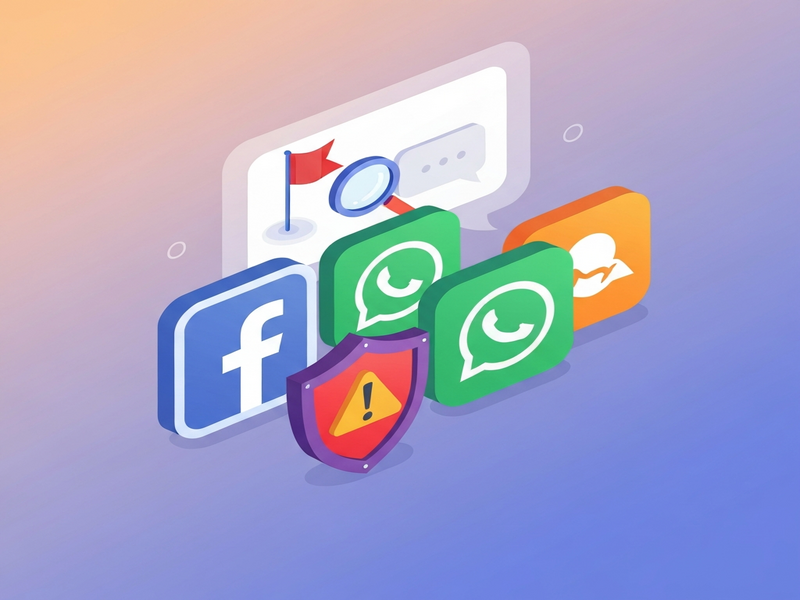
Meta has rolled out new scam detection tools across Facebook, WhatsApp, and Messenger that warn users about suspicious device links, dubious friend requests, and AI‑identified chat scams before they can cause damage.
In a move aimed at tightening security on its flagship messaging platforms, Meta announced a suite of proactive alerts designed to stop scammers in their tracks. The full rollout details were first reported by The Verge, and the features are already being tested with millions of active users worldwide.
What’s new in Meta’s scam detection arsenal?
Meta’s latest security upgrades focus on three core threat vectors:
- Device‑link alerts on WhatsApp that flag unrecognized attempts to pair a new device with a user’s account.
- Friend‑request warnings on Facebook that surface when a profile shows signs of fraudulent activity.
- AI‑driven chat‑scam reviews on Messenger that automatically analyze suspicious conversations and suggest block or report actions.
These tools are built on Meta’s long‑standing machine‑learning models, now enhanced with real‑time behavioral analysis and contextual warnings that appear directly in the user interface.
Device‑link alerts on WhatsApp
When a user receives a QR‑code or numeric code request to link a new device, WhatsApp will now display a warning if the request originates from an unfamiliar source. The alert includes:
- The geographic region of the requesting device.
- A brief risk score based on recent phishing patterns.
- A one‑click “Reject” option that prevents the link from being established.
This feature directly addresses scams that masquerade as “talent competitions” or “vote‑casting” campaigns, where scammers ask victims to scan a QR code and inadvertently hand over control of their WhatsApp account.
Friend‑request warnings on Facebook
Facebook’s new warning system activates when a profile exhibits any of the following red flags:
- Few or no mutual friends with the recipient.
- Recent creation date (less than 30 days old).
- Location in a country that differs from the user’s typical network.
When these conditions are met, a banner appears next to the request, stating: “This friend request may be from a suspicious account.” Users can then choose to accept, ignore, or report the request without opening a conversation.
AI‑driven scam reviews on Messenger
Messenger’s expanded AI engine scans incoming messages for patterns that match known scams—such as unsolicited job offers, fake investment opportunities, or “click‑to‑win” links. If a conversation triggers the model, the user sees a prompt:
“We’ve detected potential scam activity in this chat. Would you like to block or report this conversation?”
The AI not only flags the conversation but also offers a short summary of why it was flagged, giving users context before they act.
Why these tools matter for online safety
Meta’s proactive approach delivers tangible benefits for both everyday users and businesses that rely on its platforms for customer engagement:
- Reduced financial loss: Early warnings stop scammers before they can extract money or personal data.
- Higher trust in digital communication: Users feel safer sharing links and files when they know suspicious activity is flagged.
- Lower support overhead: Companies experience fewer fraud‑related tickets because the platform itself handles initial detection.
- Improved ecosystem health: By removing malicious accounts faster, the overall quality of interactions on Facebook, WhatsApp, and Messenger improves.
Industry perspective on Meta’s new safeguards
Cyber‑security analysts have praised Meta’s layered approach, noting that “combining device‑level alerts with AI‑driven conversation analysis creates a defense‑in‑depth strategy that many platforms still lack.”
John Patel, senior security researcher at SecureNet, added:
“The real strength lies in the contextual information presented to users. Instead of a generic “This looks suspicious” message, Meta shows where the request originated, the risk score, and actionable steps—all in real time.”
How you can reinforce your own security posture
While Meta’s tools raise the baseline protection for billions of users, businesses and power users can take additional steps to stay ahead of scammers:
- Explore the UBOS homepage for a suite of AI‑enhanced security utilities that integrate seamlessly with your existing workflows.
- Read the About UBOS page to understand the team behind the platform’s robust privacy framework.
- Leverage AI marketing agents to automate safe outreach while monitoring for phishing attempts.
- Join the UBOS partner program to receive early access to new security features and co‑marketing opportunities.
- Get a technical overview via the UBOS platform overview, which details how data is encrypted end‑to‑end.
- Start a pilot with UBOS for startups to test AI‑driven threat detection on a lean budget.
- Scale protection for growing teams using UBOS solutions for SMBs, which include role‑based access controls.
- Enterprise‑grade security is available through the Enterprise AI platform by UBOS, offering centralized policy enforcement.
- Customize your security dashboards with the Web app editor on UBOS to visualize alerts in real time.
- Automate response workflows via the Workflow automation studio, linking Meta alerts to internal ticketing systems.
- Review pricing options on the UBOS pricing plans to find a tier that matches your security budget.
- See real‑world implementations in the UBOS portfolio examples, which showcase anti‑phishing deployments.
- Kick‑start your own security app with UBOS templates for quick start, including pre‑built phishing‑detector modules.
- Run an AI SEO Analyzer on your help‑center pages to ensure they are not inadvertently promoting malicious links.
- Generate safe content with the AI Article Copywriter, which flags risky phrasing before publishing.
- Integrate conversational AI safely using the ChatGPT and Telegram integration for secure bot deployments.
- Leverage the OpenAI ChatGPT integration to add an extra layer of content verification.
- Store vector embeddings securely with the Chroma DB integration, protecting data used for threat intelligence.
- Enhance voice‑based alerts via the ElevenLabs AI voice integration, delivering audible warnings for high‑risk events.
- Finally, connect your internal chat tools with the Telegram integration on UBOS for rapid incident response.
Staying ahead of scammers in a connected world
Meta’s new scam detection suite marks a significant step toward a safer social‑messaging ecosystem, but vigilance remains essential. By combining platform‑level alerts with supplemental AI‑driven security solutions—such as those offered by UBOS—users and organizations can create a multi‑layered defense that adapts to evolving threats.
As scammers become more sophisticated, the best protection is a proactive, informed user base backed by intelligent, real‑time detection. Keep an eye on Meta’s updates, enable the new warnings, and consider augmenting them with dedicated security tools to ensure your digital conversations stay private, trustworthy, and scam‑free.
Andrii Bidochko
CTO UBOS
Andrii Bidochko is an AI entrepreneur and researcher focused on AI agents, reinforcement learning, and autonomous systems. He writes about the technologies shaping the future of machine intelligence, from frontier models and agent architectures to real-world AI applications.