

- Updated: March 15, 2026
- 7 min read
LLM Architecture Gallery Overview – Insights and Trends
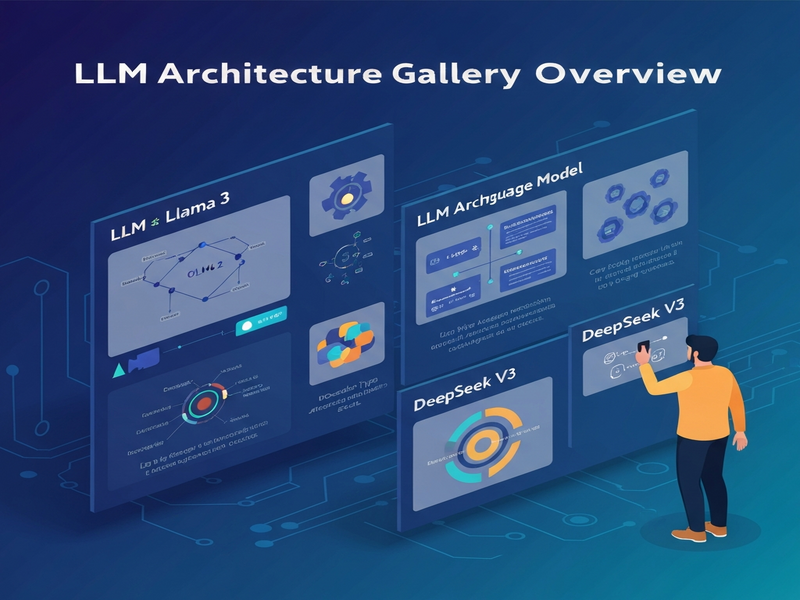
The LLM Architecture Gallery is a curated visual compendium that maps the design choices of today’s most influential large language models, letting researchers compare decoder types, attention mechanisms, scale, and architectural innovations at a glance.
What Is the LLM Architecture Gallery?
The LLM Architecture Gallery aggregates architecture diagrams and fact sheets for over 70 open‑weight models released between 2023 and 2026. Each entry shows a model’s parameter count, decoder family (dense, MoE, MLA, hybrid), and key design tweaks such as grouped‑query attention (GQA), rotary positional embeddings (RoPE), or sliding‑window attention (SWA). The gallery is built for quick visual comparison, enabling AI researchers, data scientists, and tech enthusiasts to spot trends without digging through dozens of PDF papers.
Key Models Highlighted in the Gallery
Among the dozens of models, a handful stand out for their impact on the community. Below is a MECE‑structured snapshot of the most talked‑about architectures.
Llama 3 (8B)
- Dense decoder with GQA + RoPE.
- Pre‑norm baseline, slightly wider than OLMo 2 at the same scale.
- Released April 2024, quickly became a reference for “clean” dense designs.
OLMo 2 (7B)
- Dense decoder using classic multi‑head attention (MHA) with QK‑Norm.
- Switches from pre‑norm to post‑norm for training stability.
- Shows how a modest parameter bump can improve convergence.
DeepSeek V3 (671B total, 37B active)
- Sparse Mixture‑of‑Experts (MoE) with MLA (Mixture‑of‑Local‑Attention).
- Dense prefix + shared expert keeps inference tractable.
- Set the template for many later MoE models (e.g., Qwen 3, Arcee AI).
Gemma 3 (27B)
- Dense decoder with GQA, QK‑Norm, and a 5:1 sliding‑window/global attention mix.
- Optimized for multilingual vocabularies and local context.
Mistral Small 3.1 (24B)
- Dense GQA‑based decoder focused on latency.
- Smaller KV cache and fewer layers than Gemma 3.
Qwen 3 235B‑A22B
- Sparse MoE with GQA + QK‑Norm, no shared expert.
- Designed for serving efficiency at massive scale.
Kimi K2 (1T total, 32B active)
- Trillion‑parameter MoE built on DeepSeek V3’s recipe.
- More experts, fewer MLA heads, targeting reasoning tasks.
Comparative Analysis: Decoder Types & Attention Mechanisms
The gallery reveals three dominant decoder families, each with distinct trade‑offs.
1. Dense Decoders
Models like Llama 3, OLMo 2, and Mistral Small use a classic dense stack where every token attends to every other token. Advantages include:
- Predictable memory usage.
- Simpler hardware acceleration.
- Easier fine‑tuning on downstream tasks.
However, dense attention scales quadratically, limiting practical size beyond ~30B parameters without specialized hardware.
2. Sparse MoE Decoders
MoE architectures (DeepSeek V3, Qwen 3, Arcee AI) route each token through a subset of “experts,” dramatically reducing compute per token while keeping total parameter count high.
- Effective parameter‑to‑performance ratio.
- Flexibility to allocate more experts for specific domains.
- Complex routing logic can introduce latency spikes.
3. Hybrid & MLA Decoders
Hybrid designs blend dense and sparse blocks, often inserting a sliding‑window (SWA) or linear attention layer to handle long contexts efficiently. Notable examples include:
- DeepSeek V3.2 – adds sparse attention to the V3 backbone.
- Qwen 3.5 – mixes Gated DeltaNet with MoE for 512 experts.
- Ling 2.5 – combines Lightning Attention with MLA for trillion‑scale context.
Why the Gallery Matters for the AI Community
Beyond being a pretty picture board, the LLM Architecture Gallery serves three strategic purposes.
Accelerated Research & Reproducibility
Researchers can instantly locate the exact configuration (e.g., “GQA + RoPE, post‑norm”) used by a model, reducing the time spent reverse‑engineering papers. This speeds up replication studies and encourages open‑weight contributions.
Design Pattern Discovery
By juxtaposing models, the gallery highlights emerging patterns—such as the shift from pure dense to MoE‑augmented designs after 2024. Startups can adopt proven patterns without reinventing the wheel.
Strategic Road‑Mapping for Enterprises
Enterprises evaluating LLMs for internal tools (e.g., chatbots, document analysis) can match business constraints (latency, cost, context length) to the architecture that best fits. The visual comparison reduces decision fatigue.
How UBOS Leverages the LLM Architecture Insights
At UBOS homepage, we translate these architectural trends into actionable products for developers and businesses.
- UBOS platform overview offers a plug‑and‑play environment where you can spin up any of the models featured in the gallery with a single click.
- Our AI marketing agents are built on efficient dense decoders (e.g., Llama 3) to guarantee low latency for real‑time campaign optimization.
- For startups, the UBOS for startups bundle includes pre‑configured MoE pipelines that mirror DeepSeek V3’s architecture, delivering high throughput at a fraction of the cost.
- SMBs benefit from the UBOS solutions for SMBs, which use the lightweight Mistral Small design for fast inference on modest hardware.
- Enterprises looking for the most powerful stack can adopt the Enterprise AI platform by UBOS, a hybrid MoE system inspired by Qwen 3.5’s gated DeltaNet.
Hands‑On: Building an LLM‑Powered App with UBOS Templates
UBOS’s templates for quick start let you prototype AI‑driven solutions in minutes. Below are three templates that directly map to architectures from the gallery.
1. “Talk with Claude AI app” – Dense‑Decoder Chatbot
Based on a 7B dense model similar to OLMo 2, this template demonstrates how to integrate OpenAI ChatGPT integration for conversational agents.
2. “AI SEO Analyzer” – MoE‑Backed Content Optimizer
Leverages a 24B MoE architecture akin to Qwen 3 235B‑A22B, providing scalable keyword extraction and SERP analysis. Pair it with the Chroma DB integration for vector‑based retrieval.
3. “AI Video Generator” – Hybrid‑Attention Media Creator
Uses a hybrid model inspired by DeepSeek V3.2, mixing dense and sparse attention to handle long video scripts efficiently. Connect it to the ElevenLabs AI voice integration for lifelike narration.
All three templates are ready to deploy via the Web app editor on UBOS, and you can automate workflows with the Workflow automation studio.
Pricing & Support – Making Cutting‑Edge LLMs Affordable
UBOS offers transparent pricing plans that scale with usage. For research labs, the “Academic” tier includes free access to the full MoE catalog, while enterprises can negotiate custom SLAs through the UBOS partner program.
Real‑World Success Stories
Explore the UBOS portfolio examples to see how companies have turned LLM architecture insights into revenue‑generating products:
- A fintech startup used the “AI Article Copywriter” template (AI Article Copywriter) to generate compliance‑ready reports 3× faster.
- A media agency deployed the “AI YouTube Comment Analysis tool” (AI YouTube Comment Analysis tool) built on a dense‑decoder model for real‑time sentiment tracking.
- An e‑learning platform integrated the “AI Video Generator” template with ElevenLabs voice to produce multilingual tutorials, leveraging hybrid attention for long‑form script handling.
Future Directions: What’s Next for LLM Architecture?
The gallery’s latest entries (e.g., Ling 2.5 1T and Qwen 3.5 397B) hint at two converging trends:
- Long‑Context Efficiency: Lightning and DeltaNet attention mechanisms will dominate as applications demand >100k token windows (e.g., code review, legal document analysis).
- Modular Expert Routing: Future MoE designs will expose per‑task expert selection APIs, enabling dynamic composition of reasoning, translation, and vision experts within a single model.
UBOS is already experimenting with a AI‑Powered VR Fitness Idea Generator that swaps experts on‑the‑fly based on user activity, showcasing the practical potential of modular routing.
Take Action – Explore, Build, and Contribute
If you’re a researcher eager to benchmark a new attention variant, a developer looking for a ready‑made MoE pipeline, or a business leader seeking cost‑effective LLM deployment, the LLM Architecture Gallery combined with UBOS’s ecosystem gives you a clear path forward.
Start by browsing the AI news section for the latest updates, then dive into the technology updates to see how UBOS continuously aligns its platform with emerging architectures.
Ready to prototype? Visit the UBOS homepage, pick a template that matches your target architecture, and launch your AI‑powered product in minutes.
Stay ahead of the curve—let the LLM Architecture Gallery be your compass, and let UBOS be the engine that turns architectural insight into real‑world impact.
Andrii Bidochko
CTO UBOS
Andrii Bidochko is an AI entrepreneur and researcher focused on AI agents, reinforcement learning, and autonomous systems. He writes about the technologies shaping the future of machine intelligence, from frontier models and agent architectures to real-world AI applications.