

- Updated: January 5, 2026
- 7 min read
Google’s DMCA Process Leaves Creators Frustrated – A New Look
Google’s DMCA process has become far more restrictive in 2026, often refusing to act on legitimate copyright removal requests and leaving creators to fend for themselves.
Google Broke My Heart: A First‑Hand Account of the New DMCA Roadblocks
For years, authors and digital publishers relied on Google’s DMCA takedown system as a safety net against pirated copies of their work surfacing in search results. The process was once swift, transparent, and—most importantly—effective. Fast‑forward to January 2026, and the same system now questions the very identity of the complainant, demanding proof that was never required before. This shift has profound implications for anyone who creates, distributes, or monetizes digital content.
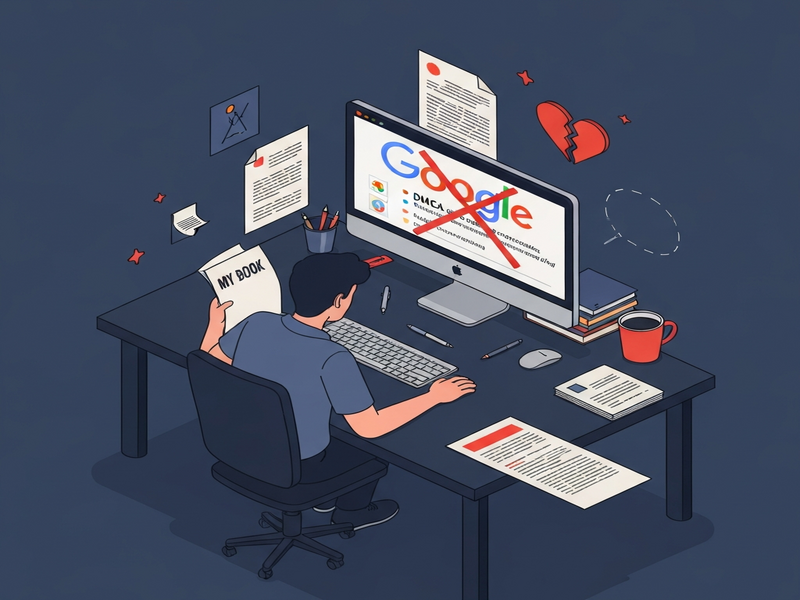
In this article we dissect the author’s recent struggle with Google’s DMCA team, explore the broader impact on the publishing ecosystem, and show how modern AI‑powered platforms—like the UBOS homepage—can help creators safeguard their intellectual property while staying SEO‑friendly.
The Author’s Journey Through Google’s New DMCA Maze
Step 1: The Initial Complaint
The author, a seasoned WordPress developer and book writer, discovered a pirated PDF of his latest title ranking on the first page of Google. He submitted a standard DMCA notice, expecting the familiar rapid removal.
Step 2: The Unexpected Rejection
Instead of the usual confirmation, Google replied:
“We are unsure whether you are authorized to submit a copyright removal request for the content in question. Only the copyright owner or their authorized representative can submit a request.”
This response not only denied the request but also hinted at potential legal liability for a “false claim.” The author’s confidence turned into confusion.
Step 3: The Identity‑Verification Loop
Seeking clarification, the author replied with his name, author credentials, and a request for guidance on how to prove ownership. Google’s next email escalated the demand:
“It is unclear how you own the copyright. Please explain the basis for your claim.”
No specific instructions were given—no request for a driver’s license, no link to a verification portal—just a vague demand for “further explanation.”
Step 4: The Exhaustive Evidence Package
Undeterred, the author compiled a comprehensive dossier: links to his author website, Google Search Console ownership screenshots, social‑media profiles, and a list of his published works. He sent this packet, hoping the extra context would satisfy Google’s new gatekeeping.
Step 5: The Final Dismissal
After another waiting period, Google responded with a polite refusal:
“We have decided not to take action on the following URLs. We encourage you to resolve the dispute directly with the site owner.”
The author’s request was effectively ignored, leaving the pirated copy to continue ranking and siphoning potential sales.
What This Means for Creators, Publishers, and the Wider Web
The shift in Google’s DMCA handling is not an isolated incident; it signals a strategic pivot that could reshape digital publishing. Below are the key ramifications:
- Increased Legal Exposure: By demanding proof of ownership, Google places the burden of documentation on creators, raising the risk of inadvertent “false claim” accusations.
- Longer Takedown Timelines: The back‑and‑forth verification loop can add weeks—or even months—to the removal process, during which pirated content continues to generate traffic and revenue for infringers.
- Reduced Trust in Search Engines: Content creators who once viewed Google as a partner now see it as a gatekeeper, potentially driving them toward alternative discovery channels (e.g., niche platforms, social media, or AI‑driven marketplaces).
- Higher Operational Costs: Small publishers must allocate resources—time, legal counsel, and technical staff—to manage DMCA compliance, diverting effort from core creative work.
- Potential for AI‑Generated Abuse: As large language models ingest publicly available text, unchecked piracy could feed AI training data, amplifying the problem.
For tech‑savvy professionals, these challenges demand a proactive, technology‑first approach. Leveraging AI‑powered tools can streamline verification, automate takedown requests, and even pre‑emptively protect content before it appears in search results.
A Content Creator’s Guide to Navigating Google DMCA in 2026
Below is a step‑by‑step checklist that blends legal best practices with modern AI solutions:
- Document Ownership Upfront: Keep a centralized repository of ISBNs, registration certificates, and publishing contracts. Services like the OpenAI ChatGPT integration can auto‑generate summary PDFs of your rights documents.
- Automate DMCA Submission: Use a workflow automation tool—such as the Workflow automation studio—to fill out Google’s form, attach proof files, and log each request in a spreadsheet.
- Leverage AI for Proof Generation: The Chroma DB integration can index your content metadata, allowing you to quickly retrieve timestamps, version histories, and source URLs when Google asks for evidence.
- Monitor Search Results Continuously: Deploy a bot (e.g., a GPT‑Powered Telegram Bot) that alerts you the moment a new infringing URL appears.
- Prepare a Standardized Response Pack: Include a one‑page ownership statement, a link to your author profile on the About UBOS page, and a screenshot of your Search Console verification.
- Consider Alternative Takedown Channels: If Google remains uncooperative, file a DMCA notice with the infringing site’s host, and use the AI SEO Analyzer to identify other search engines indexing the content.
Why UBOS Is the Ideal Ally for Modern Publishers
UBOS offers a suite of AI‑driven services that directly address the pain points highlighted above. Below are the most relevant solutions for creators battling DMCA hurdles:
- UBOS platform overview: A low‑code environment where you can build custom copyright‑monitoring dashboards without writing a single line of code.
- AI marketing agents: Automate outreach to infringing sites, generate personalized cease‑and‑desist letters, and track responses in real time.
- UBOS templates for quick start: Ready‑made “DMCA Request Builder” templates that pre‑populate fields with your stored ownership data.
- UBOS partner program: Gain access to exclusive legal‑tech integrations and priority support for high‑volume publishers.
- UBOS pricing plans: Scalable pricing that fits indie authors, startups, and enterprise‑level publishing houses.
- UBOS for startups: Fast‑track your MVP with built‑in AI content protection modules.
- UBOS solutions for SMBs: Tailored workflows for small‑to‑medium publishers who need cost‑effective compliance.
- Enterprise AI platform by UBOS: Enterprise‑grade monitoring, analytics, and automated takedown orchestration across multiple domains.
- Web app editor on UBOS: Build a public portal where readers can verify the authenticity of your works, reducing the appeal of pirated copies.
- UBOS portfolio examples: See how other creators have integrated AI‑driven copyright protection into their digital products.
By integrating these tools, you can transform a reactive, manual DMCA process into a proactive, automated defense system—saving time, money, and peace of mind.
Boost Your Publishing Workflow with UBOS Marketplace Templates
UBOS’s marketplace hosts dozens of AI‑enhanced templates that can be instantly deployed. Here are a few that directly support copyright management and SEO resilience:
AI SEO Analyzer
Detect unauthorized indexing of your content across search engines and receive actionable remediation steps.
AI Article Copywriter
Generate SEO‑optimized blog posts that reinforce your brand’s authority, making it harder for infringers to outrank you.
Talk with Claude AI app
Deploy a conversational assistant that can answer reader questions about licensing, reducing the temptation to seek pirated copies.
Your Speaking Avatar template
Create an AI‑driven voice avatar that narrates your books, adding a unique, monetizable product line.
AI YouTube Comment Analysis tool
Monitor YouTube for mentions of your titles and spot potential piracy early.
Image Generation with Stable Diffusion
Produce unique cover art that can be watermarked automatically, deterring unauthorized reuse.
Conclusion: Take Control of Your Copyright Today
The evolving Google DMCA landscape underscores a critical truth: relying solely on search engines for protection is no longer viable. Creators must adopt a multi‑layered strategy that blends legal diligence with AI‑driven automation.
If you’re a tech‑savvy author, publisher, or SaaS founder, start by auditing your ownership records, then explore UBOS’s comprehensive suite of tools. From the partner program to the enterprise AI platform, there’s a solution tailored to every scale.
Ready to future‑proof your digital assets? Visit the UBOS homepage and launch a free trial of the Web app editor on UBOS today.
Stay ahead of the curve, protect your creations, and keep your SEO rankings intact—because your work deserves a platform that respects and defends it.
Source: Google Broke My Heart
Andrii Bidochko
CTO UBOS
Andrii Bidochko is an AI entrepreneur and researcher focused on AI agents, reinforcement learning, and autonomous systems. He writes about the technologies shaping the future of machine intelligence, from frontier models and agent architectures to real-world AI applications.