

- Updated: November 27, 2025
- 5 min read
Elon Musk’s xAI launches 30 MW solar farm to power Colossus data center
Elon Musk’s AI venture xAI has submitted a plan to construct a 30 MW solar farm on an 88‑acre site adjacent to its massive Colossus data center in Memphis, Tennessee, with a $439 million USDA loan package earmarked to power the facility sustainably.
xAI’s 30 MW Solar Farm Near Colossus Data Center: A Sustainable Leap for AI Infrastructure
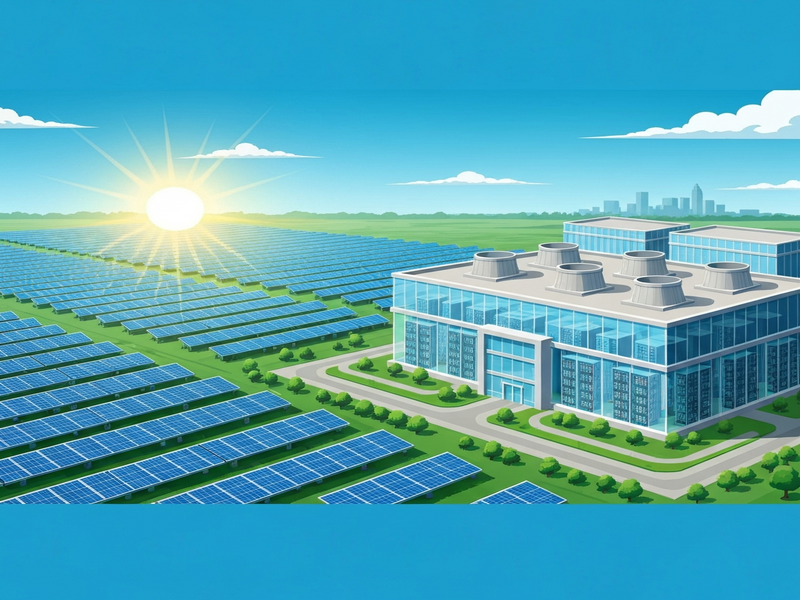
In a move that blends artificial‑intelligence ambition with renewable‑energy policy, Elon Musk’s TechCrunch report confirms that xAI intends to develop a 30 MW solar installation on an 88‑acre parcel bordering its Enterprise AI platform by UBOS-style data center. The project, backed by a $414 million interest‑free USDA loan, aims to offset roughly 10 % of the Colossus center’s projected 300 MW power demand, marking a significant step toward greener AI workloads.
Background: xAI and the Colossus Data Center
Founded in 2023 by Elon Musk, xAI positions itself as a frontier AI research lab focused on large‑scale model training. Its flagship facility, the Colossus data center, spans over 1.2 million square feet in Memphis and is touted as one of the world’s most power‑intensive AI hubs. The center currently relies on a mix of natural‑gas turbines and grid electricity, drawing criticism from environmental groups for high nitrogen‑oxide (NOX) emissions.
The Colossus site sits on a 136‑acre tract owned by the same developer that controls the adjacent vacant land earmarked for the solar farm. This proximity enables a direct power feed, reducing transmission losses and simplifying grid interconnection—an advantage often highlighted in UBOS platform overview case studies on edge‑to‑cloud energy efficiency.
Project Details: 30 MW Solar Farm and USDA Funding
The solar farm proposal outlines the following key specifications:
| Parameter | Value |
|---|---|
| Site Area | 88 acres (west & south of Colossus) |
| Capacity | 30 MW (≈10 % of Colossus demand) |
| USDA Funding | $439 million total; $414 million interest‑free loan |
| Timeline | Construction start Q2 2026, operational by Q4 2026 |
| Partner Developer | Seven States Power Corporation |
The USDA loan package is part of the agency’s Rural Development initiative, which aims to accelerate clean‑energy projects in underserved regions. The interest‑free nature of the loan reduces capital costs for xAI, allowing the company to allocate more resources toward AI research and talent acquisition.
Why 30 MW?
- Provides a steady baseline power source for non‑peak AI training cycles.
- Reduces reliance on the 400 MW of natural‑gas turbines currently operating on‑site.
- Facilitates future expansion to a 100 MW solar + 100 MW battery system, as previously announced by xAI.
Environmental and Community Impact
The solar farm is expected to cut annual CO₂ emissions by roughly 45,000 metric tons, equivalent to removing 9,800 passenger cars from the road. Moreover, the project will generate clean‑energy credits that can be sold back to the grid, creating a revenue stream that offsets operational costs.
Community leaders in Memphis’s Boxtown district, a historically underserved neighborhood, have expressed cautious optimism. While the previous deployment of 400 MW of gas turbines raised concerns about NOX spikes and respiratory health impacts, the solar initiative promises a tangible reduction in local air pollutants.
Health Benefits
- Projected 30 % decrease in NOX emissions from the data center’s power mix.
- Improved air quality metrics measured by the Tennessee Department of Environment & Conservation.
- Potential reduction in asthma-related emergency visits in the surrounding zip codes.
Economic Upside for Memphis
- Construction phase will create ~250 short‑term jobs.
- Long‑term operations will require a small permanent staff for maintenance and monitoring.
- Local tax revenue increase projected at $2.3 million annually.
Industry Reactions and Related Events
The announcement has sparked a flurry of commentary across tech and sustainability circles. Analysts at UBOS AI Innovation note that integrating renewable power directly at the data‑center edge is a “game‑changing” strategy that could set a new standard for AI‑heavy enterprises.
At the same time, environmental NGOs such as the Southern Environmental Law Center (SELC) have urged xAI to accelerate the transition from gas turbines to fully renewable sources, citing the recent spike in nitrogen‑dioxide levels documented by the University of Tennessee, Knoxville.
The solar farm also aligns with broader industry trends. Companies like Microsoft and Google have pledged to power their AI workloads with 100 % renewable energy by 2030, and xAI’s project adds a high‑visibility case study for the AI marketing agents that are increasingly being tasked with sustainability reporting.
How UBOS Can Help Similar Projects
Organizations looking to replicate xAI’s renewable‑energy integration can leverage several UBOS tools:
- Workflow automation studio – automates permit tracking and funding applications.
- Web app editor on UBOS – builds dashboards for real‑time solar output monitoring.
- UBOS templates for quick start – includes a “Renewable Energy Project Planner” template.
- UBOS portfolio examples – showcases similar data‑center sustainability deployments.
Conclusion & Future Outlook
Elon Musk’s xAI is positioning the Colossus data center as a testbed for the next generation of green AI infrastructure. By securing a $414 million interest‑free USDA loan for a 30 MW solar farm, the company not only reduces its carbon footprint but also creates a replicable model for other AI‑intensive enterprises.
Looking ahead, xAI has hinted at scaling the solar capacity to 100 MW and pairing it with grid‑scale battery storage, which would enable 24/7 renewable power for AI training cycles. If successful, this could accelerate the industry’s shift away from fossil‑fuel‑based backup generation and set a benchmark for sustainable AI development.
Explore More on Sustainable AI with UBOS
Interested in building your own AI‑powered, eco‑friendly infrastructure? Check out these resources:
- UBOS AI Innovation Hub – insights on AI and sustainability.
- AI SEO Analyzer – optimize your renewable‑energy project’s online presence.
- AI YouTube Comment Analysis tool – gauge public sentiment on green tech announcements.
- AI Video Generator – create compelling visual briefs for investors.
- AI Voice Assistant – automate stakeholder updates.
© 2025 UBOS Technologies. All rights reserved.