

- Updated: February 16, 2026
- 8 min read
Effective Error Payload Handling in Zig with Union(Enum) Diagnostics
Zig error payload handling is achieved through a union(enum)‑based Diagnostics type that couples an error code with optional contextual data, allowing developers to propagate rich error information without inflating call‑site code.
Zig Error Payloads: A Modern Approach to Precise Error Handling
When building robust systems in Zig, the ability to attach detailed context to an error can be the difference between a cryptic failure and a quickly diagnosable issue. The recent original article introduced a clever pattern using a union(enum) called Diagnostics. This guide expands on that concept, provides concrete code snippets, and shows how the pattern fits into larger software ecosystems—including AI‑driven platforms like UBOS platform overview.
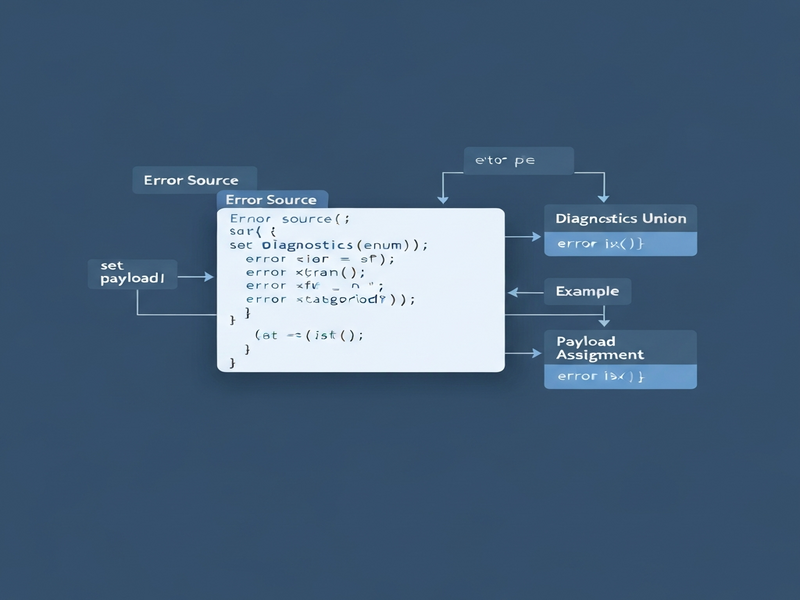
What Are Zig Error Payloads?
Zig’s error handling model is built around error unions, which allow functions to return either a value or an error tag. By default, these tags carry no additional data—just the error name. An error payload enriches this model by attaching a custom struct (or any type) to the error, preserving valuable debugging information such as SQL error codes, file paths, or network response bodies.
The key to a clean implementation is the Diagnostics wrapper, a generic struct that stores an optional payload and automatically generates an error set from the union’s enum tags. This eliminates repetitive boilerplate while keeping the binary size minimal.
The Diagnostics union(enum) Type Explained
The core of the pattern lives in a single generic function:
pub fn FromUnion(comptime _Payload: type) type {
    return struct {
        pub const Payload = _Payload;
        pub const Error = ErrorSetFromEnum(std.meta.FieldEnum(Payload));
        payload: ?Payload = null,

        // Helper methods are injected here…
    };
}
This FromUnion function does three things:
- Captures the payload type (
Payload) so the compiler knows what data may accompany each error. - Derives an error set (
Error) from the enum tags, giving you a typederrorunion without manual enumeration. - Provides a storage field (
payload) that holds the optional context when an error occurs.
Because the wrapper is generated at compile time, the resulting code is as efficient as hand‑written error handling, but with dramatically less noise at the call site.
Step‑by‑Step Code Walkthrough
1. Defining a Diagnostics Type for a Function
Suppose you are writing a SQLite wrapper. First, declare a diagnostics type that enumerates every error you want to capture:
const BuildDiagnostics = diagnostics.FromUnion(union(enum) {
    SqliteError: sqlite.ErrorPayload,
    OutOfMemory: void,
    LoadPluginsError: diagnostics.OfFunction(transforms.loadPlugins).ErrorPayload(error.LoadPluginsError),
    // …add more as needed
});
Here, SqliteError carries a custom sqlite.ErrorPayload struct, while OutOfMemory carries no extra data (hence void).
2. Attaching a Payload with withContext
When a low‑level call fails, you can store its payload in the diagnostics wrapper before bubbling the error up:
pub fn countRows(
    alloc: std.mem.Allocator,
    db: *c.sqlite,
    opts: Options,
    diag: *diagnostics.FromUnion(union(enum) {
        SqliteError: sqlite.ErrorPayload,
        OutOfMemory: void,
    })
) !usize {
    const stmt = sqlite.prepareStmt(alloc, db,
        "SELECT COUNT(*) FROM {0s} WHERE ({1s})",
        .{ opts.table_name, opts.where_expr })
    catch |err| return switch (err) {
        error.SqliteError => diag.withContext(error.SqliteError, .init(db)),
        error.OutOfMemory => error.OutOfMemory,
    };
    // Normal success path…
}
The call to diag.withContext stores the sqlite.ErrorPayload (which may include the offending SQL string, error code, etc.) inside diag and then returns the appropriate error tag.
3. Propagating Errors with the call Helper
Manually copying payloads between diagnostics objects can be tedious. The call method abstracts this pattern:
pub fn build(alloc: std.mem.Allocator, db: *c.sqlite, opts: Options, diag: *BuildDiagnostics) !void {
    const n_rows = try diag.call(countRows, .{ alloc, db, opts });
    const n_chunks = @max(1, n_rows / opts.chunk_size);
    // …continue building
}
Behind the scenes, diag.call:
- Instantiates a temporary diagnostics object matching
countRows’s signature. - Invokes
countRowswith that temporary object. - If an error occurs, copies the payload into the original
BuildDiagnosticsinstance.
This reduces a multi‑line error‑handling block to a single expressive line, keeping the call site clean and readable.
4. Accessing the Payload at the Edge
When you finally need to log or react to an error, the payload is readily available via the get method:
fn logBuildError(diag: BuildDiagnostics, err: BuildDiagnostics.Error) void {
    switch (err) {
        error.SqliteError => if (diag.get(error.SqliteError)) |info| {
            std.log.err("SQLite failed: code={d}, msg={s}", .{ info.code, info.message });
        } else {
            std.log.err("SQLite failed with unknown payload", .{});
        },
        // handle other errors…
    }
}
This pattern ensures that every error carries the exact data you need for diagnostics, without forcing every caller to know the payload shape.
Benefits of Using Diagnostics for Error Payloads
Adopting the Diagnostics wrapper yields tangible advantages across the development lifecycle:
- Zero‑bloat call sites: The heavy lifting lives in the generic wrapper, not in each function.
- Strong typing: Errors and their payloads are compile‑time checked, preventing mismatched payload accesses.
- Improved observability: Detailed context is automatically available for logging, monitoring, or user‑facing error messages.
- Reusability: The same
Diagnosticspattern can be applied to any subsystem—networking, file I/O, or third‑party APIs. - Better ergonomics for async code: When combined with Zig’s async/await, payloads travel seamlessly across await points.
Best‑Practice Checklist
- Define a dedicated
Diagnosticstype per public API boundary. - Prefer
voidfor errors that truly have no extra data to keep the payload size minimal. - Use
withContextimmediately after catching an error to avoid losing the original context. - Leverage
callfor nested function chains to keep propagation concise. - Log payloads at the highest level where they are meaningful; avoid logging low‑level details in generic libraries.
How This Differs From Traditional Zig Error Handling
Standard Zig error handling looks like this:
const result = someFunc() catch |err| {
    return err; // No payload attached
};
While simple, it forces the caller to re‑query the source of the error if more context is needed, often resulting in duplicated error‑code checks or additional wrapper functions. The Diagnostics approach centralizes that context, making the error itself a carrier of useful data.
Bridging Zig Diagnostics with AI‑Powered Development Platforms
Modern AI‑first development environments, such as the UBOS homepage, thrive on clear, machine‑readable contracts. By exposing Zig’s rich error payloads through a well‑defined API, you can feed those payloads directly into AI agents for automated debugging, log analysis, or even self‑healing workflows.
For example, an AI marketing agent could ingest error logs from a Zig‑based data pipeline, parse the payloads, and suggest corrective actions without human intervention. Similarly, the Workflow automation studio can trigger alerts or rollbacks based on specific error codes embedded in the payload.
If you need a rapid prototype, the Web app editor on UBOS lets you spin up a UI that visualizes these diagnostics in real time, turning raw structs into friendly dashboards.
Developers looking for ready‑made templates can explore the UBOS templates for quick start. The AI SEO Analyzer template, for instance, demonstrates how to pipe structured error data into an AI model that recommends SEO improvements—showcasing the same principle of payload‑driven intelligence.
For teams focused on startups, the UBOS for startups program offers credits and mentorship to integrate Zig services with AI‑enhanced back‑ends. SMBs can benefit from the UBOS solutions for SMBs, which include pre‑configured error‑monitoring pipelines that consume Zig diagnostics out‑of‑the‑box.
Enterprises looking for a scalable approach can adopt the Enterprise AI platform by UBOS, which supports custom data schemas—perfect for storing and querying Zig error payloads at petabyte scale.
Finally, developers interested in voice‑enabled debugging can pair Zig diagnostics with the ElevenLabs AI voice integration to read out critical error information during CI/CD runs, or use the Telegram integration on UBOS to push real‑time alerts to a DevOps channel.
Conclusion: Adopt Diagnostics for Safer, Smarter Zig Code
By leveraging a union(enum)‑based Diagnostics wrapper, Zig developers gain a powerful, low‑overhead mechanism to attach rich context to errors. This pattern not only streamlines code but also opens the door to AI‑driven observability and automated remediation.
Ready to experiment?
- Explore the UBOS pricing plans to find a tier that fits your team.
- Browse the UBOS portfolio examples for real‑world implementations of error‑aware AI pipelines.
- Kick‑start your next project with the AI Article Copywriter template and adapt its error‑handling strategy to your own services.
- Join the UBOS partner program to collaborate on cutting‑edge diagnostics tooling.
Embrace the future of error handling today—your code, your users, and your AI assistants will thank you.
Andrii Bidochko
CTO UBOS
Andrii Bidochko is an AI entrepreneur and researcher focused on AI agents, reinforcement learning, and autonomous systems. He writes about the technologies shaping the future of machine intelligence, from frontier models and agent architectures to real-world AI applications.