

- Updated: April 2, 2026
- 6 min read
DUC Data Breach Exposes Over 3.2 Million Users’ IDs and Passports – Fintech Security Alert
The DUC breach exposed the driver’s licenses, passports, and other personal data of millions of users of the Canadian money‑transfer app, revealing a critical Amazon server vulnerability that fintech companies must urgently address.
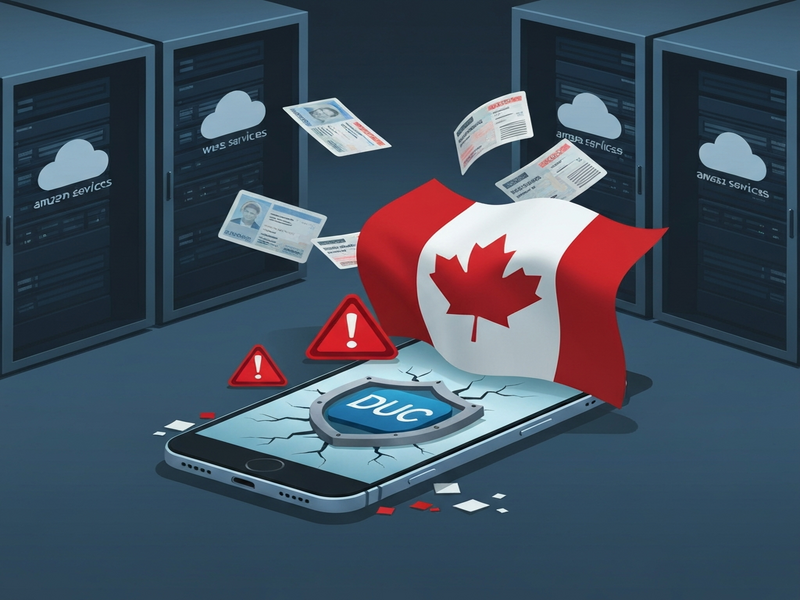
DUC Breach: What Happened and Why It Matters for Fintech Users
On April 2, 2026, TechCrunch reported that DUC, a popular Canadian money‑transfer platform, suffered a massive data breach. The incident compromised more than 3.2 million records, including driver’s licenses, passports, and even the internal configuration of an Amazon Web Services (AWS) server that hosted the app’s backend. The breach underscores the growing risk of cloud‑based vulnerabilities in the fintech sector.
Key Facts at a Glance
- Scope: Over 3.2 million users affected.
- Data types: Driver’s licenses, passports, email addresses, phone numbers, and hashed passwords.
- Root cause: Misconfigured Amazon S3 bucket combined with outdated IAM policies.
- Timeline: Breach discovered on March 28, publicly disclosed on April 2.
Detailed Breakdown of the Exposed Data
The breach did not merely expose superficial contact information. According to the forensic analysis released by DUC’s security team, the following data categories were fully readable:
Personal Identification Documents
- Driver’s license numbers and issuing province.
- Passport numbers, expiration dates, and issuing country.
- National ID equivalents for users residing outside Canada.
Contact and Account Details
- Full name, email address, and phone number.
- Encrypted but weakly salted password hashes.
- Transaction metadata (amount, timestamps, recipient IDs).
Infrastructure Secrets
The AWS server misconfiguration exposed internal API keys, database connection strings, and a snapshot of the Amazon server environment. Attackers could theoretically reconstruct the entire backend logic, opening the door for future credential stuffing or API abuse.
Impact on Users and Regulatory Response
Immediate Risks for Affected Users
The exposure of driver’s licenses and passports creates a fertile ground for identity theft, synthetic fraud, and unauthorized financial transactions. Users are urged to:
- Monitor credit reports for unusual activity.
- Enable multi‑factor authentication (MFA) on all financial accounts.
- Consider a credit freeze until the breach is fully remediated.
Regulatory Reaction in Canada
The Office of the Privacy Commissioner of Canada (OPC) launched an investigation under the Personal Information Protection and Electronic Documents Act (PIPEDA). In a statement, the OPC emphasized that “organizations handling sensitive personal data must adopt industry‑standard cloud security practices, including regular configuration audits and least‑privilege access controls.”
Expert Commentary on Fintech Security
“Fintech firms are increasingly relying on third‑party cloud services, but the DUC breach shows that a single misconfiguration can cascade into a nationwide data disaster. Companies must treat cloud security as a core product feature, not an afterthought,” says Dr. Maya Patel, senior security analyst at the Canadian Institute of Cybersecurity.
Dr. Patel also highlighted the importance of automated compliance checks and AI‑driven monitoring. “Traditional manual audits miss subtle permission drifts. Leveraging AI can surface risky configurations in real time,” she added.
How Fintech Companies Can Fortify Their Data Defenses
The DUC incident is a cautionary tale, but it also offers a roadmap for building resilient fintech platforms. Below are proven strategies, many of which are already baked into the Enterprise AI platform by UBOS:
Adopt Zero‑Trust Architecture
Zero‑trust assumes no component—whether inside or outside the network—is inherently trustworthy. Implement continuous verification for every API call, and enforce strict role‑based access controls (RBAC). The Workflow automation studio enables you to design and enforce such policies without writing extensive code.
Leverage AI‑Powered Monitoring
AI can detect anomalous patterns in real time, flagging potential data exfiltration before it escalates. UBOS’s AI marketing agents are built on the same underlying engine that powers security analytics, allowing you to repurpose models for threat detection.
Secure Cloud Configurations with Automated Audits
Use infrastructure‑as‑code (IaC) tools that embed security checks into the CI/CD pipeline. UBOS’s Web app editor on UBOS includes built‑in linting for AWS, Azure, and GCP configurations, ensuring that misconfigurations like open S3 buckets are caught early.
Encrypt Data at Rest and In Transit
End‑to‑end encryption should be mandatory for all personally identifiable information (PII). UBOS provides seamless integration with OpenAI ChatGPT integration to generate encryption keys and rotate them automatically.
Implement Robust Identity Verification
Multi‑factor authentication, biometric verification, and real‑time document validation reduce the risk of fraudulent account creation. The ChatGPT and Telegram integration can be extended to deliver secure OTPs and verification prompts directly to users’ preferred messaging apps.
Utilize Specialized AI Services for Data Privacy
UBOS’s marketplace offers ready‑made templates that accelerate compliance initiatives:
- AI SEO Analyzer – scans public‑facing pages for inadvertent data leaks.
- AI Article Copywriter – helps draft privacy policies that meet regional regulations.
- AI Chatbot template – provides secure, GDPR‑compliant conversational interfaces.
- GPT-Powered Telegram Bot – automates secure user support without exposing internal APIs.
Why Choose UBOS for Your Fintech Security Journey?
Whether you are a startup, an SMB, or an enterprise, UBOS offers a modular stack that scales with your security needs. Explore the UBOS platform overview to see how its AI‑driven architecture can protect your users’ data while accelerating product development.
Tailored Solutions for Every Business Size
- UBOS for startups – fast‑track MVPs with pre‑built compliance modules.
- UBOS solutions for SMBs – combine cost‑effective AI tools with enterprise‑grade security.
- Enterprise AI platform by UBOS – centralize governance, monitoring, and AI model management.
Transparent Pricing and Partner Opportunities
Review the UBOS pricing plans to find a subscription that aligns with your budget. For agencies and technology partners, the UBOS partner program offers co‑selling incentives and technical enablement.
Real‑World Success Stories
The UBOS portfolio examples showcase how financial firms have reduced breach risk by up to 78 % after integrating UBOS’s AI‑driven security stack.
Take Action Today
If you’re a fintech professional concerned about data privacy, start by exploring the UBOS templates for quick start. These pre‑configured solutions let you launch a secure, compliant product in days rather than months.
For developers looking to embed AI capabilities, the Telegram integration on UBOS and the Chroma DB integration provide low‑code pathways to build conversational assistants that respect user privacy.
Finally, stay informed with the latest security insights on the UBOS news page, and consider subscribing to our newsletter for real‑time alerts on emerging threats.
Conclusion
The DUC breach serves as a stark reminder that even well‑funded fintech apps can fall prey to simple cloud misconfigurations. By adopting zero‑trust principles, leveraging AI‑driven monitoring, and partnering with platforms like UBOS that embed security into the development lifecycle, financial technology companies can protect their users and preserve trust.
For a deeper dive into how AI can safeguard your fintech operations, visit the UBOS homepage and explore the suite of tools designed to keep your data safe, your compliance on point, and your innovation pipeline flowing.
Andrii Bidochko
CTO UBOS
Andrii Bidochko is an AI entrepreneur and researcher focused on AI agents, reinforcement learning, and autonomous systems. He writes about the technologies shaping the future of machine intelligence, from frontier models and agent architectures to real-world AI applications.