

- Updated: February 24, 2026
- 6 min read
DJI Sues FCC Over Drone Import Ban – Legal Battle Over U.S. Security
DJI is suing the Federal Communications Commission (FCC) to overturn the agency’s 2023 import ban on Chinese‑made drones, arguing that the ban exceeds statutory authority, violates the Fifth Amendment, and has severely harmed its U.S. business.
Why the DJI‑FCC showdown matters to every drone enthusiast
When the FCC placed DJI’s newest quadcopters on its “Covered List,” the move sent shockwaves through the hobbyist community, commercial operators, and the broader tech‑policy arena. The ban not only blocks fresh inventory from reaching U.S. retailers but also grants the FCC retroactive power to pull previously cleared devices from the market.
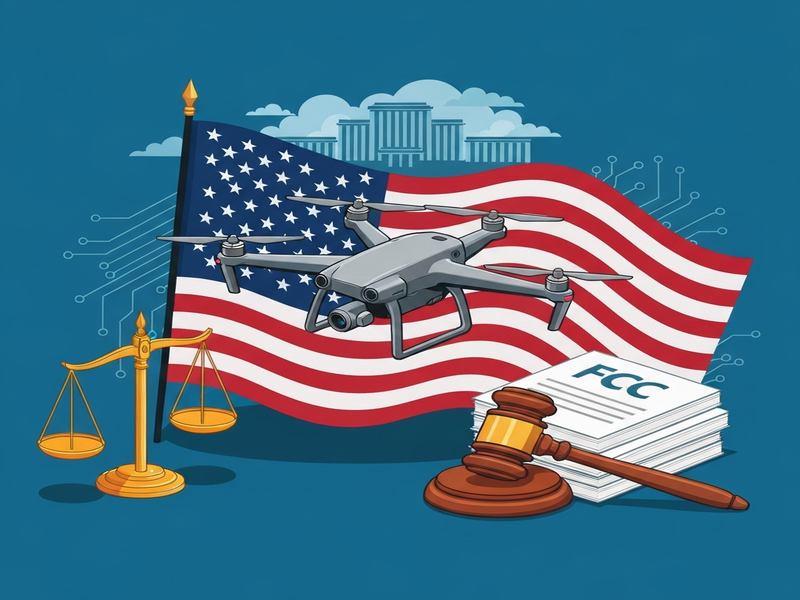
For tech‑savvy professionals and legal experts alike, the case is a litmus test for how national‑security concerns intersect with global supply chains and innovation.
DJI’s lawsuit: Core arguments in plain language
In a petition filed with the U.S. Court of Appeals for the Federal Circuit, DJI contends that the FCC:
- Exceeded its statutory authority by adding foreign‑made drones to the Covered List without clear congressional mandate.
- Violated the Fifth Amendment’s Takings Clause by effectively confiscating property without just compensation.
- Failed to provide due process, retroactively banning equipment that had already been approved.
- Imposed an “unacceptable risk” standard that is vague and overly broad, stifling legitimate competition.
DJI is seeking a court order to vacate the FCC’s decision, restore its ability to import new models, and prevent future retroactive bans.
The FCC’s perspective: National security and data sovereignty
The FCC justified the ban by citing concerns that Chinese‑manufactured drones could be leveraged for espionage, data exfiltration, or signal interference. The agency’s “Covered List” is intended to block communications equipment deemed a risk to U.S. national security.
Key points from the FCC’s statement include:
- Potential for embedded hardware backdoors that could transmit location or video data to foreign servers.
- Risk of supply‑chain vulnerabilities that could be exploited during conflict or cyber‑warfare.
- Alignment with broader U.S. export‑control policies that restrict critical technology from adversarial nations.
These concerns echo recent national security technology discussions across the industry.
Legal backdrop: How similar cases have unfolded
Historically, the FCC has exercised its authority to regulate radio‑frequency devices, but the addition of UAVs to the Covered List is unprecedented. Relevant precedents include:
| Case | Outcome | Relevance |
|---|---|---|
| FCC v. Verizon (2020) | Court upheld FCC’s spectrum‑allocation authority. | Shows deference to FCC on technical standards. |
| United States v. Huawei (2021) | Supreme Court affirmed executive‑branch ban on Huawei equipment. | Highlights national‑security rationale for tech bans. |
| Koch v. FCC (2022) | Court struck down retroactive rule as “unfairly punitive.” | Supports DJI’s claim of retroactive overreach. |
These rulings suggest a nuanced judicial approach: while the FCC enjoys broad technical discretion, courts scrutinize retroactive actions and constitutional takings claims.
What the lawsuit could mean for the U.S. drone ecosystem
If DJI succeeds, the immediate effect would be the restoration of its latest models—such as the Mavic 4 Pro and Air 3—into U.S. retail channels. The broader implications include:
- Market competition: A reversal could reignite price competition, benefiting hobbyists and commercial operators.
- Innovation pipeline: Unblocked imports would allow U.S. developers to integrate DJI’s advanced sensors into AI‑driven workflows, such as AI Video Generator projects.
- Regulatory precedent: A court decision limiting FCC retroactivity may shape future policy on other emerging technologies, including 5G equipment and autonomous vehicles.
- Supply‑chain resilience: Companies may diversify suppliers to mitigate risk, spurring growth in domestic UAV manufacturing.
Conversely, if the ban stands, U.S. consumers could see a gradual shift toward alternative manufacturers, potentially slowing the adoption of high‑resolution imaging and obstacle‑avoidance features that DJI pioneered.
Official statements: Voices from both sides
“The FCC’s decision carelessly restricts DJI’s business in the U.S. and summarily denies U.S. customers access to its latest technology,” DJI said in a statement to Reuters.
“Protecting national security is paramount, and the Covered List is a critical tool to prevent foreign‑origin equipment that could compromise U.S. communications,” the FCC explained in a press release.
Read the full coverage
For a detailed timeline and additional commentary, see the original report by The Verge:
Related resources on UBOS
Understanding how AI and automation intersect with emerging tech policies can help you stay ahead. Explore these UBOS pages:
- UBOS homepage – Overview of the platform’s AI capabilities.
- UBOS platform overview – How enterprises build secure AI pipelines.
- Enterprise AI platform by UBOS – Scalable solutions for regulated industries.
- UBOS partner program – Collaboration opportunities for tech firms.
- UBOS pricing plans – Flexible pricing for startups and SMBs.
- UBOS templates for quick start – Ready‑made AI app templates.
- AI SEO Analyzer – Optimize your content for search engines.
- AI Article Copywriter – Generate high‑quality articles at scale.
- Workflow automation studio – Automate compliance checks and data pipelines.
- Web app editor on UBOS – Build custom dashboards for drone data analysis.
- AI Video Generator – Turn drone footage into marketing videos automatically.
- AI YouTube Comment Analysis tool – Gauge public sentiment on drone releases.
- Telegram integration on UBOS – Real‑time alerts for UAV fleet status.
- ChatGPT and Telegram integration – Conversational support for drone operators.
- OpenAI ChatGPT integration – Leverage large language models for flight‑plan optimization.
- Chroma DB integration – Efficient vector search for aerial imagery.
- ElevenLabs AI voice integration – Voice‑controlled drone commands.
What’s next, and how you can stay informed
The DJI‑FCC lawsuit is more than a corporate dispute; it is a bellwether for how national‑security policy will shape the future of emerging technologies. Whether you are a drone hobbyist, a commercial operator, or a policy analyst, the outcome will influence product availability, pricing, and the regulatory landscape for years to come.
Stay ahead of the curve by subscribing to our newsletter, exploring the UBOS portfolio examples for AI‑driven compliance tools, and leveraging our AI marketing agents to keep your brand visible in a rapidly evolving market.
Ready to future‑proof your UAV strategy? Contact us today and let UBOS help you navigate the intersection of AI, regulation, and innovation.
Andrii Bidochko
CTO UBOS
Andrii Bidochko is an AI entrepreneur and researcher focused on AI agents, reinforcement learning, and autonomous systems. He writes about the technologies shaping the future of machine intelligence, from frontier models and agent architectures to real-world AI applications.