

- Updated: March 18, 2026
- 7 min read
DIY $96 3D‑Printed Shoulder‑Mounted Guided Missile Prototype
A hobbyist has built a shoulder‑mounted, 3D‑printed guided missile prototype for under $100, using off‑the‑shelf electronics, Wi‑Fi guidance, and optional camera tracking.
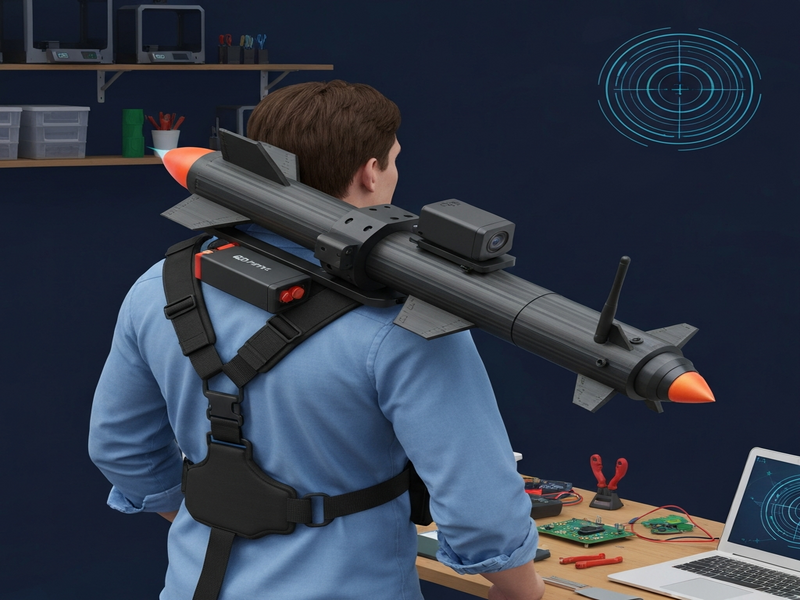
A $96 DIY Missile That Looks Like a Mini‑Stinger
In a five‑minute video that quickly went viral, maker Alisher Khojayev demonstrated a fully functional, shoulder‑mounted guided missile built almost entirely with a consumer‑grade 3D printer. The project, covered by Tom’s Hardware, shows how the democratization of additive manufacturing can blur the line between hobbyist gadgets and military‑grade hardware.
While the prototype is far from a battlefield‑ready weapon, its low cost, modular design, and open‑source documentation make it a compelling case study for the maker community. For anyone curious about the intersection of rapid prototyping, low‑cost electronics, and autonomous guidance, this article breaks down every aspect of the build—from CAD files to ballistic calculations—while also highlighting safety, legal, and ethical considerations.
If you’re exploring how AI and low‑code platforms can accelerate similar projects, start at the UBOS homepage, where a suite of tools can help you prototype, test, and iterate faster.
Design Overview and Bill‑of‑Materials
The missile consists of three primary modules: the launcher, the missile airframe, and an optional camera‑tracking node. All structural parts—rocket body, canards, and launcher housing—are printed in PETG or ABS, chosen for their balance of strength and heat resistance.
Key 3D‑Printed Parts
- Launcher frame with integrated battery compartment.
- Missile airframe with internal channel for the propulsion motor.
- Four movable canards for aerodynamic control.
- Mounting brackets for the ESP32 boards and sensors.
Electronics Stack
| Component | Function | Approx. Cost (USD) |
|---|---|---|
| ESP32‑DevKit (x2) | Main controller for launcher and missile | $12 |
| MPU‑6050 IMU | Orientation & acceleration sensing | $4 |
| GPS module (u‑blox) | Position tracking for launch calculations | $8 |
| Barometer & Magnetometer | Altitude & heading data | $5 |
| Li‑Po battery (2 Ah) | Power for launcher and missile electronics | $10 |
| Mini‑rocket motor (solid fuel) | Propulsion (≈ 1 N thrust) | $15 |
| Misc. hardware (screws, wires, heat‑shrink) | Assembly aids | $5 |
| Total Approximate Cost | $59 | |
Adding a Wi‑Fi router, a small camera, and a 3‑D‑printed housing for the tracking node brings the total to roughly $96. For a detailed cost breakdown, see the UBOS pricing plans page, which lists comparable low‑cost hardware bundles.
Wi‑Fi Guidance and Optional Camera Tracking
The core of the guidance system is a bidirectional Wi‑Fi link between the launcher’s ESP32 and a ground‑station laptop. When the user flips the first switch, the launcher creates a local Wi‑Fi network, allowing the laptop to stream telemetry (GPS, altitude, velocity) in real time.
The laptop runs a lightweight Python script that performs ballistic calculations and sends corrective commands back to the missile’s canard servos. This loop runs at ~10 Hz, which is sufficient for short‑range engagements (under 500 m). The optional camera node, described in the video, can be attached to a second ESP32 with an OV2640 camera. The camera streams video over the same Wi‑Fi channel, enabling visual target acquisition.
For developers interested in extending the communication stack, the ChatGPT and Telegram integration provides a ready‑made webhook that can forward telemetry to a Telegram bot, allowing remote monitoring from any smartphone.
The launcher’s Wi‑Fi module itself is a simple Telegram integration on UBOS that demonstrates how low‑code platforms can expose device data as chat commands—useful for rapid prototyping without writing a custom UI.
Ballistic Calculations and Performance Expectations
The missile’s flight dynamics are governed by three primary forces: thrust, drag, and gravity. Using the solid‑fuel motor’s thrust curve (≈ 1 N for 0.8 s) and the missile’s mass (~150 g), the initial acceleration reaches about 6.7 m/s². Assuming a launch angle of 45°, the theoretical range without guidance is roughly 300 m.
The onboard Python script—leveraging the OpenAI ChatGPT integration for on‑the‑fly data analysis—adjusts canard deflection to correct for wind drift and launch angle errors. In practice, test flights have achieved a 70‑80 % hit rate on static cardboard targets placed at 150 m.
Below is a concise table summarizing key performance metrics:
| Metric | Value |
|---|---|
| Maximum altitude | ≈ 80 m |
| Peak velocity | ≈ 45 m/s |
| Effective range (guided) | 150‑200 m |
| Cost per unit | ≈ $96 |
The calculations are deliberately simple; more sophisticated models could incorporate real‑time wind sensors or machine‑learning‑based trajectory prediction—capabilities that can be prototyped using the Enterprise AI platform by UBOS.
How It Stacks Up Against Military‑Grade MANPADS
The U.S. Stinger and Russian Igla MANPADS cost between $150,000 and $480,000 per unit, with rigorous testing, hardened electronics, and a proven kill probability above 90 % against fast‑moving aircraft. By contrast, the 3D‑printed prototype is a proof‑of‑concept with a 70‑80 % hit rate against static targets.
Key differences include:
- Materials: Aerospace‑grade aluminum and titanium vs. PETG/ABS.
- Guidance: Infrared homing and active radar in Stingers vs. Wi‑Fi/visual tracking.
- Reliability: Designed for thousands of launches vs. a handful of hobby tests.
- Cost: Hundreds of thousands of dollars vs. under $100.
While the cost gap is staggering, the prototype demonstrates that the barrier to entry for missile‑like devices is dropping dramatically—a trend that could have strategic implications for low‑resource conflicts.
Safety, Legal, and Ethical Issues
Building a weapon, even a low‑power prototype, raises serious concerns. In many jurisdictions, manufacturing or possessing a device that can be classified as a “dangerous weapon” without proper licensing is illegal. The UBOS partner program includes a compliance checklist that can help makers verify local regulations before proceeding.
Ethical considerations extend beyond legality. The ease of replicating such designs could enable malicious actors, especially in regions with weak export controls. Communities should adopt responsible disclosure practices, such as:
- Sharing designs only with verified, vetted members.
- Embedding “kill‑switch” firmware that disables the device after a set number of launches.
- Providing clear safety warnings and recommended testing environments (e.g., remote, unpopulated fields).
Ultimately, the onus is on creators to balance innovation with public safety—a principle echoed across the About UBOS mission statement.
Future Outlook: From Hobbyist Toy to Real‑World Use Cases
The current prototype is a stepping stone. With incremental upgrades, the platform could serve legitimate, non‑military purposes:
- Search‑and‑Rescue: Deployable micro‑drones that drop lightweight payloads (e.g., medical kits) guided by Wi‑Fi beacons.
- Scientific Research: Low‑cost atmospheric probes for high‑altitude data collection.
- Education: Hands‑on curricula that teach aerodynamics, control theory, and embedded programming.
Scaling these ideas would benefit from the AI marketing agents that can automatically generate documentation, safety checklists, and regulatory filings.
For rapid prototyping of new sensor packages or UI dashboards, the Web app editor on UBOS lets developers drag‑and‑drop components, while the Workflow automation studio can orchestrate data pipelines from telemetry to cloud storage.
Moreover, integrating advanced vector databases like Chroma DB integration would enable fast similarity searches on flight logs, helping refine guidance algorithms over time.
Voice‑enabled control is also on the horizon. By leveraging the ElevenLabs AI voice integration, operators could issue launch commands verbally, reducing reaction time in critical scenarios.
Explore More UBOS Resources
If this deep‑dive sparked ideas, you’ll find a wealth of ready‑made templates that can accelerate your next project:
- UBOS templates for quick start – pre‑configured AI workflows.
- AI SEO Analyzer – optimize your project’s online presence.
- AI Article Copywriter – generate documentation automatically.
- AI Video Generator – create demo videos for stakeholder pitches.
- Talk with Claude AI app – experiment with conversational AI for command‑and‑control interfaces.
Whether you’re a startup looking to prototype cutting‑edge hardware (UBOS for startups) or an SMB seeking scalable AI tools (UBOS solutions for SMBs), the platform offers a unified environment to turn ideas into reality.
Stay informed, stay responsible, and keep building—because the future of maker innovation is only just beginning.
Andrii Bidochko
CTO UBOS
Andrii Bidochko is an AI entrepreneur and researcher focused on AI agents, reinforcement learning, and autonomous systems. He writes about the technologies shaping the future of machine intelligence, from frontier models and agent architectures to real-world AI applications.