

- Updated: February 20, 2026
- 6 min read
Claude Code Powers New AI Accessibility Tool: Generative AI & GSD Innovation
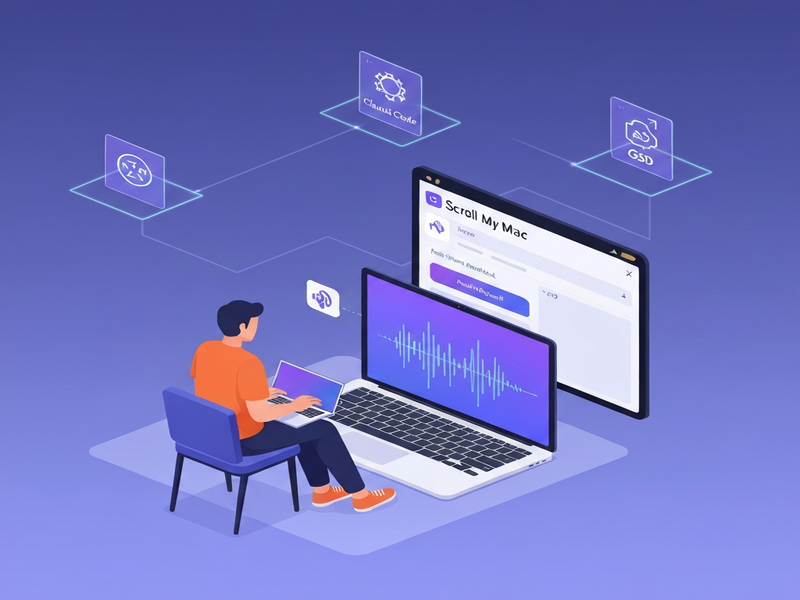
Scroll My Mac is an AI‑driven accessibility application built with Claude Code and the Get Shit Done (GSD) meta‑prompting system that lets macOS users scroll any window by simply dragging the mouse, eliminating the need for a scroll wheel or swipe gestures.
The story behind this breakthrough was first shared in a personal blog post that detailed how a developer with spinal muscular atrophy turned a daily frustration into a functional prototype. You can read the original narrative here. The post illustrates the power of generative AI when paired with a focused workflow, and it sparked interest across the accessibility community.
Why a New Scrolling Solution Was Needed
The author lives with a severe mobility impairment—spinal muscular atrophy—that makes traditional mouse actions, especially scrolling, painfully inefficient. Standard macOS interactions rely on a scroll wheel, trackpad gestures, or a visible scrollbar. When these are unavailable, the user is forced to:
- Click‑and‑drag the tiny scrollbar (often hidden in modern apps).
- Use macOS’s dwell‑to‑scroll feature, which introduces latency and visual clutter.
- Rely on third‑party extensions like ScrollAnywhere, which fail on system dialogs, reader mode, and many native apps.
These work‑arounds are either too slow or simply inapplicable in many contexts, leaving a gap for a truly universal scrolling method.
Building “Scroll My Mac” with Claude Code and GSD
The breakthrough came when the developer discovered ChatGPT and Telegram integration and, more importantly, the OpenAI ChatGPT integration that demonstrated how large language models could act as co‑developers. The next step was to adopt Claude Code, Anthropic’s code‑generation model, together with the Get Shit Done (GSD) meta‑prompting framework.
GSD structures the development lifecycle into four distinct phases—Discuss, Plan, Execute, and Verify. Each phase is recorded in markdown files, preserving context across multiple AI‑human interactions. This approach prevented the “prompt‑injection” pitfalls the author warned about and kept the project’s scope tightly scoped.
- Discuss: Claude asked clarifying questions about the desired scrolling behavior, hot‑key preferences, and accessibility constraints.
- Plan: GSD generated a detailed task breakdown, including a native macOS settings window, global keyboard shortcut handling, and an inertial scrolling engine.
- Execute: Claude wrote Swift code for the UI, the scrolling algorithm, and the preferences persistence layer. The AI also produced unit‑test snippets.
- Verify: The developer reviewed generated code, ran the app, and fed back bugs. Claude iteratively refined the implementation until the scrolling felt natural.
The entire workflow was completed in roughly eight hours spread over three days, demonstrating how generative AI can compress a multi‑week development cycle into a single weekend.
Key Features That Redefine macOS Accessibility
Scroll My Mac goes beyond a simple drag‑to‑scroll mechanic. Its feature set was deliberately crafted to address real‑world accessibility pain points:
- Universal Drag‑Scroll: Works in any window, including system dialogs, Finder, and third‑party apps.
- Toggleable Hotkey: Users can enable or disable scroll mode with a custom keyboard shortcut, preventing accidental activation.
- Click‑Through Mode: When enabled, normal clicks pass through, allowing selection and drag‑and‑drop without disabling scrolling.
- Click‑And‑Hold Passthrough: Hold the mouse button for a configurable delay to temporarily suspend scrolling for text selection or window movement.
- Inertial Scrolling: Mimics the physics of touch‑screen scrolling for a smoother experience.
- App Exclusion List: Users can blacklist apps where scrolling should remain untouched.
- Launch‑at‑Login & Auto‑Update: Guarantees the tool is ready whenever the Mac starts.
These capabilities are documented on the UBOS platform overview, where developers can see how similar AI‑enhanced utilities are packaged and distributed.
Development Timeline, Resources, and Cost Breakdown
While the code was generated by Claude, the human developer still performed essential tasks:
| Phase | Hours Spent | Cost (USD) |
|---|---|---|
| Discuss & Planning (GSD) | 2 | $20 (Claude Code Pro subscription) |
| Code Generation (Claude) | 4 | $40 (extra usage beyond plan) |
| Testing & Iteration | 2 | $20 (developer time) |
| Total | 8 | $80 |
The $80 expense is modest compared to hiring a freelance macOS developer (often $150‑$200 per hour). Moreover, the entire source code is open‑source on GitHub, allowing the community to fork, improve, and adapt it for other platforms.
For organizations interested in scaling similar solutions, the UBOS pricing plans provide a predictable cost model for AI‑assisted development, including unlimited Claude Code usage under enterprise tiers.
What This Means for AI‑Powered Accessibility
The success of Scroll My Mac illustrates a broader shift:
- Democratization of Assistive Tech: Individuals can now prototype custom accessibility tools without deep native‑code expertise.
- Rapid Prototyping Cycle: Generative AI compresses ideation, design, and implementation into hours, not weeks.
- Community‑Driven Innovation: Open‑source releases invite contributions, creating a virtuous loop of improvement.
- Enterprise Adoption: Companies can embed similar AI‑generated utilities into their internal toolchains, boosting productivity for employees with disabilities.
The AI news hub at UBOS regularly highlights projects that blend generative AI with real‑world accessibility challenges, reinforcing the platform’s commitment to inclusive technology.
Looking ahead, the combination of Claude Code, GSD, and emerging multimodal models (e.g., vision‑enabled LLMs) could enable developers to create voice‑controlled, gesture‑free interfaces that adapt to a user’s physical abilities in real time. The Enterprise AI platform by UBOS already offers APIs for such adaptive experiences.
Take the Next Step Toward Inclusive Innovation
If you’re a tech‑savvy professional or an accessibility advocate, the story of Scroll My Mac shows that you no longer need a large development budget to build meaningful assistive tools. By leveraging Claude Code and the GSD workflow, you can prototype, test, and ship solutions that directly address user needs.
Ready to explore AI‑enhanced development for your own projects? Visit the UBOS homepage to learn how the platform streamlines AI‑first product creation. Dive into the Workflow automation studio for pre‑built pipelines, or browse the UBOS templates for quick start to jump‑start your next accessibility app.
For more stories about AI transforming accessibility, check the accessibility section on our site. Join the conversation, share your own prototypes, and help shape a more inclusive digital future.