

- Updated: February 26, 2026
- 5 min read
CERN’s First Website: A Historical Milestone
CERN’s first website, launched in 1991, was the world’s inaugural web page and marked the birth of the modern internet.
CERN’s First Website: The Dawn of the World Wide Web
When Tim Berners‑Lee unveiled the first web server at the European Organization for Nuclear Research (CERN) in August 1991, he didn’t just create a site for particle‑physics data—he opened a gateway to a new era of global communication. The original page, hosted at info.cern.ch, still lives as a living museum of early internet design.
Today, science enthusiasts, researchers, and tech‑savvy readers can explore that historic site, simulate its line‑mode browser, and trace the evolution from plain text links to today’s AI‑driven platforms like UBOS homepage.
Background of CERN’s First Website
The project began as a solution to a practical problem: how to share research papers and data across a geographically dispersed team of physicists. Berners‑Lee’s proposal combined three core technologies—HTML, HTTP, and URLs—into a single, easy‑to‑use system.
- HTML (HyperText Markup Language): A simple markup language for structuring documents.
- HTTP (HyperText Transfer Protocol): The communication protocol that still powers the web.
- URL (Uniform Resource Locator): The address system that lets browsers locate resources.
By the end of 1991, the CERN server hosted a handful of pages describing the project, providing links to scientific papers, and offering a “Browse the first website” button that still works today.
Key Features, Purpose, and Navigation Options
The original CERN site is intentionally minimalist—no images, no CSS, just plain text and hyperlinks. Its core features include:
- Home Page: An introductory paragraph explaining the World Wide Web project.
- “Browse the first website” link: Directs users to a simulated line‑mode browser that reproduces the 1991 experience.
- “Learn about the birth of the web” link: Provides historical context and links to early technical documents.
- “Learn about CERN” link: Offers a brief overview of the laboratory’s mission in particle physics.
Navigation is purely linear—click a link, read the text, click the next link. This simplicity underscores the original purpose: information sharing, not visual design.
Historical Significance and Impact on the Web
Why does a text‑only page from 1991 still matter? Because it set the foundation for every website you visit today. Below is a concise impact table:
| Aspect | Legacy |
|---|---|
| Standardization | HTML, HTTP, and URLs became universal standards. |
| Open Access | The web’s open‑source ethos traces back to CERN’s free‑sharing policy. |
| Collaboration | Scientists worldwide could now exchange data instantly, accelerating discovery. |
| Commercialization | The same protocols now power e‑commerce, social media, and AI‑driven platforms. |
Modern AI platforms—such as the Enterprise AI platform by UBOS—still rely on the same HTTP foundations, proving that Berners‑Lee’s design was both visionary and technically robust.
A Visual Tribute: Generated Image of CERN’s First Website
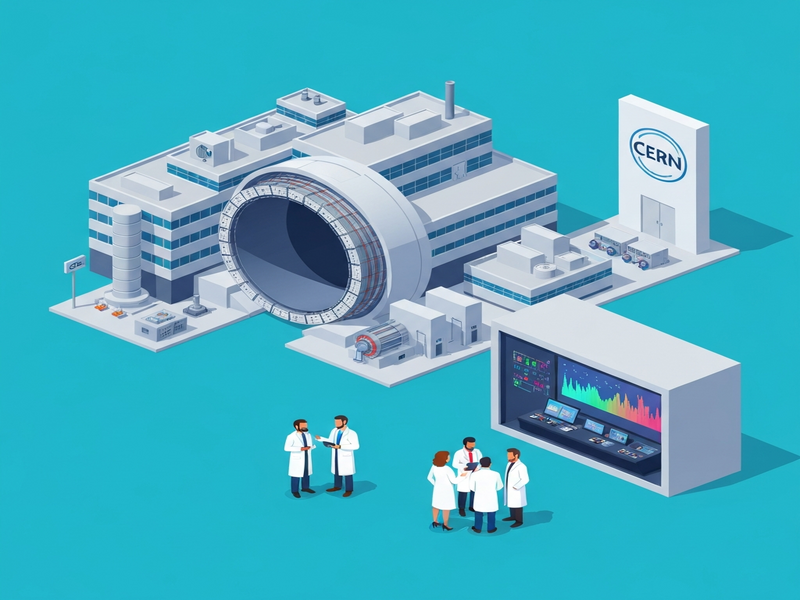
The illustration captures the stark, text‑only layout of the original CERN page, juxtaposed with modern UI elements to highlight how far web design has traveled.
From CERN’s Text‑Only Pages to AI‑Powered Digital Experiences
While CERN’s first site proved that information could be shared globally, today’s developers build interactive, AI‑enhanced applications on platforms that automate everything from UI generation to content creation.
UBOS, for example, offers a Web app editor on UBOS that lets users drag‑and‑drop components, integrate large language models, and deploy instantly—tasks that would have been unimaginable in 1991.
Key AI integrations that empower modern developers include:
- OpenAI ChatGPT integration for natural‑language interfaces.
- ChatGPT and Telegram integration to deliver bots directly to messaging platforms.
- Chroma DB integration for semantic search across large document sets.
- ElevenLabs AI voice integration that adds lifelike speech synthesis.
These tools sit inside the Workflow automation studio, allowing developers to orchestrate complex processes without writing a single line of code.
Explore UBOS Resources That Echo CERN’s Spirit of Open Innovation
Platform Overview
Get a high‑level view of the UBOS platform overview, which combines low‑code development with AI services.
AI Marketing Agents
Learn how AI marketing agents can automate campaign creation, mirroring the automation ethos of early web tools.
Pricing Plans
Review flexible UBOS pricing plans that cater to startups, SMBs, and enterprises.
Templates for Quick Start
Jump‑start projects with UBOS templates for quick start, including AI SEO Analyzer and AI Article Copywriter.
Startups & SMBs
Discover how UBOS for startups and UBOS solutions for SMBs accelerate product launches.
Partner Program
Join the UBOS partner program to co‑create AI‑driven solutions.
Portfolio Examples
Explore real‑world case studies in the UBOS portfolio examples.
AI Tools Marketplace
Try ready‑made AI utilities such as AI SEO Analyzer, AI Article Copywriter, and AI Chatbot template.
“The Web was originally conceived as a tool for sharing information among scientists. Its open nature has allowed it to become a universal platform for all of humanity.” – Tim Berners‑Lee
Conclusion: From a Single Text Page to a Global AI Ecosystem
The modest CERN page at info.cern.ch is more than a historical curiosity; it is the seed from which today’s AI‑enhanced digital experiences have grown. By understanding its origins, developers can appreciate the simplicity that underpins modern complexity.
Whether you are a researcher tracing the lineage of web standards or a startup founder building the next generation of AI‑driven apps, the lessons from CERN’s first website remain relevant: prioritize open standards, focus on clear information delivery, and let technology evolve organically.
Ready to build on this legacy? Explore the UBOS homepage and start creating AI‑powered web experiences that could one day be celebrated as historic milestones themselves.
Andrii Bidochko
CTO UBOS
Andrii Bidochko is an AI entrepreneur and researcher focused on AI agents, reinforcement learning, and autonomous systems. He writes about the technologies shaping the future of machine intelligence, from frontier models and agent architectures to real-world AI applications.