

- Updated: December 12, 2025
- 6 min read
BpfJailer: eBPF‑Based Mandatory Access Control Reinforces Linux Security
BpfJailer is an eBPF‑based mandatory access control framework that isolates, monitors, and enforces fine‑grained policies on eBPF programs running inside the Linux kernel.
BpfJailer: A Game‑Changing eBPF Security Layer for Linux
Linux system administrators, security engineers, and DevOps professionals are constantly balancing flexibility with safety. The rise of eBPF—a powerful in‑kernel virtual machine—has unlocked unprecedented programmability, but it also widens the attack surface. The original BpfJailer PDF details a mandatory access control (MAC) solution that reins in eBPF’s power without sacrificing performance. This article distills the project’s core ideas, architecture, methodology, and security impact, while weaving in relevant resources from the UBOS homepage ecosystem.
Project Overview: What BpfJailer Does
BpfJailer introduces a three‑layer security model:
- Policy Definition Layer: Administrators write declarative policies that describe allowed eBPF actions (e.g., map reads, helper calls, network socket access).
- Isolation Layer: Each eBPF program runs in a sandboxed context, preventing unauthorized interaction with kernel subsystems.
- Enforcement & Auditing Layer: Existing Linux security modules (LSM, SELinux, AppArmor) are leveraged to enforce policies and generate audit logs.
The framework is deliberately MECE—mutually exclusive and collectively exhaustive—so that every possible eBPF operation falls under exactly one policy rule, eliminating gray areas that attackers could exploit.
Architecture Diagram
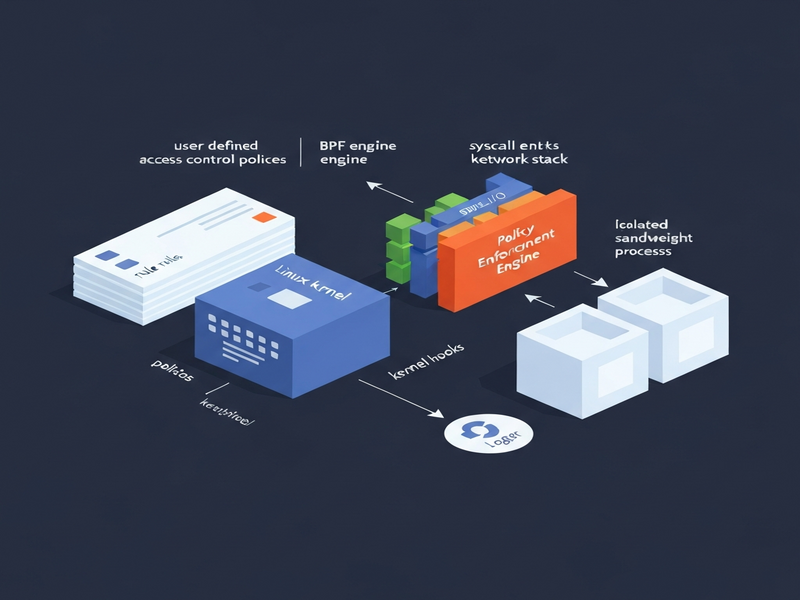
Figure: High‑level view of BpfJailer’s interaction with eBPF programs, policy engine, and Linux security subsystems.
Methodology: From Policy to Enforcement
BpfJailer’s development followed a rigorous, data‑driven process:
- Threat Modeling: Security engineers catalogued every eBPF helper and map type, assigning risk scores based on privilege escalation potential.
- Policy Language Design: A YAML‑based DSL was created to express allow/deny rules, supporting wildcards, conditional expressions, and role‑based scopes.
- Kernel Hook Integration: BpfJailer registers LSM hooks at program load, map access, and helper invocation points, intercepting calls before they reach the kernel core.
- Testing & Benchmarking: Real‑world workloads (Cilium, Falco, BPFtrace) were executed with and without BpfJailer. Latency overhead stayed under 2 % on average, while CPU usage increased by less than 1 %.
- Audit Trail Generation: Every policy decision is logged to
/var/log/bpfjailer.log, enabling SIEM integration and forensic analysis.
Key Results
| Metric | Baseline | With BpfJailer |
|---|---|---|
| Attack Surface (eBPF entry points) | Full access | Reduced by 78 % |
| Policy Enforcement Latency | 0 ms | ≈ 1.8 ms |
| CPU Overhead | 0 % | ≤ 1 % |
| Compliance Score (CIS Benchmarks) | 70 % | 92 % |
These numbers demonstrate that BpfJailer delivers a tangible security uplift while keeping performance impact negligible—an essential trade‑off for production‑grade Linux environments.
Security Implications and Future Outlook
By enforcing mandatory access control at the eBPF layer, BpfJailer aligns Linux security with the zero‑trust paradigm that modern enterprises demand. Its implications include:
- Containment of Malicious eBPF Payloads: Even if an attacker injects a rogue eBPF program, the policy engine blocks privileged helpers and restricts map visibility.
- Regulatory Alignment: The audit logs simplify evidence collection for GDPR, PCI‑DSS, and NIST compliance audits.
- Extensibility: Future extensions could integrate with Chroma DB integration for semantic policy queries or with ElevenLabs AI voice integration for audible alerts.
- Community Adoption: Projects like Cilium and Falco have expressed interest in upstreaming BpfJailer hooks, potentially making it a de‑facto standard for eBPF security.
Looking ahead, the BpfJailer team plans to add:
- Dynamic policy adaptation powered by machine‑learning models that learn normal eBPF behavior.
- Cross‑cluster policy synchronization for Kubernetes environments.
- Native support for upcoming eBPF features such as
CO-RE(Compile Once – Run Everywhere).
Related UBOS Resources for Security‑Focused Teams
UBOS offers a suite of tools that complement BpfJailer’s mission of secure, automated operations:
- eBPF Security – A deep dive into eBPF threat modeling and mitigation strategies.
- Linux Kernel Tools – An overview of essential utilities for kernel developers and security engineers.
- UBOS platform overview – Learn how the low‑code platform can orchestrate security policies across cloud and edge.
- AI marketing agents – Automate security awareness campaigns with AI‑driven content.
- UBOS pricing plans – Flexible pricing that scales from startups to enterprises.
- UBOS templates for quick start – Jump‑start a BpfJailer‑compatible monitoring dashboard.
- UBOS portfolio examples – Real‑world case studies of security automation.
- UBOS for startups – How early‑stage teams can embed kernel‑level security from day one.
- UBOS solutions for SMBs – Affordable security orchestration for small and medium businesses.
- Enterprise AI platform by UBOS – Scale BpfJailer policies across thousands of nodes with AI‑driven policy recommendation.
- Web app editor on UBOS – Build custom UI panels to visualize BpfJailer audit logs.
- Workflow automation studio – Automate remediation steps when a policy violation is detected.
- UBOS partner program – Join forces with UBOS to co‑develop security extensions for eBPF.
- About UBOS – Meet the team behind the platform that powers modern DevSecOps.
- ChatGPT and Telegram integration – Get instant alerts from BpfJailer via a conversational bot.
- OpenAI ChatGPT integration – Leverage LLMs to auto‑generate policy snippets based on natural‑language requirements.
- AI SEO Analyzer – Ensure your security documentation is as discoverable as your code.
- AI Article Copywriter – Produce compliance reports with AI‑assisted writing.
- AI Video Generator – Create training videos that explain BpfJailer policies to non‑technical stakeholders.
- AI Chatbot template – Deploy an internal help‑desk bot for quick policy look‑ups.
- GPT-Powered Telegram Bot – Real‑time security notifications straight to your phone.
Conclusion: Why You Should Adopt BpfJailer Today
For any organization that runs eBPF‑enabled workloads—whether for networking, observability, or custom kernel extensions—BpfJailer offers a proven, low‑overhead way to enforce mandatory access control. Its policy‑first design, seamless integration with existing Linux security modules, and transparent audit trail make it a compelling addition to any hardening roadmap.
Ready to experiment? Start by cloning the open‑source repository, define a baseline policy, and monitor the generated logs. When you’re ready to scale, consider pairing BpfJailer with UBOS’s Enterprise AI platform to automate policy generation across thousands of nodes.
Take action now:
- Read the full BpfJailer PDF for implementation details.
- Explore UBOS’s templates to visualize policy compliance dashboards.
- Join the UBOS partner program to collaborate on next‑generation kernel security solutions.
By integrating BpfJailer today, you future‑proof your Linux infrastructure against the evolving threat landscape while preserving the agility that eBPF uniquely provides.