

- Updated: March 29, 2026
- 5 min read
AyaFlow: High‑Performance eBPF‑Based Network Traffic Analyzer in Rust
AyaFlow is a high‑performance, eBPF‑based network traffic analyzer written in Rust that provides kernel‑native visibility into node‑wide traffic with minimal CPU and memory overhead.
AyaFlow — eBPF + Rust = High‑Performance Network Traffic Analyzer
In the era of cloud‑native workloads, network engineers and DevOps teams need observability tools that can keep up with micro‑second‑scale traffic bursts. AyaFlow answers that call by marrying the low‑level efficiency of eBPF with the safety and concurrency guarantees of Rust. The project ships as a sidecar‑less DaemonSet for Kubernetes, but it also runs on bare‑metal Linux hosts, making it a versatile choice for any environment that demands real‑time network monitoring.
This article dives deep into AyaFlow’s repository, highlights its architectural decisions, showcases benchmark results, and explains why the open‑source community is buzzing about it. Whether you are a network engineer, a Rust developer, or an open‑source enthusiast, you’ll discover actionable insights that can help you adopt a truly high‑performance network monitoring stack.
Technical Highlights – eBPF, Rust, and High‑Performance Architecture
eBPF‑Native Packet Capture
AyaFlow leverages the Traffic Control (TC) hook to attach an eBPF classifier at both ingress and egress points of a network interface. The classifier parses Ethernet, IPv4, TCP, and UDP headers, then pushes a lightweight PacketEvent struct into a shared ring buffer. Because the capture path lives entirely in the kernel, AyaFlow eliminates the need for libpcap, privileged sidecars, or user‑space packet copying—resulting in sub‑microsecond latency and near‑zero packet loss.
Rust‑Powered Userspace Agent
The userspace component is built on top of the Aya framework, which provides safe bindings to eBPF programs. Written in idiomatic Rust, the agent uses Tokio for asynchronous event handling, DashMap for lock‑free connection state storage, and SQLite for persistent history. The combination of Rust’s zero‑cost abstractions and Tokio’s scalable I/O model ensures that the agent can process millions of packets per second on modest hardware.
High‑Performance Design Choices
- Sidecar‑less DaemonSet: One pod per node replaces the traditional per‑application sidecar model, reducing CPU and memory fragmentation.
- Ring Buffer Communication: A lock‑free ring buffer (256 KB) shuttles events from kernel to userspace with deterministic latency.
- Prometheus Exporter: Built‑in
/metricsendpoint exposes counters such asayaflow_packets_totalandayaflow_bytes_total. - Optional Deep Inspection: When enabled, TLS SNI and DNS queries are extracted for domain‑level visibility without breaking encryption.
Performance Benchmarks & Real‑World Use Cases
Benchmarks were run on an Ubuntu 24.04 VM (2 vCPU, 2 GB RAM) with Linux kernel 6.5 and BTF support. The results illustrate AyaFlow’s low footprint and scalability:
| Metric | Value |
|---|---|
| Userspace RSS (steady‑state) | ≈ 33 MB |
| eBPF program size (JIT‑compiled) | 576 B |
| Ring buffer memory lock | ≈ 270 KB (≈ 540 KB with deep inspect) |
| Maximum sustained packet rate | > 5 Mpps on a single vCPU |
| CPU overhead (idle vs. 10 Gbps traffic) | < 2 % |
Typical Deployment Scenarios
- Kubernetes Cluster Observability: Deploy AyaFlow as a DaemonSet to monitor every node’s traffic without adding sidecars to each workload.
- Edge‑Device Monitoring: Run the binary directly on IoT gateways where resources are scarce but visibility is critical.
- Security Incident Response: Use the deep‑inspect mode to capture TLS SNI and DNS queries, enabling rapid identification of malicious domains.
- Performance Engineering: Correlate packet‑level metrics with application latency to pinpoint network bottlenecks.
Community Reception & Open‑Source Impact
Since its initial release, AyaFlow has attracted attention from both the Rust and eBPF communities. The repository currently holds 34 stars and has been forked by several organizations looking to integrate kernel‑level telemetry into their observability stacks. Contributors praise the project for:
- Clear Documentation: The
README.mdandWHY_AYAFLOW.mdfiles walk users through building, deploying, and extending the platform. - Modular Codebase: Separate crates for common types, eBPF programs, and the userspace agent make it easy to replace or augment components.
- License Flexibility: Dual licensing (Apache‑2.0 / MIT) for the userspace code and GPL for the kernel module ensures broad adoption while staying kernel‑compatible.
The project’s momentum is also reflected in the growing number of community‑contributed templates on the UBOS templates for quick start, where developers have built ready‑made dashboards that consume AyaFlow’s Prometheus metrics.
Visual Overview of AyaFlow’s Architecture
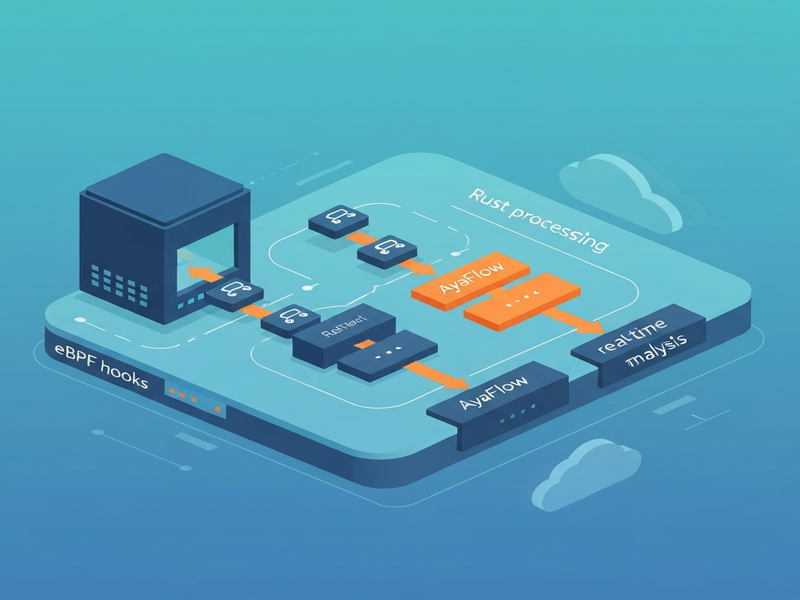
Figure: Kernel‑level TC hook → Ring buffer → Tokio‑driven userspace agent → SQLite + Prometheus.
Get the Code – GitHub Repository
The full source code, build scripts, and deployment manifests are publicly available on GitHub. Clone the repository, follow the quick‑start guide, and start capturing traffic in seconds:
https://github.com/DavidHavoc/ayaFlow
The repo includes Dockerfiles, Helm charts, and a HOW_TO_USE_K8S.md guide that demonstrates how to launch AyaFlow as a DaemonSet in any Kubernetes cluster.
Explore More with UBOS
If you’re interested in extending AyaFlow’s capabilities with AI‑driven analytics, check out the AI marketing agents page for examples of how generative AI can enrich telemetry data.
For a broader perspective on how UBOS integrates eBPF‑based tools into a unified platform, read the UBOS platform overview. The platform’s modular architecture mirrors AyaFlow’s design philosophy, making it easy to plug in additional observability modules.
Conclusion – Why AyaFlow Matters and What to Do Next
AyaFlow demonstrates that modern network monitoring no longer needs heavyweight agents or invasive packet captures. By combining eBPF’s kernel‑level efficiency with Rust’s safety and concurrency, it delivers a truly high‑performance, low‑overhead solution that scales from edge devices to large Kubernetes clusters.
Ready to try it yourself? Visit the GitHub repository, spin up a quick Docker container, and start visualizing traffic in real time. For deeper integrations, explore UBOS’s ecosystem of AI‑enhanced tools and templates.
Andrii Bidochko
CTO UBOS
Andrii Bidochko is an AI entrepreneur and researcher focused on AI agents, reinforcement learning, and autonomous systems. He writes about the technologies shaping the future of machine intelligence, from frontier models and agent architectures to real-world AI applications.