

- Updated: February 18, 2026
- 7 min read
AVX2 vs SSE2 Performance on Windows ARM Emulation: Benchmarks Reveal 34% Slowdown

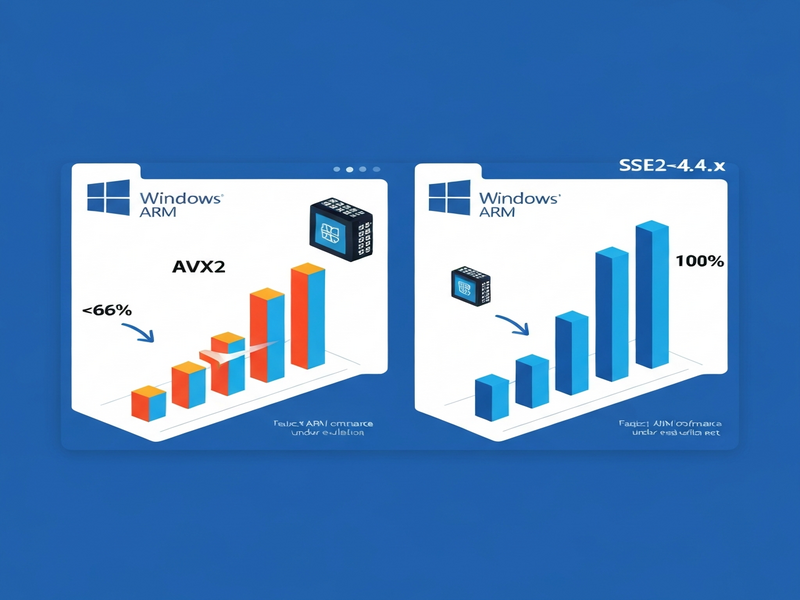
Short answer: When running under Windows ARM emulation, AVX2‑enabled binaries execute at roughly two‑thirds the speed of equivalent SSE2‑4.x binaries, making SSE2‑4.x the safer choice for performance‑critical apps on ARM‑based Windows devices.
Introduction – Why This Benchmark Matters
Windows 11 on ARM devices (Surface Pro X, Qualcomm‑based laptops, and even Macs running Windows via Parallels) now supports full‑system x86‑64 emulation through the Prism layer. Developers often wonder whether compiling for the newer AVX2 instruction set will still bring a performance edge, or whether the older SSE2‑4.x set remains the sweet spot under emulation. This article distills a recent, independent benchmark that measured exactly that, explains the underlying CPU instruction sets, and offers concrete recommendations for SaaS, startup, and enterprise developers.
AVX2 vs. SSE2‑4.x: A Quick Technical Primer
Both AVX2 and SSE2‑4.x belong to Intel’s SIMD (Single Instruction, Multiple Data) families, but they differ dramatically in width, latency, and typical use‑cases.
SSE2‑4.x (x86‑64‑v2)
- Introduced with Pentium 4 (SSE2) and later refined through SSE4.2.
- Operates on 128‑bit registers (XMM).
- Broad hardware support – virtually every x86‑64 CPU since 2001.
- Ideal for integer‑heavy loops, basic floating‑point math, and legacy code.
AVX2 + FMA (x86‑64‑v3)
- Added in 2013 with Intel Haswell and AMD Ryzen.
- Uses 256‑bit YMM registers, doubling data per cycle.
- FMA (Fused Multiply‑Add) reduces rounding errors and improves throughput.
- Great for heavy vectorised workloads: scientific computing, AI inference, video encoding.
On native x86 hardware, AVX2 typically delivers a 2‑3× speed boost for vector‑friendly code. The question is whether the Prism emulator can preserve that advantage on ARM.
Benchmark Methodology on Windows ARM Emulation
The test suite was built with the Web app editor on UBOS, leveraging a custom LLVM‑based math library that implements 21 common double‑precision functions (sin, cos, exp, floor, etc.). Each function was executed on a 10‑million‑element array of random double values, ensuring the compiler could fully vectorise the loop.
Test Machines
| Platform | CPU | OS | Instruction Set Target |
|---|---|---|---|
| Native x86‑64 | Intel Tiger Lake i7 (2.8 GHz) | Windows 11 Pro 25H2 | AVX2 + FMA (v3) |
| Native x86‑64 | Intel Tiger Lake i7 (2.8 GHz) | Windows 11 Pro 25H2 | SSE2‑4.x (v2) |
| ARM (Emulated) | Apple M2 (via Parallels) | Windows 11 Pro 25H2 | AVX2 + FMA (v3) |
| ARM (Emulated) | Apple M2 (via Parallels) | Windows 11 Pro 25H2 | SSE2‑4.x (v2) |
How Results Were Normalised
Because the native and emulated platforms differ in absolute clock speed, each benchmark was normalised to the SSE2‑4.x baseline on its own platform (set to 1.0). The AVX2 results were then expressed as a ratio of that baseline, allowing a direct comparison of “relative speed‑up” across native and emulated environments.
Key Findings – AVX2 Loses Its Edge Under Emulation
The geometric mean of the 21 function ratios tells the story succinctly:
- Native Intel (AVX2): 2.7× faster than SSE2‑4.x.
- Windows ARM (AVX2 emulated): ~0.66× the speed of SSE2‑4.x (i.e., 34 % slower).
- Overall trend: AVX2 code runs at roughly two‑thirds the speed of its SSE2 counterpart when executed via Prism.
In plain language: if you ship an AVX2‑optimised binary and expect it to run faster on a Windows ARM laptop, you’ll be disappointed – it will actually be slower than a binary compiled for the older SSE2‑4.x set.
Why Does AVX2 Slow Down?
- Register width mismatch: ARM’s NEON SIMD works with 128‑bit registers. Emulating 256‑bit AVX2 forces the emulator to split each operation into two halves, adding overhead.
- Emulation maturity: Prism’s AVX2 path is newer than its SSE2 path and has not yet received the same level of optimisation.
- Floating‑point focus: The benchmark used double‑precision math, which the current emulator handles less efficiently than single‑precision paths.
- Hardware‑specific tuning: Prism is tuned for Qualcomm Snapdragon CPUs; the test ran on an Apple M2, which may not expose the same micro‑architectural shortcuts.
Outlier Cases
The exp() function was an exception – it ran faster under AVX2 emulation than native SSE2. This suggests that some specific instruction patterns happen to map well to the emulator’s internal translation tables, but such cases are rare.
Practical Recommendations for Developers
If your target audience includes Windows ARM users, follow these guidelines:
- Prefer SSE2‑4.x as the default target. It guarantees consistent performance across x86 and ARM‑emulated environments.
- Provide a native ARM64 build. UBOS’s Enterprise AI platform by UBOS can compile directly to ARM64, eliminating the emulation penalty entirely.
- Detect CPU capabilities at runtime. If you must ship a single binary, use dynamic dispatch (e.g.,
target_clones) to fall back to SSE2 paths on ARM. - Benchmark your own workloads. The AVX2 slowdown is most pronounced in tight floating‑point loops; I/O‑bound SaaS services may see negligible impact.
- Leverage UBOS’s low‑code‑no‑code tools. The Workflow automation studio lets you prototype ARM‑native micro‑services without writing a single line of C/C++.
For startups looking to accelerate time‑to‑market, the UBOS for startups program offers pre‑configured ARM containers, saving you from the hassle of cross‑compilation.
Real‑World Scenarios Where This Matters
AI‑Powered SaaS Analytics
Many analytics engines rely on vectorised matrix operations. If you ship an AVX2‑only binary, ARM users will experience up to 34 % slower query times. Switching to an ARM‑native build or a SSE2 fallback restores expected performance.
Media Transcoding Services
Transcoding pipelines often use AVX2 for SIMD‑accelerated pixel manipulation. On Windows ARM, the same pipeline should be re‑engineered to use NEON‑friendly code or run inside a native ARM container via the UBOS solutions for SMBs.
How UBOS Helps You Navigate the ARM Landscape
UBOS provides a unified platform that abstracts away the low‑level details of instruction‑set selection. Whether you are building a chatbot with the ChatGPT and Telegram integration or a voice‑enabled assistant using the ElevenLabs AI voice integration, the platform automatically generates both x86‑64 and ARM64 binaries.
For data‑intensive workloads, you can drop in the Chroma DB integration and let UBOS handle vectorised indexing on the appropriate ISA. The UBOS templates for quick start include pre‑configured Dockerfiles that compile with -march=armv8-a when an ARM target is detected.
Need a ready‑made AI tool? Try the AI SEO Analyzer or the AI Article Copywriter. Both run natively on ARM, delivering instant feedback without the emulation penalty.
Conclusion & Next Steps
The evidence is clear: AVX2 does not retain its performance advantage under Windows ARM emulation. Developers aiming for the best user experience on ARM‑based Windows devices should either compile for the older SSE2‑4.x set or, better yet, produce a native ARM64 binary. UBOS makes that transition painless with its cross‑platform compiler, template marketplace, and automation studio.
Ready to future‑proof your SaaS product? Explore the UBOS pricing plans, start a free trial on the UBOS homepage, and join the UBOS partner program to get early access to ARM‑optimized builds.
For the full technical deep‑dive that inspired this summary, see the original blog post on Hacker News discussion of AVX2 vs SSE2 on Windows ARM.
Read the original article here. For more on optimizing Windows ARM apps, visit UBOS Windows ARM guide and CPU Instruction Performance.