

- Updated: February 16, 2026
- 6 min read
AT&T Long Lines: A Historical Journey Through America’s Telecommunication Backbone
AT&T Long Lines was the nationwide backbone that carried long‑distance telephone and television signals across the United States from the early 1950s until its gradual replacement by fiber optics, satellites, and the post‑breakup restructuring of AT&T.
The Birth of AT&T Long Lines
In the aftermath of World War II, the Bell System recognized that the existing coaxial‑cable “long lines” were fragile, costly, and increasingly unable to meet the nation’s growing demand for voice and data traffic. To overcome these limitations, AT&T launched the Long Lines division in 1948, tasked with building a high‑capacity, line‑of‑sight microwave network that could span the continent without the vulnerability of ground‑level cables.
The first milestone arrived on August 17, 1951, when the inaugural coast‑to‑coast Direct Distance Dial (DDD) call was completed using the new microwave system—often referred to as the “Telephone Skyway.” This achievement marked the transition from a patchwork of regional cables to a unified, high‑speed backbone that would dominate U.S. telecommunications for the next three decades.
From Towers to a Nationwide Microwave Grid
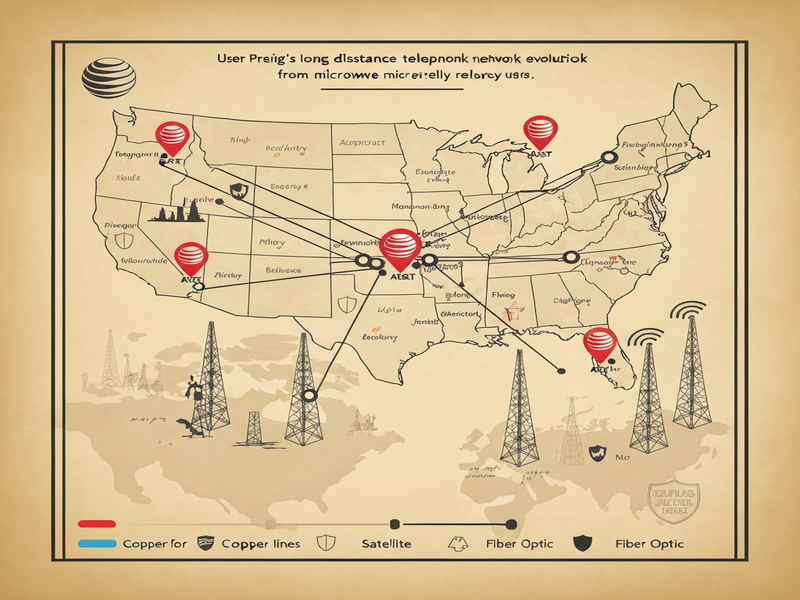
The Long Lines network grew by deploying hundreds of steel‑frame towers, each equipped with horn antennas that transmitted and received microwave signals in the 4 GHz to 6 GHz band. Because microwave beams travel in straight lines, each tower was positioned to maintain a clear line‑of‑sight to its neighbors, creating a “hop‑by‑hop” relay path that could span thousands of miles.
- By 1960, the network comprised over 200 towers covering the continental United States.
- Each tower could handle dozens of simultaneous voice channels, later upgraded to support television and data streams.
- The design incorporated redundant paths, allowing traffic to be rerouted automatically if a tower failed.
The robustness of this architecture made it the preferred conduit for both commercial and government communications, a fact that would become crucial during the Cold War.
Powering Long‑Distance Voice and Television
Long Lines didn’t just move voices; it became the invisible highway for live television. Major networks—NBC, CBS, and ABC—routed their flagship programs through the microwave chain, enabling coast‑to‑coast broadcasts of news, sports, and entertainment. The first live national broadcast of Edward R. Murrow’s “See It Now” in 1951 traveled the same microwave path that carried a telephone call.
“The microwave network turned the United States into a single, real‑time media market, a feat that would have been impossible with coaxial cable alone.” – Telecom historian
As computer technology advanced in the 1960s, the Long Lines system also began to carry data for early time‑sharing mainframes and later for the first commercial packet‑switched experiments, foreshadowing today’s internet backbone.
Strategic Asset During the Cold War
The strategic importance of the microwave towers extended far beyond commercial use. The Department of Defense contracted AT&T to route secure voice and data links between command centers, missile sites, and early warning stations. Many tower sites were hardened with underground shelters designed to survive a nuclear blast and equipped with diesel generators, EMP‑shielded equipment, and even basic survival kits.
These fortified stations ensured that, even in the event of a continental attack, the United States could maintain a resilient communications lifeline—a capability that earned the Long Lines network a place in the nation’s civil defense planning.
Why the Microwave Era Faded
By the late 1970s, two disruptive technologies began to erode the dominance of microwave relays:
- Fiber‑optic cables—capable of transmitting terabits of data per second using light, they were immune to weather and electromagnetic interference.
- Geostationary satellites—offering near‑global coverage for television and data, they eliminated the need for a dense ground‑based tower network.
Simultaneously, the 1982 antitrust settlement forced AT&T to divest its local exchange operations, culminating in the 1984 breakup into the “Baby Bells.” The newly independent regional companies accelerated investment in fiber and satellite solutions, leaving the microwave infrastructure increasingly obsolete.
By the early 1990s, AT&T officially decommissioned most of the Long Lines towers. Some were sold to tower companies for cellular reuse; others were stripped for parts or left to rust in rural fields.
The Ghosts of Long Lines Today
Today, the skeletal remains of Long Lines towers dot the American landscape, serving as silent monuments to a bygone era of analog ingenuity. A handful have been repurposed:
- Converted into cellular sites for modern LTE and 5G networks.
- Adapted by amateur radio enthusiasts as high‑gain antennas.
- Demolished for scrap, their steel recycled into new infrastructure.
Their presence continues to inspire engineers who design today’s AI‑driven network management platforms. For example, the UBOS platform overview showcases how modern cloud‑native tools can monitor legacy assets alongside next‑generation fiber and edge‑computing nodes, ensuring seamless service continuity.
What the Long Lines Legacy Means for Today’s Telecom Innovators
Understanding the rise and fall of AT&T Long Lines offers valuable lessons for anyone building the next generation of communication infrastructure. Resilience, redundancy, and the ability to evolve with emerging technologies remain core principles—whether you’re deploying a 5G mesh, a satellite constellation, or an AI‑enhanced network‑operations center.
Modern developers can accelerate their projects with ready‑made solutions from UBOS templates for quick start, such as the AI SEO Analyzer for optimizing telecom‑related content, or the AI Video Generator to create training videos for field technicians.
Startups looking to disrupt the telecom space can leverage the UBOS for startups program, while midsize firms may find the UBOS solutions for SMBs a perfect fit for scaling their network‑monitoring dashboards. Enterprises seeking a full‑stack AI‑powered environment can explore the Enterprise AI platform by UBOS, which integrates seamlessly with tools like the AI Chatbot template for automated support.
Whether you’re modernizing legacy assets or building a brand‑new fiber backbone, the principles that made Long Lines a success—scalable architecture, redundancy, and forward‑thinking investment—still apply. Embrace them, and you’ll be ready for the next wave of connectivity.
Ready to modernize your communications stack? Visit the UBOS homepage to explore how AI can power your next telecom breakthrough.