

- Updated: April 2, 2026
- 6 min read
Artemis II Uses Laser Beams to Stream 4K Moon Footage – A New Era in Deep‑Space Communication
Artemis II’s laser‑beam communication system enables 4K live‑streaming from the Moon at up to 260 Mbps, a dramatic upgrade over the legacy S‑band radio used on previous missions.
A New Era of Lunar Connectivity
When NASA launched Artemis II on 2026‑04‑01, the world expected a historic crewed flyby of the Moon. What many didn’t anticipate was the debut of a laser‑based optical communications link that will transmit crystal‑clear 4K video back to Earth in near‑real time. This breakthrough, dubbed the Orion Artemis II Optical Communications (O2O) system, marks the first operational use of space‑to‑ground laser links for a crewed mission.
For tech enthusiasts and space‑communication followers, the significance is twofold: unprecedented data rates for scientific payloads, and a glimpse of the “space internet” architecture that could underpin future deep‑space exploration and commercial services.
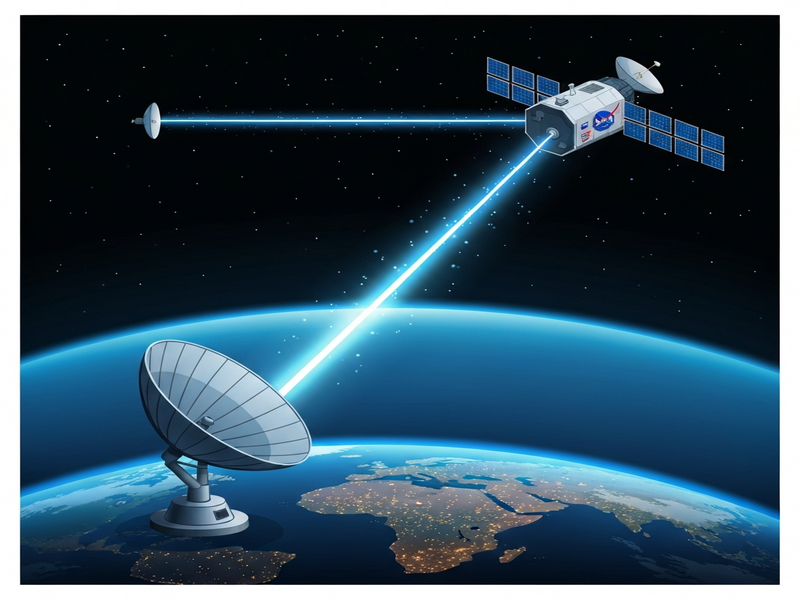
How the Artemis II Laser‑Beam Communication Works
The O2O system replaces traditional radio frequency (RF) transmitters with a compact, high‑power laser transmitter mounted on the Orion crew module. The key components are:
- Laser Transceiver: A 1550 nm wavelength fiber‑laser capable of 260 Mbps sustained data flow.
- Pointing, Acquisition, and Tracking (PAT) Unit: Fine‑steering mirrors keep the laser beam locked on Earth‑based ground stations despite the spacecraft’s rapid motion.
- Adaptive Optics: Real‑time wavefront correction mitigates atmospheric turbulence, preserving signal integrity.
- Ground Receivers: Two dedicated optical ground stations—one in Las Cruces, New Mexico, and another on Table Mountain, California—use large aperture telescopes and photon‑counting detectors to capture the incoming beam.
Because light travels at roughly 300,000 km/s, the latency is essentially the same as RF, but the bandwidth advantage is massive. NASA’s own technical brief states that the O2O link can handle “high‑definition video, large‑format imagery, and rapid telemetry” with a margin that comfortably exceeds mission requirements.
4K Moon Footage in Real Time
One of the most public‑facing demonstrations of the laser link will be a continuous 4K live‑stream from the lunar surface. The video stream, encoded in H.265/HEVC, consumes roughly 15 Mbps per stream, leaving ample headroom for additional data channels such as:
- High‑resolution scientific imagery (up to 100 Mbps).
- Telemetry packets for navigation and health monitoring (under 5 Mbps).
- Voice and command‑and‑control communications (under 2 Mbps).
With a raw capacity of 260 Mbps, the system can simultaneously broadcast multiple 4K feeds, a feature that will be invaluable for future lunar habitats where crews, scientists, and the public will all demand live visual access.
Why Laser Beats S‑Band Radio
Traditional deep‑space missions have relied on S‑band (2–4 GHz) and X‑band (8–12 GHz) radio links. While reliable, these frequencies suffer from two major constraints:
- Limited Bandwidth: S‑band typically tops out at 10–20 Mbps, insufficient for high‑definition video.
- Spectrum Congestion: The RF spectrum is heavily allocated, leading to interference and regulatory hurdles.
Laser communication, by contrast, operates in the optical spectrum where bandwidth is effectively limitless. The O2O system’s 260 Mbps rate is more than ten times the maximum S‑band capacity used on Artemis I, and it opens the door to “space‑to‑ground internet” speeds that were once only theoretical.
NASA still retains S‑band as a backup, especially during the “dark window” when the Moon blocks line‑of‑sight to the ground stations. This redundancy mirrors the dual‑link strategy employed on the Deep Space Network (DSN) for Voyager and Mars rovers.
NASA’s Perspective
“The O2O laser link is a game‑changer for crewed exploration,” said Dr. Karen Huang, NASA’s Chief of Deep‑Space Communications. “It not only delivers breathtaking 4K video, but also provides the data bandwidth needed for autonomous navigation, AI‑driven science, and rapid decision‑making on the lunar surface.”
“Our ground stations in New Mexico and California have been upgraded with adaptive optics that were once only used in astronomical observatories,” added James Miller, Lead Engineer for the O2O program. “The result is a reliable, high‑throughput link that will set the standard for Artemis III and beyond.”
Beyond Artemis II: The Future of Space Internet
The successful demonstration of laser communication on Artemis II will ripple across multiple domains:
Deep‑Space Exploration
Future missions to Mars, the Jovian moons, and even interstellar probes will need data rates far beyond what RF can provide. A laser link capable of 260 Mbps is a stepping stone toward the gigabit‑per‑second links already tested in low‑Earth orbit (LEO) experiments.
Commercial Satellite Services
Companies developing “space‑based broadband” can leverage the same PAT and adaptive‑optics technologies to offer high‑speed internet to remote Earth locations. The technology also aligns with the emerging Tom’s Hardware article that highlights the commercial potential of optical links.
AI‑Driven Operations
With a data‑rich pipeline, AI agents can process imagery, run real‑time anomaly detection, and even control robotic assets on the Moon without human latency bottlenecks. This is where platforms like the Enterprise AI platform by UBOS become critical, providing the orchestration layer for massive data streams.
Secure, Low‑Latency Communications
Laser beams are inherently narrow, making them difficult to intercept. This security advantage is attractive for defense and governmental applications that require encrypted, low‑latency links.
What This Means for You
If you’re a developer, researcher, or startup looking to harness high‑throughput space data, now is the time to explore the tools that can ingest, analyze, and visualize laser‑link streams. UBOS offers a suite of AI‑powered services that can turn raw telemetry into actionable insights:
- AI SEO Analyzer – Optimize your own space‑related web content for maximum visibility.
- AI Video Generator – Turn mission data into engaging video briefs.
- Workflow automation studio – Build pipelines that automatically ingest laser‑link telemetry.
- AI Chatbot template – Deploy a conversational assistant that answers real‑time mission queries.
- AI Image Generator – Create visualizations of lunar terrain from high‑resolution data.
Explore the UBOS templates for quick start and accelerate your development cycle. Whether you’re a startup (UBOS for startups) or an established SMB (UBOS solutions for SMBs), the platform scales with your needs.
Conclusion
The Artemis II laser‑beam communication system is more than a technical novelty; it is a foundational technology that will reshape how humanity interacts with deep space. By delivering 4K lunar footage at 260 Mbps, it proves that optical links can meet the demanding data requirements of future crewed missions, commercial satellite services, and AI‑driven operations.
Stay ahead of the curve—follow the latest developments on the UBOS news page, join the UBOS partner program, and start building the next generation of space‑enabled applications today.
Explore more:
Andrii Bidochko
CTO UBOS
Andrii Bidochko is an AI entrepreneur and researcher focused on AI agents, reinforcement learning, and autonomous systems. He writes about the technologies shaping the future of machine intelligence, from frontier models and agent architectures to real-world AI applications.