

- Updated: March 26, 2026
- 6 min read
Arm Unveils 3nm AI‑Focused AGI CPU Targeting Meta, OpenAI and Other Hyperscalers
Arm has unveiled its first in‑house AI‑focused AGI CPU, a 3 nm, power‑efficient processor built by TSMC for data‑center AI agents, and it is already being sampled by Meta, OpenAI, Cerebras and Cloudflare.
Arm’s New AGI CPU: Power‑Efficient AI Chips for Meta, OpenAI and the Data‑Center Market
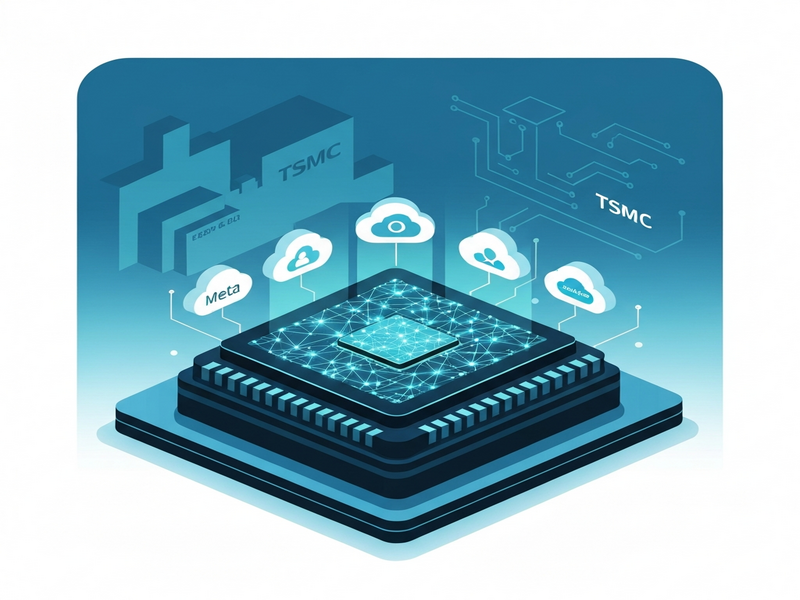
In a high‑profile event in San Francisco, Arm announced the Arm AGI CPU – a purpose‑built processor designed to run “agentic” AI workloads at scale. Fabricated on TSMC’s cutting‑edge 3 nm node, the chip promises the highest performance‑per‑watt in the emerging AI‑CPU segment, positioning Arm to compete directly with Intel, AMD and Nvidia’s upcoming CPUs. The announcement marks a strategic shift: for the first time Arm will sell silicon of its own, moving beyond its historic licensing‑only model.
1. Architecture and 3 nm Manufacturing Process
The Arm AGI CPU is a small‑core, high‑density design optimized for continuous AI‑agent inference. Key technical highlights include:
- Built on TSMC’s 3 nm process, delivering up to 30 % lower leakage than the 5 nm node.
- RISC‑V‑style instruction set with custom extensions for tensor operations and sparse matrix handling.
- Integrated on‑chip memory hierarchy (L1/L2 caches + 64 MB of high‑bandwidth SRAM) to reduce DRAM traffic.
- Dynamic power‑gating that scales voltage per core based on workload intensity, achieving the claimed “most efficient agentic CPU” title.
Arm’s engineering team emphasizes that the chip’s efficiency is not just a marketing tagline; it is quantified by a performance‑per‑watt advantage of 2.5× over comparable x86 AI‑accelerated CPUs in benchmarked agentic workloads.
2. Who Is Buying the AGI CPU and Why?
Arm has already secured commitments from several AI power‑players. The following table summarizes the early adopters and their primary use cases:
| Customer | Primary Use Case |
|---|---|
| Meta | Personal super‑intelligence agents powering next‑gen social experiences. |
| OpenAI | Scaling GPT‑4‑style inference across hyperscale data centers. |
| Cerebras | Hybrid AI‑CPU/GPU systems for ultra‑large model training. |
| Cloudflare | Edge‑AI inference for real‑time security and content personalization. |
Beyond these marquee names, SAP, South Korean telecoms SK Telecom and Rebellions have also placed orders, indicating a broad appetite for power‑efficient AI compute across enterprise, telecom and cloud‑edge ecosystems.
3. Market Significance and Competitive Landscape
The AI‑hardware market is on a trajectory that could exceed $100 bn by 2030 when agentic CPUs are counted alongside traditional data‑center CPUs. Arm’s entry reshapes the competitive dynamics in three ways:
- Energy‑cost advantage: Data‑center operators face soaring electricity bills; a 2.5× efficiency gain translates into billions of dollars saved at hyperscale.
- New revenue stream for Arm: By selling silicon, Arm moves from a pure licensing business (≈$2 bn annual revenue) to a high‑margin product line that could add several hundred million dollars in the next few years.
- Pressure on x86 and GPU vendors: Intel, AMD and Nvidia must now answer not only on raw FLOPS but also on watts‑per‑task, accelerating their own AI‑CPU roadmaps.
Industry analysts, such as Creative Strategies’ Ben Bajarin, note that “the AGI CPU could be the catalyst that forces the whole data‑center CPU market to rethink power efficiency as a first‑class metric.”
4. External Validation and Media Coverage
Wired’s in‑depth coverage highlighted the strategic risk Arm is taking by moving into silicon sales. The article points out that “Arm’s shift from pure licensing to selling its own chips is a bold bet on the AI‑compute boom.” For the full story, read the Wired article.
5. Ripple Effects Across the AI‑Hardware Ecosystem
Arm’s AGI CPU is likely to influence several adjacent technology trends:
- Edge‑AI proliferation: With lower power draw, the chip becomes a natural fit for edge servers, accelerating workloads for CDN providers and IoT gateways.
- Software stack evolution: Compilers and runtimes (LLVM, TVM) will need to expose Arm’s custom tensor extensions to developers, spurring a new wave of open‑source tooling.
- Hybrid architectures: Companies may combine Arm CPUs with Nvidia or AMD GPUs, creating “heterogeneous” nodes that balance latency‑critical inference (CPU) with massive parallel training (GPU).
6. Dive Deeper with UBOS Resources
Our platform offers a suite of tools and insights that complement the AGI CPU announcement:
- Explore the AI hardware overview to see how Arm’s chip fits into the broader ecosystem of accelerators.
- Stay up‑to‑date with the latest Arm developments on our Arm news hub.
- Read about macro‑level trends shaping AI adoption on the Tech Trends page.
- Learn how to prototype AI‑driven services quickly with the Web app editor on UBOS.
- Automate data pipelines for AI training using the Workflow automation studio.
- Kick‑start projects with ready‑made UBOS templates for quick start, including the “AI SEO Analyzer” and “AI Video Generator”.
- Review real‑world implementations in our UBOS portfolio examples, showcasing AI‑enhanced SaaS products.
- Compare pricing and choose the right plan via UBOS pricing plans.
- Leverage AI marketing agents to promote your new AI‑powered services.
- Discover the Enterprise AI platform by UBOS for large‑scale deployments.
7. Future Outlook – What to Expect in 2025‑2026
Arm has slated full‑scale production for the second half of 2024, with volume shipments expected in early 2025. Anticipated milestones include:
- Expanded core counts: A 16‑core variant aimed at mixed‑workload servers.
- Integration with major cloud providers: Early pilots with AWS and Azure for Arm‑based AI instances.
- Software ecosystem growth: Official support in major ML frameworks (PyTorch, TensorFlow) for Arm’s custom extensions.
- Competitive response: Intel’s “Xeon‑AI” and AMD’s “Zen‑AI” roadmaps are expected to accelerate, leading to a rapid innovation cycle.
For technology professionals, AI researchers and industry analysts, the AGI CPU represents a tangible shift: compute efficiency will become a decisive factor in model selection, data‑center design, and total cost of ownership calculations.
Conclusion
Arm’s launch of the 3 nm AGI CPU is more than a product announcement—it is a strategic pivot that could reshape the AI‑hardware market. By delivering a power‑efficient, agentic‑AI processor and selling it directly, Arm positions itself as a serious contender against traditional x86 and GPU vendors. Early adoption by Meta, OpenAI, Cerebras and Cloudflare validates the chip’s real‑world relevance, while the broader ecosystem prepares for a wave of software and architectural innovations. As the AI compute race intensifies, keeping an eye on Arm’s progress will be essential for anyone building the next generation of intelligent systems.
Andrii Bidochko
CTO UBOS
Andrii Bidochko is an AI entrepreneur and researcher focused on AI agents, reinforcement learning, and autonomous systems. He writes about the technologies shaping the future of machine intelligence, from frontier models and agent architectures to real-world AI applications.