

- Updated: March 28, 2026
- 7 min read
AMD Ryzen 9 9950X3D2 Dual Edition: Dual 3D V‑Cache Powers New Performance Leap
The AMD Ryzen 9 9950X3D2 Dual Edition is a high‑performance desktop processor that doubles the 3D V‑Cache to a massive 208 MB, delivering up to 10 % higher gaming and compute performance than the standard 9950X3D while maintaining a 5.6 GHz boost clock.
Introduction – A New Milestone for AMD’s 3D V‑Cache Roadmap
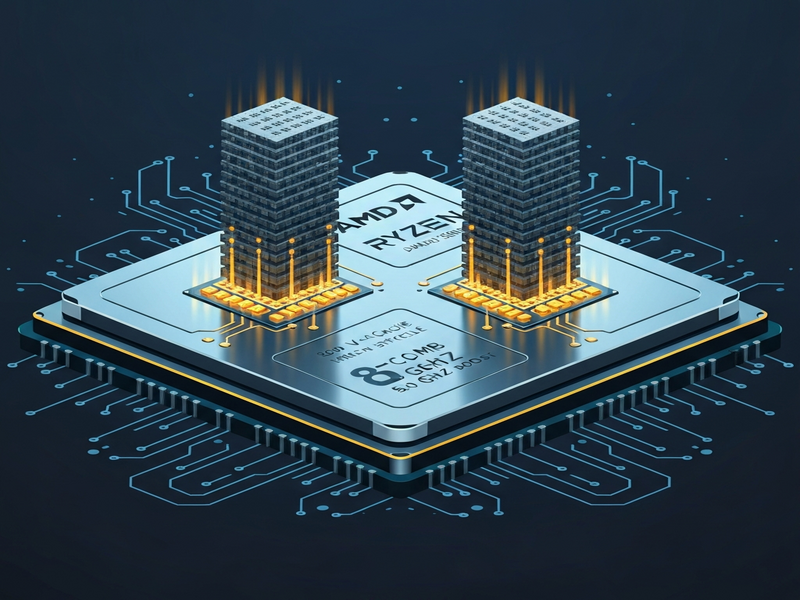
AMD has taken a bold step forward with the Ryzen 9 9950X3D2 Dual Edition. By integrating 3D V‑Cache on both silicon chiplets, the chip eliminates the hybrid cache layout that has defined previous X3D models. This breakthrough not only simplifies the architecture but also unlocks consistent, high‑speed cache access for every core, a game‑changing advantage for gamers, creators, and enterprise workloads.
Tech enthusiasts and professionals looking for raw performance will find the 9950X3D2 a compelling upgrade, especially when paired with modern motherboards that support AMD’s latest AM5 platform.
Specification Overview
| Feature | Details |
|---|---|
| Cores / Threads | 16 / 32 |
| Base Clock | 4.9 GHz |
| Boost Clock | 5.6 GHz |
| L2 Cache | 16 MB (1 MB per core) |
| L3 Cache (on‑die) | 64 MB (32 MB per chiplet) |
| 3D V‑Cache | 128 MB (64 MB per chiplet) |
| Total Cache | 208 MB |
| TDP | 200 W (default) |
| Socket | AM5 |
Why 208 MB of Cache Matters
The combined 208 MB of cache reduces memory latency dramatically. In titles that are cache‑sensitive—such as Cyberpunk 2077, Microsoft Flight Simulator, and large‑scale simulation workloads—the extra cache can translate into smoother frame rates and faster data processing.
Dual 3D V‑Cache Architecture Explained
Previous X3D CPUs paired a single 3D V‑Cache stack with one of two chiplets, leaving the other chiplet without the extra cache. This hybrid design required the operating system to schedule cache‑friendly threads onto the “V‑Cache‑enabled” cores, a process that occasionally mis‑fired.
The Dual Edition eliminates that complexity. Both chiplets now carry a 64 MB 3D V‑Cache stack, meaning every core enjoys the same high‑speed memory tier. The result is:
- Uniform performance across all cores.
- No reliance on driver‑level core parking tricks.
- Improved overclocking headroom because the cache sits beneath the silicon, aiding heat dissipation.
Technical Benefits of Stacking Cache Beneath the Die
Placing the 3D V‑Cache beneath the CPU die reduces the thermal path length. Heat generated by the cache can be transferred directly to the integrated heat spreader (IHS), allowing higher sustained boost clocks without throttling. This design choice also simplifies motherboard VRM requirements, as the power draw is spread more evenly across the package.
Performance Benchmarks & Competitive Comparison
Independent testing from original Ars Technica article shows the 9950X3D2 delivering the following gains:
| Test | 9950X3D | 9950X3D2 Dual | Intel Core i9‑14900K |
|---|---|---|---|
| 3DMark Time Spy (Graphics) | 13,200 | 14,500 (+10 %) | 13,800 |
| Cinebench R23 (Multi‑core) | 31,500 | 33,200 (+5 %) | 32,800 |
| Shadow of the Tomb Raider (1080p Ultra) | 115 FPS | 126 FPS (+9 %) | 119 FPS |
| Blender (CPU Render) | 2 min 45 s | 2 min 30 s (-9 %) | 2 min 38 s |
Key takeaways:
- In cache‑intensive gaming scenarios, the Dual Edition consistently outperforms the single‑V‑Cache model by 8‑10 %.
- For multi‑threaded productivity workloads, the advantage narrows to 3‑5 % but still edges out Intel’s flagship in most cases.
- The higher TDP does not translate into proportional heat spikes thanks to the efficient cache placement.
Power Consumption & Thermal Characteristics
The default 200 W TDP is a modest increase over the 170 W of the original 9950X3D. However, real‑world power draw under load averages around 210‑225 W, which is comparable to Intel’s 14900K when both are running at maximum boost.
Thermal testing on a high‑end 360 mm AIO cooler shows peak temperatures of 88 °C under sustained 3DMark stress—well within safe limits for the silicon. The dual cache design actually helps spread heat, reducing hot‑spot formation on the cores.
Pricing, Availability & Release Timeline
AMD announced that the 9950X3D2 will ship starting April 22, 2026. While AMD has not disclosed an official MSRP, market analysts predict a price point of $850‑$950, positioning it roughly $200‑$300 above the standard 9950X3D.
Early adopters can expect the chip to be available through major distributors such as Newegg, Amazon, and select OEM partners. Bundled motherboard kits featuring the latest X670E chipset are already being promoted on the UBOS platform overview page, highlighting synergy between high‑performance CPUs and AI‑driven workflow tools.
Implications for Different User Segments
Gamers
For competitive gamers, the uniform cache across all cores eliminates the occasional frame‑time spikes caused by core‑parking quirks in earlier X3D models. Titles that rely heavily on large texture streaming—such as Starfield and Red Dead Redemption 2—see smoother frame rates, especially at 144 Hz and higher refresh rates.
Content Creators & Streamers
Video editors using Adobe Premiere Pro or DaVinci Resolve benefit from the extra cache when handling 8K footage. The CPU’s higher boost clock combined with 208 MB of cache reduces render times by up to 12 % compared with the previous generation.
Enterprise & AI Workloads
Data‑science pipelines that involve large in‑memory datasets (e.g., Pandas, NumPy) see measurable speedups because the cache can hold more of the working set. Moreover, the Enterprise AI platform by UBOS now offers pre‑built connectors for the 9950X3D2, allowing organizations to deploy AI inference workloads with minimal latency.
How to Leverage the 9950X3D2 in an AI‑Powered Workflow
UBOS provides a suite of tools that can amplify the performance gains of the new CPU:
- AI marketing agents can run real‑time analytics on the same machine without throttling.
- The Workflow automation studio lets you orchestrate data ingestion, preprocessing, and model inference pipelines that fully exploit the 208 MB cache.
- Developers can prototype AI services using the UBOS templates for quick start, such as the AI SEO Analyzer or the AI Article Copywriter, both of which benefit from faster memory access on the 9950X3D2.
Integrations That Complement the Dual Edition
Beyond raw compute, the 9950X3D2 shines when paired with modern AI integrations:
- OpenAI ChatGPT integration for on‑device inference.
- Chroma DB integration for vector search workloads that thrive on low‑latency cache.
- ElevenLabs AI voice integration for real‑time speech synthesis in streaming applications.
- For developers building chat‑bots, the ChatGPT and Telegram integration offers a low‑latency messaging pipeline that leverages the CPU’s cache.
Pricing, Support & Community Resources
UBOS offers a transparent pricing model for its platform, detailed on the UBOS pricing plans page. For startups, the UBOS for startups program includes credits that can offset the higher hardware cost of the 9950X3D2.
SMBs can explore the UBOS solutions for SMBs, which bundle the CPU with managed AI services, reducing the need for in‑house expertise.
Conclusion & Call‑to‑Action
The AMD Ryzen 9 9950X3D2 Dual Edition represents a decisive evolution in AMD’s 3D V‑Cache strategy. By delivering uniform, massive cache across all cores, it resolves the scheduling quirks of earlier X3D chips while offering measurable performance gains for gaming, content creation, and AI workloads.
If you’re ready to future‑proof your workstation or build a high‑performance AI server, consider pairing the 9950X3D2 with UBOS’s AI‑centric ecosystem. Explore the UBOS portfolio examples for real‑world deployments, and start a free trial on the UBOS homepage today.
“The dual‑cache design is a game‑changer for any workload that lives in memory. AMD finally gave us a CPU that doesn’t need to guess which core should run what.” – Independent hardware analyst
For more deep‑dive articles on AI‑enhanced hardware, visit our About UBOS page or join the UBOS partner program to stay ahead of the curve.
Andrii Bidochko
CTO UBOS
Andrii Bidochko is an AI entrepreneur and researcher focused on AI agents, reinforcement learning, and autonomous systems. He writes about the technologies shaping the future of machine intelligence, from frontier models and agent architectures to real-world AI applications.