

- Updated: December 28, 2025
- 6 min read
AMD Ryzen 7 5800X3D Prices Surge Amid DDR5 Memory Cost Crisis – UBOS Tech News
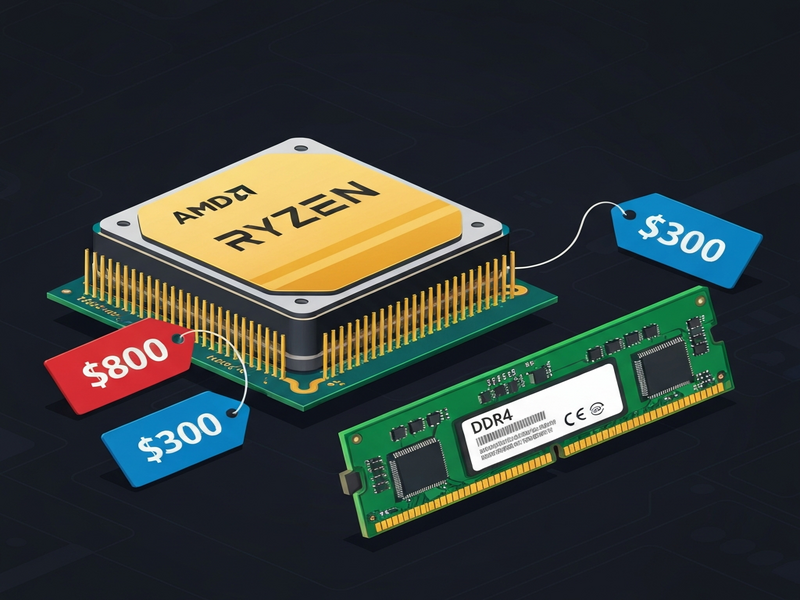
The AMD Ryzen 7 5800X3D, a DDR4‑based gaming CPU, has seen its second‑hand price jump to $500‑$800, out‑pricing even newer Ryzen 7 9800X3D models because DDR5 memory costs have exploded.
This surge reflects a broader market shift where builders cling to the cheaper AM4 platform as DDR5 kits become prohibitively expensive.
AMD Ryzen 7 5800X3D Second‑Hand Price Surge Amid DDR5 Memory Crisis
In the past month, eBay listings for the 5800X3D have regularly topped $600, with some units fetching as much as $800—more than the MSRP of AMD’s latest 9800X3D. The unexpected price inflation is driven by a perfect storm: dwindling DDR4 supply, soaring DDR5 prices, and the 5800X3D’s unique 3D‑VCache advantage that still outperforms many newer chips in gaming workloads.
Why the 5800X3D Still Matters
Launched in early 2022, the Ryzen 7 5800X3D was the first consumer CPU to feature AMD’s 3D‑VCache technology, stacking an extra 64 MB of L3 cache on top of the standard Zen 3 die. This gave it a measurable edge in frame‑rate‑critical titles, often beating Intel’s flagship i9‑12900KS at a fraction of the power draw.
Even after the arrival of Zen 4, the 5800X3D remains a compelling mid‑range option because it runs on the mature AM4 socket, which supports a vast ecosystem of affordable DDR4 motherboards and memory kits.
DDR4 Platform Advantage in a DDR5‑Dominated World
When AMD introduced the AM5 platform, it committed exclusively to DDR5, leaving the AM4/DDR4 ecosystem behind. As DDR5 prices have surged—some 32 GB kits now exceed $2,000—builders looking to stay on a budget are forced to reconsider older platforms.
DDR4 kits, while not as fast, still deliver solid performance for most games and cost roughly 30‑40 % of comparable DDR5 kits. This price differential is the primary catalyst for the renewed demand for the 5800X3D.
Market Dynamics: Second‑Hand vs. New CPUs
eBay Price Trends and New‑CPU Comparison
Data collected from eBay between July and November 2024 shows the following average prices:
- Ryzen 7 5800X3D (used): $500‑$600, with peak listings at $800.
- Ryzen 7 9800X3D (new, AM5): $450‑$500 MSRP, often discounted to $400.
- Ryzen 7 5700X3D (used): $300‑$450.
When you factor in the cost of a DDR5‑compatible motherboard (often $150‑$250) and a DDR5 kit, a brand‑new 9800X3D build can easily exceed $1,200, whereas a refurbished 5800X3D with a $100 DDR4 board stays under $800.
The 3D‑VCache Edge
Benchmarks from reputable tech sites still rank the 5800X3D ahead of many Zen 4 CPUs in titles like Cyberpunk 2077, Assassin’s Creed Valhalla, and Shadow of the Tomb Raider. The extra cache reduces memory latency, a factor that DDR5’s higher bandwidth cannot fully compensate for in latency‑sensitive gaming scenarios.
DDR5 Memory Pricing Impact on DDR4 Builds
Cost Breakdown: DDR4 vs. DDR5
| Component | DDR4 (Typical) | DDR5 (Typical) |
|---|---|---|
| 16 GB Kit (2×8 GB) | $70‑$90 | $250‑$300 |
| 32 GB Kit (2×16 GB) | $130‑$150 | $500‑$600 |
| Motherboard (mid‑range) | $80‑$120 | $150‑$250 |
The table illustrates why many builders are gravitating back to AM4: a complete DDR4 gaming rig can be assembled for roughly $600‑$800, while a comparable DDR5 system often starts above $1,200.
Real‑World Build Example
DDR4 Build (5800X3D)
- CPU: AMD Ryzen 7 5800X3D – $550 (used)
- Motherboard: B550 chipset – $110
- RAM: 32 GB DDR4 3200 MHz – $140
- GPU: RTX 3060 12 GB – $300 (used)
- Total (excluding case, PSU, storage): ≈ $1,100
DDR5 Build (9800X3D)
- CPU: AMD Ryzen 7 9800X3D – $450 (new)
- Motherboard: B650 chipset – $200
- RAM: 32 GB DDR5 5600 MHz – $580
- GPU: RTX 3060 12 GB – $300 (used)
- Total (excluding case, PSU, storage): ≈ $1,530
The DDR4 configuration saves roughly $430 while delivering comparable gaming performance, making it the smarter choice for budget‑conscious gamers.
Buying Tips for Savvy Builders
- Check seller reputation. Look for eBay power‑sellers with ≥99 % positive feedback and detailed photos of the CPU and cooler.
- Verify BIOS compatibility. Most B550 and X570 boards have received updates to support the 5800X3D; confirm the version before purchase.
- Factor in cooling. The 5800X3D runs hotter under load due to the extra cache. Pair it with a quality air cooler or a 240 mm AIO.
- Leverage existing DDR4 stock. If you already own DDR4 modules, the total cost drops dramatically.
- Consider the 5700X3D. For a tighter budget, the 5700X3D offers similar cache benefits at $300‑$400 on the secondary market.
- Watch for bundle deals. Some sellers include a B550 motherboard and DDR4 kit for a flat price, effectively lowering the per‑part cost.
How UBOS Can Streamline Your Build Process
Beyond hardware, modern builders need software tools that automate testing, monitoring, and deployment. UBOS offers a suite of AI‑driven services that can turn a raw PC build into a managed, performance‑tuned workstation.
- Explore the UBOS platform overview to see how you can integrate AI monitoring into your gaming rig.
- Use the AI marketing agents to automatically generate performance reports and share them on social media.
- Automate driver updates and benchmark scheduling with the Workflow automation studio.
- Leverage the Telegram integration on UBOS to receive real‑time alerts when temperatures exceed safe thresholds.
- Combine OpenAI ChatGPT integration with your build logs for natural‑language troubleshooting.
- Enhance voice notifications using the ElevenLabs AI voice integration.
- For developers, the Web app editor on UBOS lets you create custom dashboards without writing a line of code.
- Check out the UBOS templates for quick start, including a pre‑built “Gaming Performance Tracker” template.
Whether you’re a startup building a SaaS‑based performance analytics service or an SMB looking to keep your office PCs humming, the Enterprise AI platform by UBOS scales with you.
Further Reading & Resources
Deep‑dive into the technical nuances of memory technologies and how they affect gaming performance:
- DDR4 vs DDR5 Guide – a comprehensive comparison of latency, bandwidth, and cost.
- UBOS news – stay updated on the latest hardware‑software integration announcements.
- Ryzen Products – explore the full lineup of AMD CPUs supported by UBOS tools.
Conclusion
The AMD Ryzen 7 5800X3D’s second‑hand price surge is not a fleeting hype; it’s a rational market response to the DDR5 price explosion and the enduring value of 3D‑VCache for gamers. By pairing the chip with affordable DDR4 components and leveraging AI‑powered management tools from UBOS, builders can achieve high‑frame‑rate performance without breaking the bank.
Ready to future‑proof your rig? Explore UBOS pricing plans today and start automating your build’s performance monitoring.
Read the full story on Tom’s Hardware.