

- Updated: February 4, 2026
- 6 min read
Alphabet Avoids Discussing Google‑Apple AI Deal in Q4 Earnings Call
Alphabet chose not to discuss its AI partnership with Apple during the Q4 earnings call, even when investors explicitly asked about the deal.
Alphabet’s Silence on the Google‑Apple AI Deal Raises Investor Questions
During the TechCrunch report on February 4, 2026, analysts noted that Alphabet’s leadership sidestepped a direct question about its AI collaboration with Apple. The omission is striking because the partnership—intended to power the next generation of Siri—represents one of the most high‑profile AI alliances in the tech sector.
For tech‑savvy investors and AI enthusiasts, this silence is more than a PR blip; it signals strategic uncertainty around how the deal will affect Google’s core advertising business, its AI roadmap, and the broader competitive landscape.
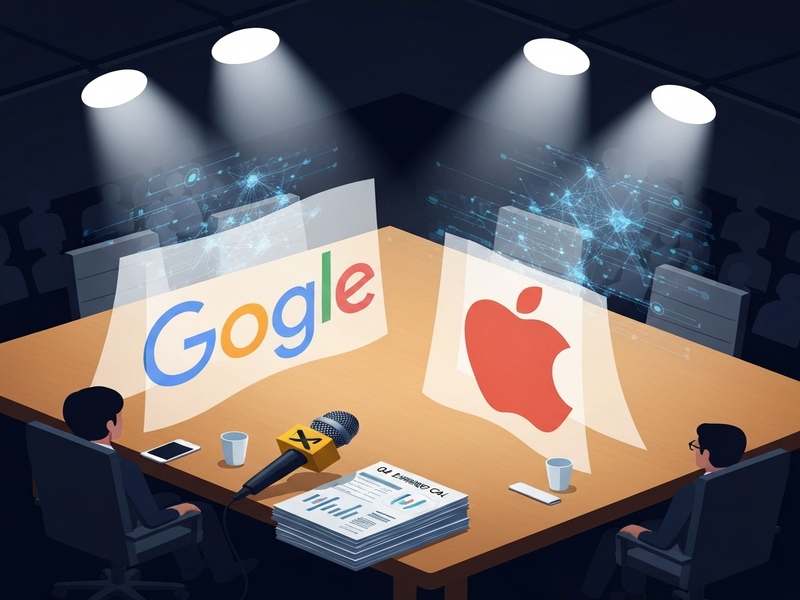
Earnings Call: What Was Said—and What Was Not
On the earnings call, Sundar Pichai was asked about “AI partnerships such as the one with Apple to power Siri.” Instead of answering, he pivoted to a broader statement about Google’s commitment to “building the next generation of foundation models.” The same phrasing was echoed by Chief Business Officer Philipp Schindler, who highlighted Apple’s role as a “preferred cloud provider.” No financial figures, timeline, or product roadmap details were disclosed.
Key takeaways from the call include:
- Alphabet emphasized its focus on Gemini‑based models for enterprise and consumer AI.
- The company reiterated progress on AI‑enhanced Search and Ads, but omitted any mention of Siri integration.
- Investors received a reminder of Google’s $20 billion historic search‑default deal with Apple, but the new AI agreement was left untouched.
Analysts interpreting the silence suggest that Alphabet may be waiting for measurable outcomes before publicizing the partnership’s impact, or that internal negotiations are still fluid.
What the Silence Means for Google
Google’s AI ambitions are tightly coupled with its advertising engine. While the search‑default arrangement with Apple directly funnels billions of ad impressions, the AI‑Siri deal is less straightforward.
Advertising Revenue Uncertainty
Google has begun testing ads in “AI Mode,” a chatbot‑style interface that could eventually replace traditional SERP ads. However, the integration of ads into AI‑driven conversations is still experimental, and the Siri partnership does not yet guarantee ad inventory on Apple devices.
Strategic Positioning Against Competitors
By embedding Gemini models into Siri, Google could gain a foothold in the voice‑assistant market, challenging Amazon’s Alexa and Microsoft’s Copilot. Yet, the lack of public metrics makes it difficult for investors to gauge the partnership’s ROI.
For companies looking to leverage AI in their own workflows, the uncertainty underscores the importance of flexible platforms. Enterprise AI platform by UBOS offers a modular architecture that can adapt to evolving AI partnerships without vendor lock‑in.
Apple’s Perspective: Benefits and Risks
Apple’s decision to partner with Google for Siri’s next‑gen AI reflects its desire to stay competitive without building a massive AI infrastructure from scratch. The rumored $1 billion annual fee is modest compared to the potential value of a more capable voice assistant.
- Enhanced User Experience: Gemini‑powered Siri could deliver more natural, context‑aware responses.
- Data Privacy Alignment: Apple can leverage Google’s AI while maintaining its on‑device privacy stance.
- Revenue Diversification: A stronger Siri may open new monetization pathways, such as in‑app purchases or premium services.
Apple’s reliance on an external AI provider also introduces risk: any shift in Google’s strategic priorities could affect Siri’s roadmap. Startups and SMBs watching this partnership can learn from Apple’s approach to augmenting core products with third‑party AI. See how UBOS solutions for SMBs enable rapid AI integration without deep internal expertise.
Expert Commentary: Why the Quiet Might Be Strategic
Industry analysts point to three primary reasons for Alphabet’s reticence:
- Regulatory Sensitivity: Disclosing financial terms could attract antitrust scrutiny, especially after the DOJ’s ongoing investigations into Google’s search agreements.
- Competitive Positioning: By keeping details under wraps, Google prevents rivals from gauging the depth of its integration with Apple’s ecosystem.
- Product Maturity: The Gemini models powering Siri may still be in beta, and premature announcements could set unrealistic expectations.
Dr. Elena Morales, an AI policy researcher at the Stanford Institute for Human‑Centric AI, notes: “Silence can be a tactical move. It allows Alphabet to iterate internally while avoiding premature market pressure.”
For businesses seeking to stay ahead of such strategic moves, adopting a flexible AI stack is crucial. The Web app editor on UBOS lets developers prototype AI‑enhanced features quickly, and the Workflow automation studio can orchestrate multi‑service AI workflows without deep code changes.
Leveraging UBOS to Future‑Proof Your AI Strategy
Whether you are a startup, an SMB, or an enterprise, the evolving landscape of AI partnerships demands tools that can adapt. UBOS provides a suite of capabilities that align with the challenges highlighted by Alphabet’s silence:
- UBOS platform overview – A unified environment for building, deploying, and scaling AI models.
- UBOS templates for quick start – Pre‑built AI app templates such as AI SEO Analyzer and AI Article Copywriter accelerate time‑to‑value.
- AI marketing agents – Automate campaign creation, mirroring how Google plans to embed ads in AI Mode.
- OpenAI ChatGPT integration – Seamlessly add conversational AI to existing products.
- Chroma DB integration – Store and retrieve vector embeddings for fast semantic search.
- ElevenLabs AI voice integration – Power voice assistants with high‑quality synthetic speech, a direct parallel to Siri enhancements.
These tools enable organizations to experiment with AI features now, rather than waiting for large‑scale vendor announcements.
Conclusion: Watching the Quiet, Preparing for the Future
Alphabet’s decision to remain silent on the Google‑Apple AI deal during its earnings call sends a clear message: the partnership is still in a formative stage, and the company prefers to manage expectations internally. For investors, the key takeaway is to monitor subsequent product releases, regulatory filings, and any future earnings‑call disclosures.
Meanwhile, businesses can mitigate uncertainty by adopting adaptable AI platforms. Explore the UBOS homepage for a holistic view of how modern AI infrastructure can keep you ahead of industry shifts.
Stay informed, stay agile, and consider leveraging ready‑made solutions like the AI Video Generator or the AI YouTube Comment Analysis tool to enrich your own product ecosystems while the giants negotiate behind the scenes.
For a deeper dive into the strategic implications of AI partnerships, revisit the original TechCrunch article and keep an eye on future Alphabet disclosures.