

- Updated: March 26, 2026
- 6 min read
AI Safety Bill Could Halt Data Center Construction
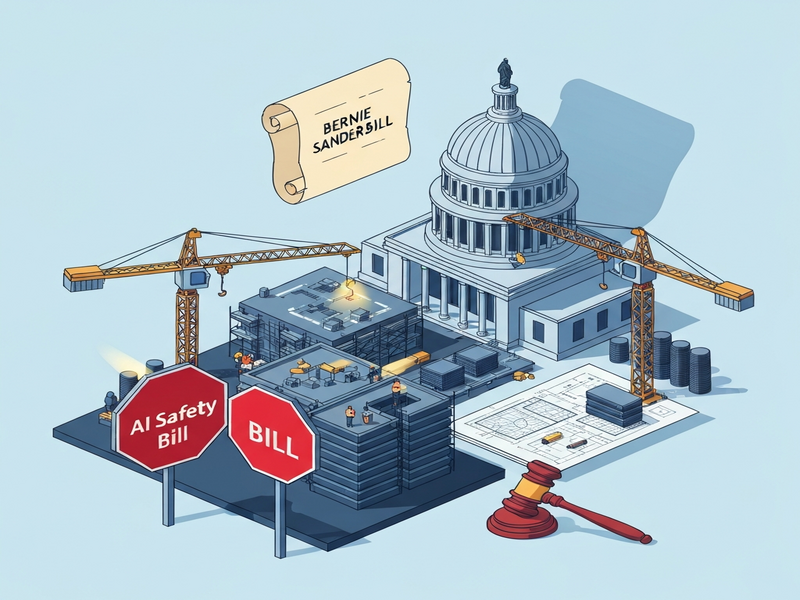
Senator Bernie Sanders’ AI safety bill would impose a nationwide moratorium on the construction and upgrade of AI‑focused data centers until comprehensive legislation guarantees that artificial‑intelligence systems are safe, environmentally responsible, and economically equitable.
Why a Data‑Center Moratorium Matters Now
The rapid expansion of AI‑driven workloads is forcing tech giants to build massive data centers at a breakneck pace. While these facilities power everything from chatbots to autonomous vehicles, they also consume megawatts of electricity, strain water supplies, and raise privacy concerns. In a bold move, Wired reports that Senator Bernie Sanders will introduce legislation that could halt new AI data‑center projects until a robust safety framework is in place.
For tech‑savvy professionals, policymakers, and environmentally‑conscious readers, understanding the bill’s mechanics, its political landscape, and the ripple effects on the data‑center market is essential. This article breaks down the proposal, examines the opposition, and highlights what the shift could mean for the AI industry and the broader economy.
Bill Overview: A Structured Pause on AI Infrastructure
The AI Safety Moratorium Act defines a data center as “any facility that consumes more than 20 megawatts of power for AI‑specific workloads.” Under the bill, construction, expansion, or major upgrades of such facilities would be prohibited until Congress passes a suite of safeguards covering:
- Carbon‑neutral energy sourcing and transparent emissions reporting.
- Consumer‑price protection to prevent utility bill spikes.
- Data‑privacy standards that limit surveillance and ensure civil‑rights compliance.
- Equitable profit‑sharing mechanisms that direct a portion of AI‑generated wealth to working families.
- Export controls on high‑performance chips to nations lacking comparable safety regulations.
The moratorium is open‑ended; it lifts only when all criteria are codified into law. By tying the pause to concrete, measurable outcomes, the bill aims to give legislators and regulators the breathing room needed to craft policies that balance innovation with public interest.
Political Landscape: Allies, Critics, and the Road Ahead
The proposal arrives at a time of heightened bipartisan tension over AI. While progressive lawmakers view the moratorium as a necessary check on corporate power, many Republicans argue it could cripple U.S. competitiveness. Notably, Representative Alexandria Ocasio‑Cortez is slated to introduce a companion bill in the House, signaling coordinated progressive momentum.
On the other side, industry‑friendly senators have warned that a blanket halt could “slow critical services, eliminate high‑wage jobs, and drain billions in local tax revenue.” The Data Center Coalition, representing developers and cloud providers, has already issued statements emphasizing the economic stakes.
Yet even some traditionally pro‑tech Republicans, such as Senator Josh Hawley, have voiced concerns about unchecked AI growth, proposing separate legislation to shield consumers from electricity rate hikes. This cross‑aisle anxiety suggests the debate may evolve beyond simple partisan lines, focusing instead on concrete consumer protections.
Environmental & Consumer Impact: What the Numbers Reveal
Data centers are already responsible for roughly 1% of global electricity consumption. When AI workloads are layered on top, power demand can surge dramatically. A recent Pew poll found that 38% of Americans believe data centers increase their household electricity bills, while 42% worry about local water scarcity.
By enforcing a moratorium until clean‑energy standards are met, the bill could:
- Accelerate the shift to renewable power contracts for AI facilities.
- Encourage water‑recycling technologies that reduce freshwater draw.
- Prompt developers to adopt modular, energy‑efficient hardware designs.
- Provide regulators with data to set realistic caps on emissions per megawatt‑hour.
For consumers, the legislation promises clearer billing structures and stronger privacy safeguards, potentially averting the “AI‑induced price shock” many fear.
Industry Response & Emerging Data‑Center Trends
Tech giants have responded with a mix of caution and optimism. In March, leaders from Amazon, Microsoft, Google, and Meta met at the White House to sign a non‑binding pledge to “pay the full cost of their energy and infrastructure” and to explore community‑benefit programs. While critics label the pledge symbolic, it signals a willingness to engage on sustainability.
Meanwhile, the data‑center market is already adapting. According to our data center trends analysis, developers are:
- Deploying edge‑computing nodes to reduce long‑haul data traffic.
- Investing in liquid‑cooling systems that cut water usage by up to 30%.
- Exploring “green‑by‑design” architectures that integrate on‑site solar and battery storage.
These shifts align with the bill’s environmental goals, suggesting that the moratorium could accelerate already‑underway innovations rather than stall progress entirely.
What This Means for Developers, Start‑ups, and Enterprises
For teams building AI‑powered products, the legislation introduces new compliance checkpoints. Here are three actionable steps:
- Audit energy footprints. Use tools like the AI SEO Analyzer or AI Article Copywriter to estimate the compute load of your models and identify opportunities for optimization.
- Integrate compliance workflows. UBOS’s Workflow automation studio lets you embed regulatory checks—such as emissions reporting—directly into your CI/CD pipelines.
- Leverage low‑code AI services. The Web app editor on UBOS offers pre‑built templates like the AI Chatbot template that are already tuned for energy‑efficient inference.
Start‑ups can also explore the UBOS for startups program, which provides credits for green‑hosting and access to the Enterprise AI platform by UBOS. Meanwhile, SMBs may benefit from the UBOS solutions for SMBs, which include built‑in cost‑control dashboards.
Stay Informed: Related Resources
For ongoing coverage of AI policy, visit our AI safety news hub. It aggregates legislative updates, expert commentary, and case studies on responsible AI deployment.
If you’re looking to prototype AI‑driven marketing workflows, check out the AI marketing agents suite, which includes voice‑enabled campaigns powered by the ElevenLabs AI voice integration.
Looking Ahead: How to Influence the Future of AI Infrastructure
The AI safety moratorium is more than a legislative hurdle; it’s a catalyst for a broader conversation about who benefits from AI and at what cost. By engaging early—whether through policy advocacy, adopting greener tech stacks, or leveraging platforms like UBOS—you can help shape a future where AI advances without compromising the environment or consumer rights.
Ready to future‑proof your AI projects? Explore the UBOS platform overview, experiment with the UBOS templates for quick start, and join the UBOS partner program to stay ahead of regulatory change.
The conversation is just beginning. Share your thoughts in the comments, join the policy briefings, and let’s build AI that serves everyone—safely, sustainably, and equitably.
ChatGPT and Telegram integration
OpenAI ChatGPT integration
Chroma DB integration
UBOS homepage
About UBOS
UBOS pricing plans
UBOS portfolio examples
Andrii Bidochko
CTO UBOS
Andrii Bidochko is an AI entrepreneur and researcher focused on AI agents, reinforcement learning, and autonomous systems. He writes about the technologies shaping the future of machine intelligence, from frontier models and agent architectures to real-world AI applications.