

- Updated: February 22, 2026
- 4 min read
AI as Cognitive Exoskeleton vs Super‑Fast Intern: Hacker News Debate
AI as a Cognitive Exoskeleton vs. a Fast Intern: What the Hacker News Debate Reveals
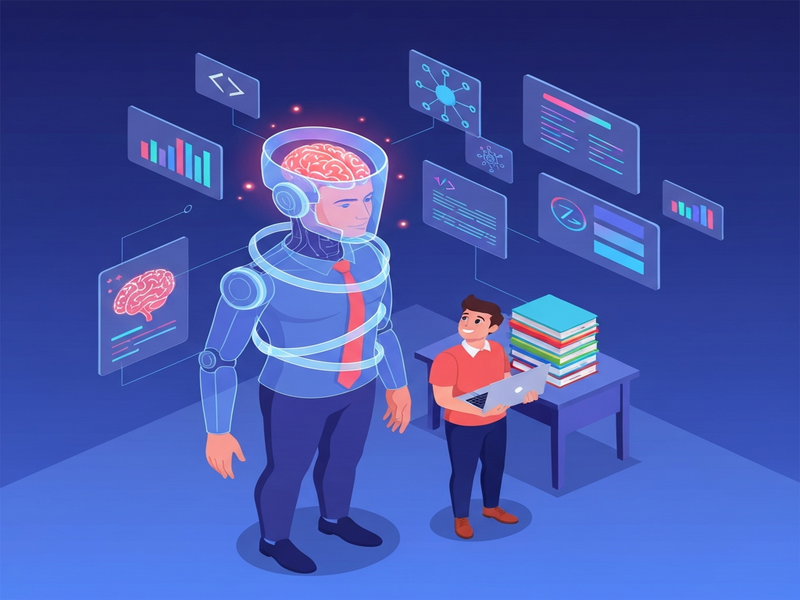
In short, the community on Hacker News frames modern AI either as a cognitive exoskeleton that amplifies human thinking or as a fast intern that automates routine work, each metaphor highlighting different limits and opportunities for productivity.
Why This Debate Matters
Tech‑savvy professionals, AI enthusiasts, and business leaders constantly ask: Is AI a tool that extends our mental capacity, or is it simply a cheap labor substitute? The Hacker News thread (see the original discussion) sparked a nuanced conversation that surfaces the strategic choices companies must make when integrating AI into their workflows.
Key Takeaways from the Hacker News Thread
1. AI as a Cognitive Exoskeleton
The “cognitive exoskeleton” metaphor emphasizes AI’s role in amplifying human intellect rather than replacing it. Commenters highlighted three core ideas:
- Layered reasoning: AI can hold intermediate thoughts, allowing users to off‑load complex mental scaffolding.
- Contextual augmentation: By remembering prior interactions, AI acts like a wearable memory aid, extending the brain’s bandwidth.
- Creative partnership: The exoskeleton model encourages co‑creation, where AI suggests alternatives while the human retains final authority.
2. AI as a Fast Intern
Opponents argued that many current deployments treat AI as a “fast intern” – a cheap, tireless worker that handles repetitive tasks. The discussion identified two main risks:
- Over‑automation: Relying on AI for low‑level chores can erode critical thinking skills.
- Scope creep: Organizations may assign AI responsibilities beyond its competence, leading to hallucinations or biased outputs.
3. Community Reactions & Counter‑Arguments
Several seasoned engineers offered balanced perspectives:
“Treating AI as an exoskeleton doesn’t mean we ignore its limitations; it means we design interfaces that surface uncertainty and let humans intervene.” – u/tech‑philosopher
Others warned that the “intern” view can be productive when applied to well‑defined, low‑risk processes such as data entry, ticket triage, or basic code linting.
Implications for AI Adoption in Business
Strategic Alignment
Companies must decide which metaphor aligns with their strategic goals:
- Exoskeleton‑first strategy: Invest in AI that integrates tightly with knowledge workers, providing real‑time suggestions, summarizations, and decision support.
- Intern‑first strategy: Deploy AI for high‑volume, low‑complexity tasks to free up human capacity for higher‑order work.
Technology Stack Considerations
Choosing the right stack can reinforce the chosen metaphor. For an exoskeleton approach, platforms that enable contextual memory and human‑in‑the‑loop workflows are essential. UBOS offers a suite of tools that fit both paradigms:
- UBOS platform overview – a low‑code environment that lets you embed AI agents directly into existing apps, preserving user context.
- AI marketing agents – automate campaign creation while still allowing marketers to steer the narrative.
- UBOS pricing plans – scalable pricing that lets startups experiment with exoskeleton‑style AI without prohibitive costs.
Risk Management
Regardless of the metaphor, robust governance is non‑negotiable:
| Risk Category | Mitigation Tactics |
|---|---|
| Hallucinations | Implement human verification checkpoints. |
| Bias Propagation | Regularly audit model outputs against diverse datasets. |
| Over‑reliance | Rotate tasks between AI and human staff to maintain skill levels. |
Productivity Gains in Real‑World Scenarios
Here are two illustrative use‑cases that map directly to the exoskeleton vs. intern debate:
- Legal research assistant: An exoskeleton AI surfaces relevant case law, annotates key passages, and lets attorneys focus on argumentation.
- Customer‑support ticket triage: A fast‑intern AI classifies incoming tickets, assigns priority, and drafts initial responses for human agents to review.
Conclusion: Choose Your Metaphor, Then Build Accordingly
The Hacker News discussion makes it clear that AI is neither a one‑size‑fits‑all solution nor a simple replacement for human labor. Whether you view it as a cognitive exoskeleton that expands mental bandwidth or as a fast intern that handles repetitive chores, the key is to align technology, process, and governance with that vision.
Ready to experiment with the exoskeleton approach? Start with UBOS’s UBOS templates for quick start and prototype an AI‑enhanced workflow in minutes. If you’re more interested in automating high‑volume tasks, explore the Workflow automation studio to build a fast‑intern bot without writing code.
Take the next step: join the UBOS partner program and turn the insights from this debate into measurable productivity gains for your organization.
Andrii Bidochko
CTO UBOS
Andrii Bidochko is an AI entrepreneur and researcher focused on AI agents, reinforcement learning, and autonomous systems. He writes about the technologies shaping the future of machine intelligence, from frontier models and agent architectures to real-world AI applications.