

- Updated: March 11, 2026
- 5 min read
AI‑Powered Holographic Frame Looking Glass Musubi Redefines Digital Picture Frames
The Looking Glass Musubi is an AI‑powered holographic frame that turns ordinary photos and short videos into 3D holograms, processes everything locally on a PC, and launches on Kickstarter with a starting price of $99.
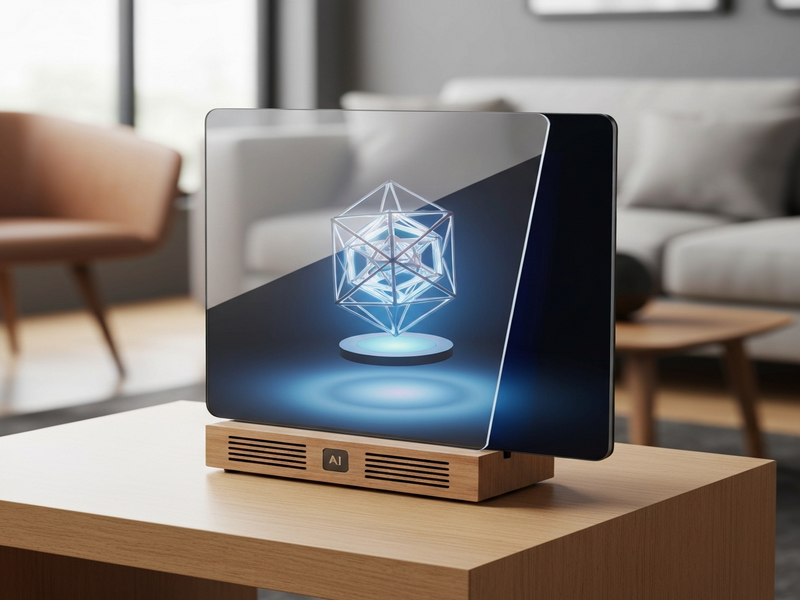
Looking Glass Unveils Musubi: A Consumer‑Focused AI‑Powered Holographic Frame
Brooklyn‑based Looking Glass has taken a bold step from enterprise‑grade displays to the living‑room with the Musubi. Announced in March 2026, Musubi is a 7‑inch digital picture frame that uses on‑device AI to extract depth from 2D media and render it as a floating 3D image viewable from up to 170°.
The launch is being staged on Kickstarter, where early backers can secure the frame for $99 during the first 24 hours, rising to $149 after the campaign’s initial window. With a sleek aluminum chassis, USB‑C connectivity, and a rechargeable battery that lasts three hours, Musubi aims to bring the sci‑fi dream of holographic displays to everyday consumers.
Design & Technical Specs: Minimalist Form Meets Hololuminescence
Musubi’s design philosophy is “less is more.” The frame measures 7 inches diagonally (178 mm) and sits on a thin aluminum stand that can be placed on a desk, shelf, or wall‑mounted with an optional bracket. Key specifications include:
- Display technology: Looking Glass’s proprietary Hololuminescence engine, delivering true‑depth holograms without glasses.
- Resolution: 1920 × 1080 px, optimized for 3D rendering.
- Viewing angle: 170° horizontal, 120° vertical.
- Storage: Internal flash capable of holding up to 1,000 images (videos limited to 30‑second clips).
- Power: Built‑in 3‑hour rechargeable battery; also supports continuous wall power via USB‑C.
- Connectivity: No Wi‑Fi or Bluetooth required; media transferred via USB‑C cable from a companion desktop app.
The frame’s exterior is matte black with a subtle brushed finish, echoing the aesthetic of high‑end consumer electronics. A single tactile button on the front cycles through stored holograms, while a discreet LED indicator shows charging status.
AI‑Driven Local Processing: Privacy‑First, Cloud‑Free Holography
What truly sets Musubi apart is its local AI pipeline. Users install a free desktop application (available for macOS and Windows) that runs a lightweight neural network to:
- Detect the primary subject in a photo or video.
- Generate a depth map using a pre‑trained monocular depth model.
- Convert the depth map into a volumetric mesh that the Hololuminescence engine can render.
Because all computation happens on the user’s computer, no image data ever leaves the device, addressing privacy concerns that have plagued other AI‑enhanced hardware. The processing time averages 12 seconds per image on a mid‑range laptop, making it fast enough for casual users while still delivering high‑quality holograms.
Market Positioning, Pricing, and Kickstarter Campaign
Looking Glass positions Musubi as the “first affordable AI‑powered holographic frame for the home.” The pricing strategy reflects a clear tiered approach:
| Tier | Price (USD) | Inclusions |
|---|---|---|
| Early‑bird (first 24 h) | $99 | Musubi frame, USB‑C cable, desktop app, 1‑year warranty |
| Standard | $149 | Same as early‑bird, plus optional premium aluminum stand |
| Bundle | $199 | Musubi + 3 months of premium “AI Art” templates (e.g., AI‑generated holiday cards) |
The Kickstarter campaign runs for 30 days, with a stretch goal of a 10‑inch “Musubi Pro” model if funding exceeds $500 k. Even if the campaign falls short, Looking Glass has pledged to manufacture the 7‑inch version, ensuring backers receive the product regardless of crowdfunding success.
What Wired Says: A Quote That Captures the Vision
“The goal for us is to bring holograms to everybody,” says Looking Glass CEO Shawn Frayne. “In a way, it gets as close to the sci‑fi dream as humanly possible.” – Wired
This statement underscores the company’s commitment to democratizing holographic tech, moving it from museum installations and $20 k corporate displays to a price point that fits a typical household budget.
How Musubi Stacks Up Against Competing Holographic Displays
While several startups claim to offer “holographic” experiences, Musubi distinguishes itself in three critical dimensions:
- Local AI vs. Cloud Rendering: Razer’s Ava AI relies on cloud‑based avatars, requiring constant internet connectivity and raising privacy concerns. Musubi’s on‑device processing eliminates these issues.
- Price Point: The Holo‑Labs LightBox starts at $2,199 for a 10‑inch unit, whereas Musubi’s entry price is $99, a 95% reduction.
- Display Technology: Traditional “volumetric” displays (e.g., VividQ) use laser‑based light fields that are still in beta and require specialized hardware. Musubi leverages mature Hololuminescence panels that are already in production.
In short, Musubi offers the most accessible blend of privacy‑first AI, affordable pricing, and proven holographic display tech on the market today.
Why This Matters for AI‑Driven Creators and Where to Learn More
If you’re a creator, marketer, or tech enthusiast, Musubi illustrates how AI can be embedded directly into consumer hardware to unlock new visual storytelling formats. To explore similar AI‑enhanced experiences, check out the following UBOS resources:
- UBOS Tech News – Stay updated on the latest AI hardware breakthroughs.
- UBOS Product Reviews – In‑depth analyses of emerging AI‑powered devices, including holographic frames.
- AI Holography – A deep dive into the science behind Hololuminescence and how it powers products like Musubi.
Whether you’re looking to integrate holographic displays into a retail environment, develop AI‑generated art for your brand, or simply add a futuristic touch to your home office, Musubi sets a new benchmark for what’s possible at a consumer‑friendly price.
Suggested Meta Description
Looking Glass launches Musubi, an AI‑powered holographic frame that turns photos and short videos into 3D displays. Learn about its design, local AI processing, Kickstarter pricing, and how it compares to rival holographic products.
© 2026 UBOS. All rights reserved.
Andrii Bidochko
CTO UBOS
Andrii Bidochko is an AI entrepreneur and researcher focused on AI agents, reinforcement learning, and autonomous systems. He writes about the technologies shaping the future of machine intelligence, from frontier models and agent architectures to real-world AI applications.